Cerma
Permanent Ceramic Protection for Hydraulic Pumps, Cylinders, Valves & Motors
Permanent Ceramic Protection for Hydraulic Pumps, Cylinders, Valves & Motors
Couldn't load pickup availability
Permanent Ceramic Protection for Hydraulic Pumps, Cylinders, Valves & Motors
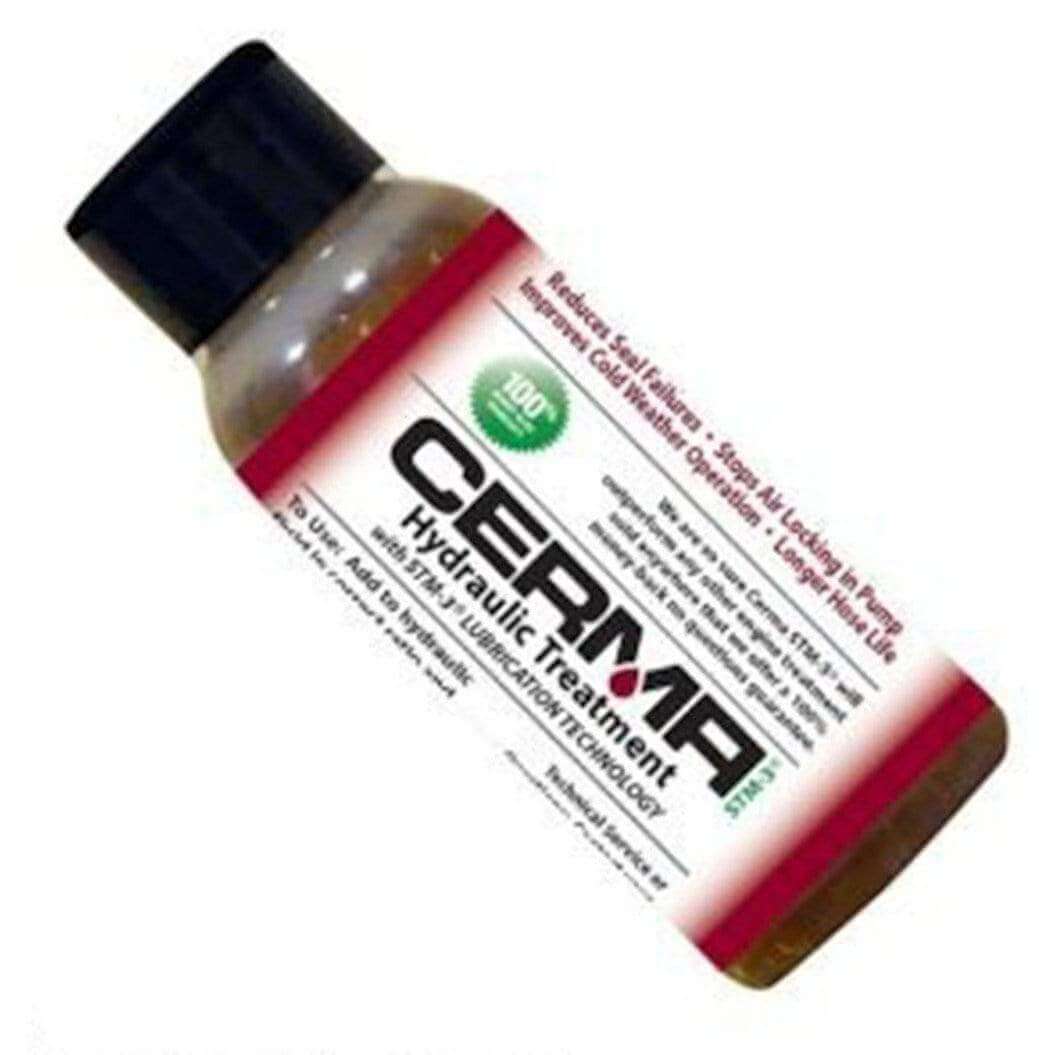
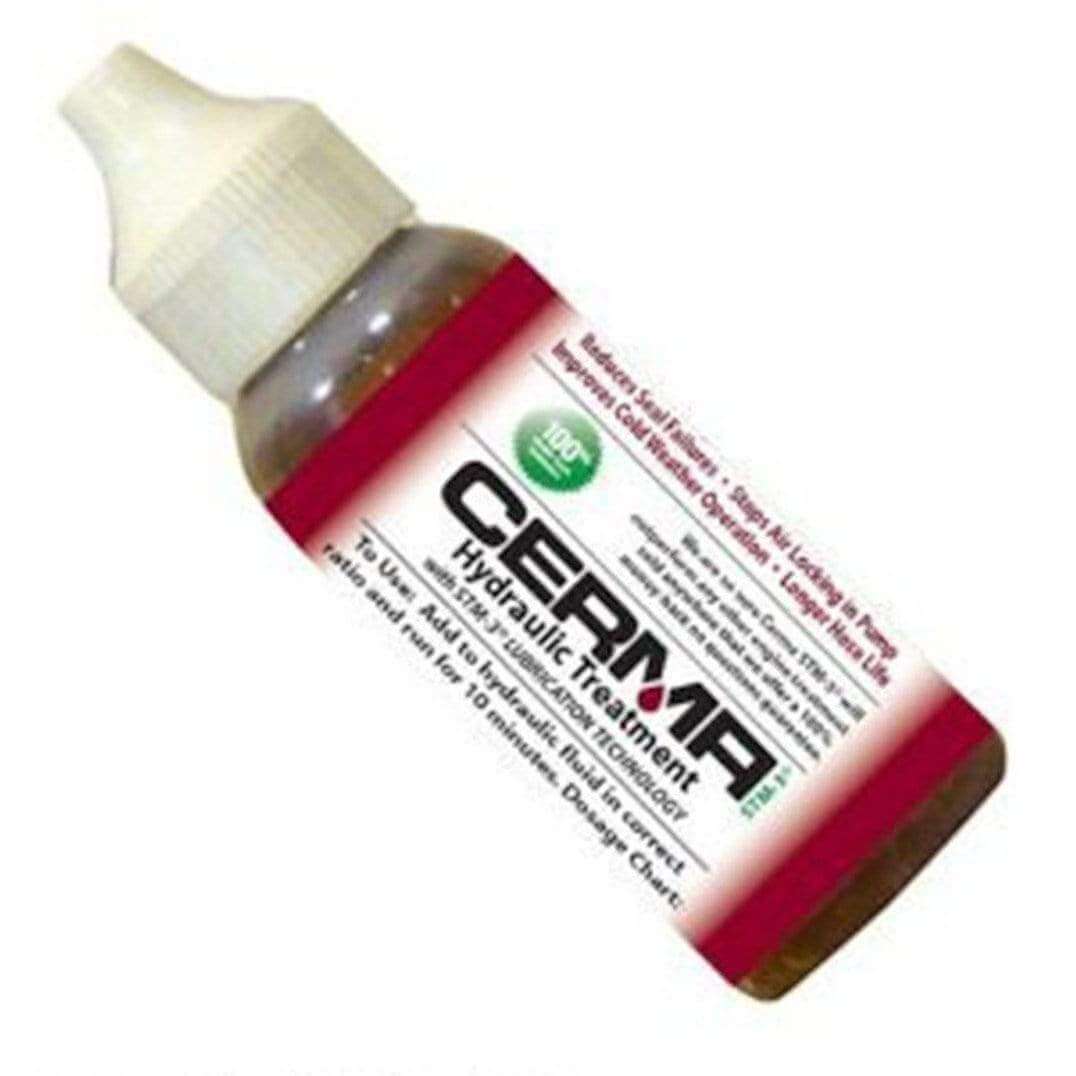
Cerma Ceramic Hydraulic Treatment is a one-time application that permanently bonds STM-3® Nano Silicon Carbide (SiC) ceramic to the internal ferrous metal surfaces of your hydraulic system — pumps, cylinders, valve spools, and motors. Used in construction equipment, agricultural tractors, industrial presses, dump trucks, forestry machines, marine steering, hydraulic tailgates, and any closed-loop hydraulic circuit with a reservoir.
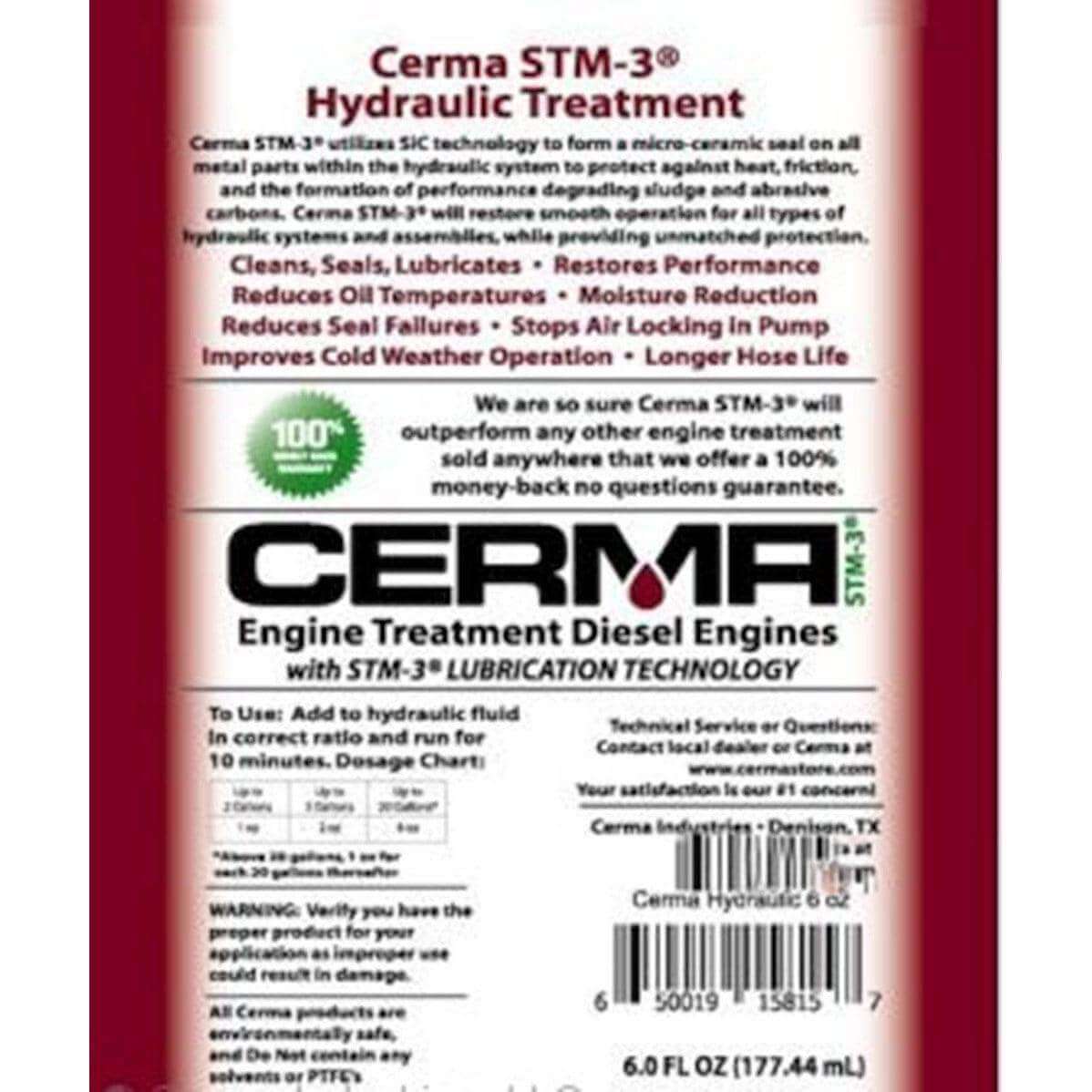
Three sizes available to match reservoir capacity: 1 oz (up to 2 gallons), 2 oz (up to 5 gallons), and 6 oz (up to 20 gallons). For systems over 20 gallons, scale at 1 oz per additional 20 gallons. Made in the USA by Bijou Inc. in Fort Myers, FL. PTFE-free, solvent-free, anti-corrosive — compatible with all hydraulic fluid types.
What Cerma Hydraulic Treatment Does
- Reduces hydraulic operating temperature — SiC ceramic reduces friction at pump and valve contact surfaces; lower friction means lower heat generation, which is the #1 driver of hydraulic fluid degradation (every 18°F/10°C above 140°F roughly halves fluid service life)
- Extends hydraulic fluid life — cooler-running fluid oxidizes slower, breaks down less, and stays within its specified viscosity envelope longer between changes
- Helps eliminate pump cavitation and air-locking — reduces air content in circulating fluid and smooths pump internal surfaces, resulting in more stable pressure delivery and reduced cavitation noise on aging pumps
- Stabilizes cylinder and ram operation — smoother internal surfaces on valve spools and cylinder bores produce more predictable actuation and reduced jerky motion under load
- Extends pump service life — ceramic barrier reduces wear progression on vane tips, gear teeth, and piston slippers inside pumps — the parts that define when a pump starts losing efficiency
- Protects seals and O-rings — lubricated contact surfaces reduce shear stress on dynamic seals; absence of solvents and PTFE means no seal-swell or seal-hardening risk from the treatment itself
- Reduces system stress on hoses — cooler fluid and more stable pressure reduce pressure spikes that accelerate hose fatigue and fitting failures
- One-time application — the SiC ceramic bonds permanently to ferrous metal at the sub-surface level. Survives hydraulic fluid changes. No reapplication needed.
How STM-3® Technology Works in Hydraulic Systems
Cerma STM-3® is a thermo-chemical catalyst — not a conventional additive or film modifier. When circulated through a working hydraulic system under normal operating pressures and temperatures, the Nano Silicon Carbide particles undergo a bonding reaction with ferrous metal at the sub-surface level. The result is a permanent ceramic matrix on pump internals, valve spools, cylinder bores, and motor surfaces.
SiC has a Mohs hardness of 9.5 (harder than hardened steel, harder than most wear-resistant coatings in OEM hydraulic components) and a melting point of 2,730°C. The resulting hard, low-friction ceramic layer reduces wear progression on contact surfaces that define hydraulic component service life.
Because the bond is chemical and permanent, the ceramic protection survives hydraulic fluid changes. You can drain and replace your hydraulic oil during normal maintenance without affecting the Cerma ceramic layer — it stays bonded to the metal regardless of what fluid is circulating over it.
Size & Dosage
| Size | Reservoir Capacity | Typical Applications |
|---|---|---|
| 1 oz | Up to 2 gallons | Log splitters, shop presses, hydraulic tailgates, small utility trailers, compact equipment, marine trim/steering systems |
| 2 oz | Up to 5 gallons | Compact tractors, skid steers, mini-excavators, small backhoes, hydraulic lifts, smaller dump truck beds, chippers |
| 6 oz | Up to 20 gallons | Full-size excavators, wheel loaders, dump trucks, cranes, industrial presses, garbage trucks, forestry equipment, large agricultural machinery |
| 20+ gallons | Larger systems | 6 oz base dose + 1 oz per additional 20 gallons of reservoir capacity. Call 239-344-9861 for fleet or industrial sizing. |
📋 Application — How to Use
- Determine your hydraulic fluid capacity. Check equipment manual, reservoir sight glass, or dipstick markings. Round up when borderline between sizes.
- Select the correct size for your reservoir. Using a smaller size than recommended will under-treat the system. Using a larger size on a small system is not harmful but is not cost-efficient.
- Add Cerma Hydraulic Treatment through the reservoir fill port. Hydraulic fluid should be at normal operating level and temperature is not critical, but warm fluid (after a cycle of work) distributes the treatment more evenly.
- Operate the equipment normally through its typical duty cycle. The SiC ceramic bonds to ferrous metal during normal hydraulic cycling — cylinder extensions and retractions, valve actuations, and pump rotation all contribute to full coverage within the first few hours of operation.
- No fluid drain required. The treatment is designed to be added to your existing hydraulic fluid. If you happen to be scheduling a fluid service, add Cerma to the fresh fluid after filling.
- Permanent protection — one-time application. The ceramic matrix bonds for the life of the components. No reapplication needed, even across future fluid changes.
Equipment & Industry Applications
| Industry | Typical Equipment & Brands |
|---|---|
| Construction | Excavators, wheel loaders, backhoes, skid steers, cranes, telehandlers — Caterpillar, John Deere, Komatsu, Volvo CE, Hitachi, Case, Bobcat, JCB, Hyundai CE, Kubota |
| Agriculture | Tractor hydraulics, implement cylinders, loader cylinders, combine headers, sprayer booms — John Deere, Kubota, New Holland, Case IH, Massey Ferguson, Mahindra, Kioti, Claas |
| Trucking & Transport | Dump truck beds, roll-off hoist cylinders, boom trucks, car-hauler tailgates, wrecker/tow cylinders, refuse compactors |
| Industrial Manufacturing | Hydraulic presses, injection molding machines, CNC hydraulic units, die-casting machinery, rubber-molding presses, metal-forming equipment |
| Forestry | Log splitters, feller-bunchers, skidders, forwarders, knuckle booms, wood chippers, mulching heads |
| Marine | Hydraulic steering (Seastar, Uflex), trim tabs, anchor windlasses, davits, outboard tilt/trim, crane/winch systems on commercial vessels |
| Waste Management | Garbage truck compactors, front loaders, rear loaders, transfer station balers, recycling equipment |
| Automotive Service | Two-post and four-post hydraulic lifts, alignment racks, shop presses, motorcycle lifts, tire-mounting equipment |
Cerma vs. Conventional Hydraulic Additives
| Feature | Cerma STM-3® | Conventional Additives |
|---|---|---|
| Technology | Nano Silicon Carbide ceramic | Chemical film modifiers |
| Application | ✓ One-time (permanent) | ✗ Every fluid change |
| Survives Fluid Changes | ✓ Yes — bonded to metal | ✗ No — drains out with fluid |
| Reduces Operating Temperature | ✓ Measurable | ⚠ Minimal |
| Helps With Cavitation | ✓ Yes | ✗ No |
| Seal & O-Ring Effect | ✓ Lubricates without swelling | ⚠ Some products over-swell seals |
| PTFE / Teflon | ✓ None | ⚠ Some products contain PTFE |
| Solvents | ✓ None | ⚠ Some products use solvents |
Related Cerma Products
- Cerma STM-3 Engine Treatment — one-time ceramic protection for the engine
- Cerma Gear Box & Axle Treatment — differentials, gear boxes, and axle gear sets
- Cerma Gear Treatment H.D. — heavy-duty industrial gear box treatment
- Cerma Transmission Treatment — automatic or manual transmissions on trucks and equipment
- Cerma Diesel Fuel Treatment — 6-in-1 fuel system protection for diesel equipment
Frequently Asked Questions
Yes — Cerma STM-3 bonds to ferrous metal regardless of pump manufacturer or design. Compatible with all major industrial hydraulic pump brands: Eaton/Vickers (piston, vane, and Char-Lynn motors), Parker Hannifin (PV piston series, gear pumps, vane pumps), Bosch Rexroth (A10V/A11V axial piston pumps, gear pumps), Denison (mobile equipment vane and piston pumps), Sauer-Danfoss (hydrostatic transmissions, mobile hydraulics), Kawasaki (K3V/K5V excavator piston pumps), Hydac, Sun Hydraulics, HydraForce, and OEM pumps on Caterpillar, John Deere, Komatsu, Bobcat, Case, Kubota, and New Holland equipment. Applies equally to vane pumps, gear pumps, axial/radial piston pumps, and gerotor pumps. If you can see steel or cast iron internals in a cutaway, Cerma will bond to them.
Depends on the root cause. Cerma addresses wear-related sluggishness meaningfully; it does not fix mechanical failures. Three common causes of sluggish hydraulics: (1) Internal pump wear — worn vane tips, gear clearances, or piston slippers reduce volumetric efficiency. Cerma's ceramic coating on pump internals helps restore efficiency in wear-related cases and slows further wear progression. (2) Contaminated or degraded fluid — debris and oxidation products accelerate wear and reduce efficiency. Fix this first with a fluid and filter service, then apply Cerma to the fresh fluid for ongoing protection. (3) Mechanical failures — torn cylinder seals (causing internal bypass), broken pressure-relief valves, failed pilot valves, or kinked lines. These require physical repair; Cerma then protects the repaired system going forward. For typical "my loader/excavator/tractor isn't lifting like it used to" complaints on well-maintained equipment, wear is the most common cause and Cerma often delivers noticeable improvement.
Helps significantly in most cases, though the underlying cause matters. Cavitation in hydraulic pumps happens when air (or vaporized fluid) forms in the inlet and collapses violently as it enters the high-pressure zone — producing characteristic rattling, whining, or knocking noise and physical erosion damage to pump internals. Cerma addresses cavitation through two mechanisms: (1) the SiC treatment helps decrease air content in circulating fluid by smoothing internal surfaces and reducing turbulence-driven aeration; (2) the ceramic coating on pump surfaces provides hardened protection against cavitation erosion damage. Both mechanisms help reduce existing cavitation symptoms and slow progression of cavitation damage on aging pumps. What Cerma cannot fix on its own: fundamental suction-side problems (clogged inlet strainer, restricted suction line, undersized inlet plumbing, cracked reservoir return causing air ingestion, low fluid level). If you have structural cavitation causes, address those first — Cerma then helps the recovered system run longer.
Varies by system condition, load profile, duty cycle, ambient temperature, and cooler capacity — so we avoid giving a specific number on a marketing page. The reliable statement: the SiC ceramic coating measurably reduces friction on internal contact surfaces, which directly lowers heat generation. For hydraulic systems, this matters because heat is the primary driver of fluid degradation — every 18°F/10°C above 140°F (60°C) approximately halves fluid life. Operators on heavily-loaded equipment (excavators under constant cycling, presses in continuous production, forestry equipment in warm climates) tend to report the most noticeable temperature drops because their baseline operating temps are highest. Operators on lightly-loaded equipment see smaller changes because baseline temps were already within a comfortable range. The common thread across both groups: cooler-running hydraulics correlate with fluid lasting longer, seals drying out slower, and pumps needing fewer rebuilds over the equipment's service life.
One-time. The SiC ceramic bonds permanently to ferrous metal at the sub-surface level through a thermo-chemical reaction driven by the normal operating temperatures and pressures inside your hydraulic system. Once cured, the ceramic matrix is part of the metal — not a film on top of it. This means: (1) routine hydraulic fluid changes do not remove the ceramic layer; (2) filter changes have no effect on the bonded protection; (3) the ceramic stays in place through typical equipment service life, including pump rebuilds on the untreated replacement parts (rebuilt components receive their own treatment if you choose to reapply to the replaced pump). No recurring application schedule, no maintenance dosing, no "top-up" every season. A single correctly-sized dose is all the system needs.
Yes — Cerma Hydraulic Treatment works on virtually all hydraulic equipment. Excavators: Caterpillar 300-series through 390-series, John Deere E/G-series, Komatsu PC-series, Hitachi ZX, Volvo EC, Kubota KX/U, Hyundai HX. Skid steers and compact track loaders: Bobcat T-series and S-series, Case TV/SV/SR, John Deere G/E skid-steers, Kubota SSV, New Holland C/L-series, Takeuchi TL. Wheel loaders: Caterpillar K/L-series, John Deere L-series, Volvo L, Komatsu WA-series. Backhoes: Caterpillar 416/420/430, John Deere 310/410, Case 580/590, Kubota M-series. Agricultural tractors: John Deere (all sizes from compact to 9R), Kubota M/L-series, New Holland T-series, Case IH Farmall and Magnum, Massey Ferguson, Mahindra. Dump trucks: Peterbilt, Kenworth, Mack, International, Freightliner with various hoist brands (Heil, Crysteel, Galbreath, Ox Bodies). Sizing: check reservoir capacity and pick 1 oz (up to 2 gal), 2 oz (up to 5 gal), or 6 oz (up to 20 gal). For larger industrial systems scale at 1 oz per additional 20 gallons.
Yes. Cerma Hydraulic Treatment is compatible with all hydraulic fluid types we've validated or had operator feedback on: standard ISO VG grades (AW 32, AW 46, AW 68 — the most common industrial and mobile-equipment fluids); bio-based / biodegradable (HEES synthetic esters, HETG vegetable-based fluids used in forestry, marine, and environmentally-sensitive applications); full synthetic hydraulic fluids (PAO-based, ester-based); fire-resistant fluids (HFC water-glycol, HFDR/HFDU phosphate esters used in steel mills, die-casting, mining); Mil-spec fluids (MIL-H-5606 red mineral-base aviation/military, MIL-H-83282 synthetic hydrocarbon, MIL-PRF-87257 for aircraft); and OEM-specific multi-purpose fluids (John Deere Hy-Gard, Case Hy-Tran, Kubota UDT/Super UDT, Caterpillar TDTO and HYDO Advanced, New Holland Ambra Multi-G, Massey Ferguson M1141). Because Cerma bonds to metal rather than mixing with fluid, fluid chemistry doesn't affect ceramic performance. If you run a specialty or proprietary fluid not listed above, call 239-344-9861 before applying.
Yes. The on-page Bundle & Save gets you started: Buy 2 save 7.3% or Buy 5 save 18.8% on any size variant, automatically applied at checkout. For larger fleet orders — construction companies with multi-machine fleets, municipal fleets (public works, parks, transit), industrial facilities with many hydraulic systems, ag operations with multi-tractor fleets, or resellers — we offer custom volume pricing and technical guidance on fleet-wide dosing. Contact us at 239-344-9861 or email info@cermatreatment.com with your equipment list and we'll quote accordingly. Use code C10 for 10% off at checkout on standard online orders.
Made in the USA by Cerma Treatment (Bijou Inc.), 15880 Summerlin Road #300 Box #301, Fort Myers, FL 33908. 30-day return policy. Free shipping on orders over $150. Ships to US & Canada. Questions? Call 239-344-9861 or email info@cermatreatment.com. Use discount code C10 for 10% off.
Cerma STM-3® is a registered trademark of Bijou Inc. SiC (Silicon Carbide) technology is EPA ETV certified. Cerma Ceramic Hydraulic Treatment is formulated for use in hydraulic systems containing ferrous metal internal components (pumps, valves, cylinders, and motors with steel or cast-iron working surfaces). Compatible with all hydraulic fluid types commonly encountered in mobile and industrial hydraulic applications. Performance claims represent formulation targets and typical results; individual equipment results vary based on system condition, age, operating pressure, duty cycle, climate, and maintenance practices. Cerma Hydraulic Treatment is a wear-protection and friction-reduction technology; it is not a repair compound and cannot correct pre-existing mechanical failures such as torn seals, broken valves, failed pressure-relief devices, cracked cylinder housings, damaged lines, or scored pump components. For cavitation caused by structural suction-side problems (restricted inlet, undersized suction plumbing, low fluid level, air ingestion at return), address root cause before application. For fleet and industrial applications, call 239-344-9861 for sizing and compatibility confirmation. Brand references (Eaton, Parker, Vickers, Bosch Rexroth, Denison, Sauer-Danfoss, Kawasaki, Hydac, Sun Hydraulics, HydraForce, Caterpillar, John Deere, Komatsu, Bobcat, Case, Kubota, New Holland, Volvo, Hitachi, Hyundai, JCB, Takeuchi, Massey Ferguson, Case IH, Claas, Mahindra, Kioti, Peterbilt, Kenworth, Mack, International, Freightliner, Heil, Crysteel, Galbreath, Seastar, Uflex, and hydraulic fluid specifications AW 32/46/68, ISO VG, HEES, HETG, HFC, HFDR, HFDU, MIL-H-5606, MIL-H-83282, MIL-PRF-87257, Hy-Gard, Hy-Tran, UDT, TDTO, HYDO, Ambra Multi-G) are property of their respective owners and are used for compatibility identification only — Cerma is not affiliated with or endorsed by any of these brands.
Frequently Asked Questions
Two different product categories that work together. Cerma Ceramic Hydraulic Treatment (this product) is a one-time ceramic bonding treatment — a concentrated STM-3 SiC catalyst that you add once to your hydraulic reservoir to create a permanent ceramic layer on pump, valve, cylinder, and motor internals. It's a protection product, not a fluid. Your existing hydraulic fluid stays in the system. Cermax Ceramic Hydraulic Oil (if applicable to your system) would be a full-replacement ceramic-enhanced hydraulic fluid designed to replace your current hydraulic oil entirely at the next service, delivering ongoing SiC reinforcement with every fluid change. Most customers use just the treatment because hydraulic fluid replacement is expensive at industrial reservoir sizes and the one-time ceramic bond provides durable protection regardless of which fluid circulates over it. For high-duty industrial applications where maximum protection justifies the higher fluid cost, running both is possible. For most mobile equipment and standard industrial applications, the treatment alone is sufficient.
Match the size to your hydraulic reservoir capacity. 1 oz bottle treats systems up to 2 gallons — log splitters, shop presses, hydraulic tailgates, small utility applications, marine trim/steering systems. 2 oz bottle treats up to 5 gallons — compact tractors, skid steers, mini-excavators, small backhoes, automotive shop lifts. 6 oz bottle treats up to 20 gallons — full-size excavators, wheel loaders, dump trucks, cranes, large agricultural tractors, industrial presses, forestry equipment, garbage trucks. For reservoirs over 20 gallons, scale at 6 oz base + 1 oz per additional 20 gallons (e.g., a 40-gallon industrial system needs 6 oz + 1 oz = 7 oz total; a 60-gallon system needs 6 oz + 2 oz = 8 oz total). To find your reservoir capacity: check your equipment service manual, look for a capacity marking on the reservoir itself, or measure the sight-glass range. When borderline between two sizes (e.g., exactly 2 gallons, or exactly 5 gallons), size up rather than down. Call 239-344-9861 for sizing on unusual or fleet applications.
Cerma creates a permanent ceramic layer on ferrous internal surfaces of your hydraulic system that delivers multiple connected benefits: (1) Lower operating temperatures — reduced friction at pump and valve contact surfaces means less heat generation, which directly extends hydraulic fluid service life since heat is the primary driver of fluid degradation. (2) Extended fluid life between changes — cooler fluid oxidizes slower and stays within its viscosity envelope longer. (3) Reduced pump wear progression — the ceramic coating protects vane tips, gear teeth, and piston slippers, slowing efficiency loss over the pump's service life. (4) Smoother cylinder and ram actuation — reduced friction on valve spools and cylinder bores produces more predictable motion under load. (5) Help with cavitation — decreased air content in circulating fluid and smoother pump internals reduce cavitation noise and erosion damage. (6) Seal protection — the treatment contains no solvents or PTFE that could swell or harden rubber seals; the ceramic layer reduces shear stress on dynamic seals over time. (7) Reduced downtime — fewer failures, longer component life, less emergency maintenance. One application; the benefits last the life of the components.
Yes — and this is a deliberate design choice. Many hydraulic additives on the market work by swelling rubber seals to reduce or hide leaks; this can initially look like it "fixes" a leak but causes problems long-term as over-swollen seals lose elasticity, harden, and eventually fail catastrophically. Cerma Hydraulic Treatment takes a different approach: it contains no seal-swelling solvents, no PTFE, and no seal conditioners that chemically alter the rubber. Instead, the ceramic layer on metal surfaces reduces friction and heat at seal contact points, which protects seals by (1) reducing thermal degradation of the rubber, (2) reducing mechanical wear on dynamic seal lips, and (3) helping maintain rated seal contact pressure without over-stressing the seal material. Compatible with all common hydraulic seal materials — Buna-N (NBR), Viton (FKM), EPDM, polyurethane, and PTFE seal rings — and with fluid types requiring specific seal compatibility (like fire-resistant phosphate esters). If you currently have a leaking seal, replace the seal mechanically — Cerma will then help the replaced seal last longer.
Simple and non-disruptive. Step 1: Verify your reservoir capacity (equipment manual or reservoir markings) and confirm you have the correct size (1 oz for up to 2 gal, 2 oz for up to 5 gal, 6 oz for up to 20 gal; scale larger systems at 1 oz per additional 20 gal). Step 2: Bring the equipment to normal operating condition (hydraulic fluid at normal level; warm fluid distributes the treatment better but ambient-temperature application also works). Step 3: Add the full contents of the Cerma bottle through the reservoir fill port. Do not drain or replace hydraulic fluid first — Cerma is designed to go into your existing fluid. Step 4: Operate the equipment normally through its typical duty cycle. Cylinder extensions and retractions, valve actuations, and normal pump rotation distribute the treatment throughout the hydraulic circuit within the first few hours of operation. Step 5: The ceramic bond cures during normal operation — no special break-in procedure, no "run it for X hours at Y load" requirement. You can use the equipment on its regular work schedule. Step 6: Done — permanent protection. No reapplication needed, no follow-up dosing, no maintenance schedule. Future hydraulic fluid changes are unaffected; the ceramic bond stays on the metal regardless of what fluid circulates over it.
Share