Cerma
Cerma Ceramic Gear Treatment for Axles and Gear Box
Cerma Ceramic Gear Treatment for Axles and Gear Box
Couldn't load pickup availability
Cerma Ceramic Gear Box & Axle Treatment — STM-3 Nano Silicon Carbide for Differentials, Transfer Cases & Gear Boxes
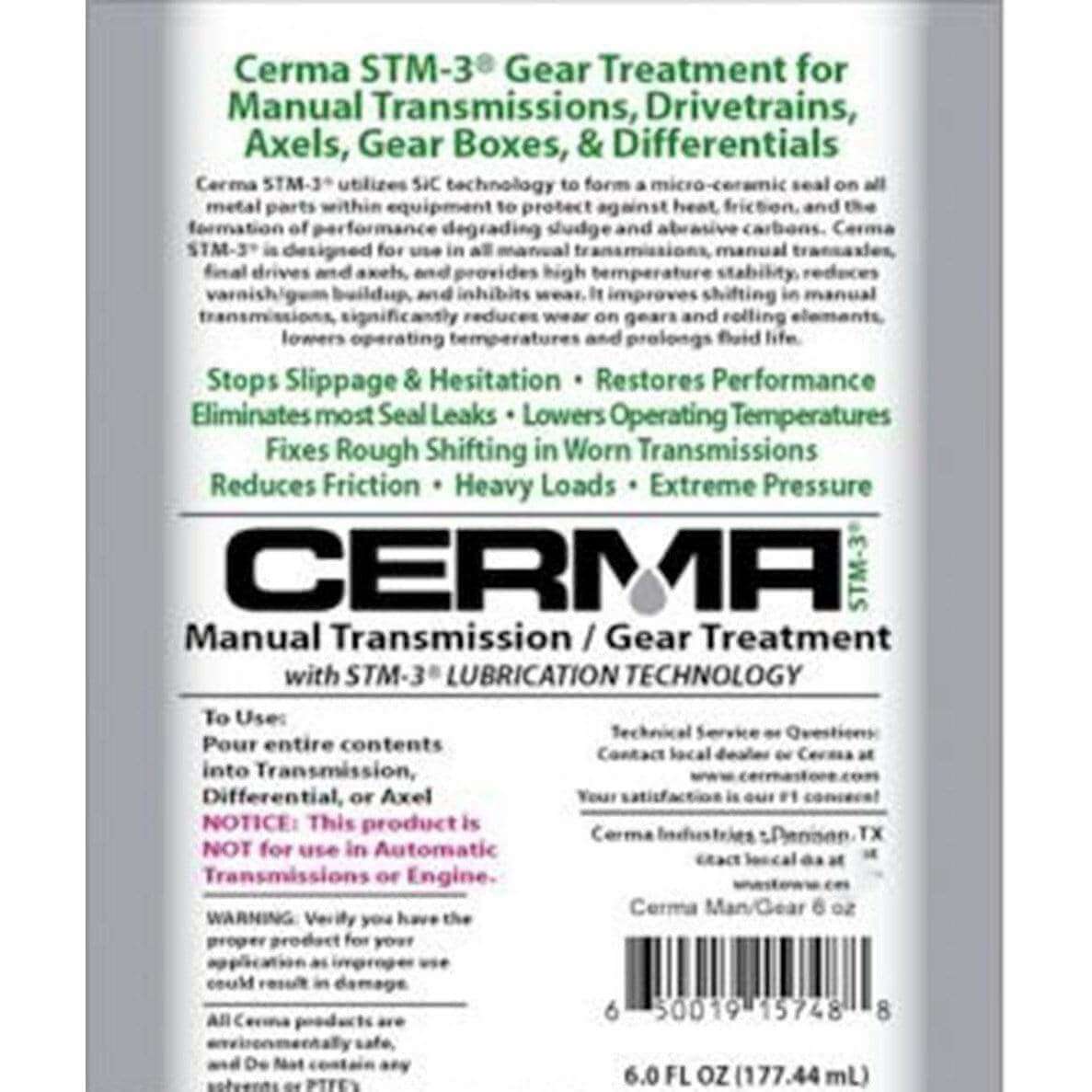
Cerma STM-3® Gear Box Treatment is a one-time ceramic application that permanently bonds Nano Silicon Carbide (SiC) to the internal metal surfaces of your differentials, axles, gear boxes, and transfer cases. Helps reduce rough operation, quiets gear noise, and provides permanent protection against heat, friction, and sludge buildup.
One application per component. Permanent ceramic protection. No disassembly required.
✅ What Cerma Gear Box Treatment Does
- Quiets gear noise — ceramic coating on ring, pinion, and spider gears reduces gear whine and howl
- Helps restore smooth operation — reduces roughness in differentials and transfer cases
- Reduces operating temperature — less friction means less heat (critical for towing and heavy loads)
- Prevents sludge and varnish buildup — SiC ceramic barrier keeps gear oil clean
- Extends gear oil life* — cleaner internals mean fluid lasts significantly longer
- Protects against wear and corrosion — permanent ceramic matrix on all metal contact surfaces
- Reduces friction and drag — less drivetrain loss means more power to the wheels
- Conditions seals — may help reduce minor leaks from differential and transfer case seals
💡 Why it matters: Differentials and gear boxes operate under extreme pressure — the contact between ring and pinion gears generates tremendous heat and shear forces. Over time, this wears gear teeth, degrades oil, and creates noise. Cerma's SiC ceramic matrix (Mohs hardness 9.5) permanently hardens and smooths these contact surfaces, helping stop wear at the source.
📋 How to Apply
- Locate the fill plug — differentials and transfer cases have a fill plug on the housing
- Add Cerma STM-3 Gear Treatment — pour the correct dose into the fill port
- Drive normally — the SiC particles bond to gear surfaces during normal operation
- Enjoy permanent protection — the ceramic matrix is now part of your drivetrain. No reapplication needed
No fluid drain required — add directly to existing gear oil. Compatible with all gear oil types and weights (GL-4, GL-5, 75W-90, 75W-140, synthetic, conventional). Safe for limited slip differentials (LSD) — does not affect clutch pack operation.
📦 Sizing & Pricing
| Size | Application | Price |
|---|---|---|
| 2 oz | Cars, SUVs, vans, light trucks — differentials, transfer cases, gear boxes | $70.40 |
| 6 oz | Semi trucks, commercial vehicles, heavy equipment — large differentials and gear boxes | $193.60 |
Tip: Many vehicles have both a front and rear differential (4WD/AWD) plus a transfer case — each requires its own treatment. For a full-size 4WD truck, you may need 3 bottles (front diff + rear diff + transfer case).
🚗 Ideal Applications
| Component | Vehicle Types |
|---|---|
| Rear Differential | RWD cars, trucks, SUVs — open and limited slip |
| Front Differential | 4WD/AWD trucks, SUVs, Jeeps |
| Transfer Case | 4WD trucks, SUVs, Jeeps — part-time and full-time 4WD |
| Manual Transmission | Any vehicle with separate manual gearbox (see also Manual Transmission Treatment) |
| Axle Assemblies | Dana, AAM, Ford, GM axles — all sizes |
| Commercial / Semi | Semi truck tandem axles, heavy equipment final drives |
🔬 How STM-3 Technology Works
Cerma STM-3® is not a gear oil additive — it's a ceramic surface treatment. The Nano Silicon Carbide particles penetrate into the sub-surfaces of ring gears, pinion gears, spider gears, bearings, and shafts — creating a permanent Silicon Carbide ceramic matrix.
SiC has a Mohs hardness of 9.5 (just below diamond) and a melting point of 2,730°C. This creates ultra-smooth, ultra-hard surfaces on every gear tooth and bearing race — dramatically reducing friction, heat, and wear. The coating survives fluid changes because it's bonded to the metal, not suspended in the oil.
Contains no solvents and no PTFE (Teflon). Non-corrosive. Environmentally safe.
🛡️ Cerma vs Traditional Gear Oil Additives
| Feature | Cerma STM-3® | Traditional Additives |
|---|---|---|
| Technology | Nano Silicon Carbide (SiC) | Friction modifiers / PTFE |
| Application | ✅ One-time (permanent) | ❌ Every fluid change |
| Survives Fluid Changes | ✅ Yes — bonded to metal | ❌ No — drains out |
| Reduces Temperature | ✅ Yes (less friction = less heat) | ⚠️ Minimal |
| LSD Compatible | ✅ Yes | ⚠️ Some cause chatter |
| Non-Corrosive | ✅ Yes | ⚠️ Varies |
🔗 Complete Drivetrain Protection
Protect every drivetrain component with Cerma's SiC ceramic technology:
- Cerma STM-3 Engine Treatment — one-time ceramic engine protection ($105.60 for gas engines)
- Cerma Automatic Transmission Treatment — for automatic transmissions ($70.40)
- Cerma Manual Transmission Treatment — for manual transmissions ($70.40)
- Cerma Ceramic Fuel Treatment — continuous 6-in-1 fuel system protection (from $10.95)
- Cerma Synthetic Motor Oil — SiC-enhanced oil with extended change intervals
🔬 Technical & Compatibility FAQs
Common symptoms of a differential that could benefit from Cerma: persistent gear whine that varies with vehicle speed (not RPM), howling sounds on deceleration, increased gear noise when towing or under load, higher-than-normal operating temperature, or gear oil that darkens/contaminates faster than expected. If your differential is making clunking or popping noises, that typically indicates mechanical damage (worn bearings, broken gear teeth, bad axle shafts) that Cerma cannot repair — have it inspected before treatment. For healthy differentials, Cerma works preventatively to extend service life significantly.
Yes. The 6oz bottle is specifically formulated for semi truck tandem axles (drive axle + trailing axle), Class 8 final drives, and heavy-duty commercial differentials from Dana, Eaton, Meritor, and Rockwell. For tandem axle setups, treat each axle separately — one 6oz bottle per axle housing. Fleet managers often see significant reductions in operating temperature and gear oil replacement intervals on treated axles, especially on long-haul routes and under heavy loads.
Cerma's SiC ceramic coating bonds to existing metal surfaces — it cannot rebuild metal that has been physically removed through wear, pitting, or damage. For early-stage ring and pinion wear (mild pitting, slight gear whine, elevated operating temps), Cerma can significantly slow further wear and often reduces noise. For advanced wear (deep pitting, chipped teeth, visible gear damage, clunking sounds), Cerma is not a repair product — a differential rebuild or gear replacement is needed. Think of Cerma as preventative ceramic armor, not a mechanical patch.
Yes — Jeep and off-road owners are one of our core customer groups. Cerma is compatible with all off-road differential setups: Dana 30, Dana 35, Dana 44, Dana 60, Ford 8.8", 9.75", 10.25", GM 14-bolt, Toyota 8" and 9.5", and aftermarket housings. Safe for air lockers (ARB), electronic lockers (Eaton E-Locker), limited slips (Detroit Truetrac, Eaton), and spools. The ceramic coating is especially valuable for off-road use where differentials see water crossings, high-heat trail runs, rock crawling, and extreme articulation. Treat both front and rear differentials for balanced drivetrain protection.
Yes. Electric vehicle gearboxes (also called reducer units or differential-integrated motors) use gear oil and benefit from ceramic protection just like traditional differentials. This applies to Tesla Model S/3/X/Y drive units, Rivian R1T/R1S motors, Lucid Air motors, Ford F-150 Lightning, Mustang Mach-E, Hyundai Ioniq 5/6, Kia EV6, and most other EVs. EV motors run at very high RPM (up to 20,000+), which makes gear protection particularly valuable. Before treating, verify the gearbox uses standard gear oil (most do) — some manufacturers specify proprietary lubricants that should not be supplemented without dealer consultation.
Yes, both. Cerma is compatible with all transfer case designs: gear-driven (NP203, NP205, older heavy-duty setups), chain-driven (NP241, NP261, NP263, NP246 — most modern 4WD SUVs and trucks), and electronic full-time transfer cases (Subaru, AWD vehicles). The SiC particles bond to metal gears and chain drive sprocket surfaces equally well. If your transfer case uses ATF instead of gear oil (some chain-driven cases do), Cerma works in both fluid types — it bonds to metal regardless of fluid chemistry.
Yes — classic high-performance differentials love Cerma. Legendary housings like the Ford 9-inch (one of the strongest differentials ever built), GM 12-bolt, Chrysler 8.75", Dana 60, and Dana 44 were designed for heavy-duty service but typically show wear after decades of use in restored vehicles, hot rods, and drag cars. Cerma's ceramic matrix is especially valuable on these older high-torque applications where replacement gears are expensive and availability is limited. Safe for factory limited slips (Sure-Grip, Posi-Traction, Trac-Lok), aftermarket LSDs (Detroit Locker, Truetrac), and spools. Compatible with thick gear oils (85W-140, 80W-90) commonly used in muscle cars.
Yes — this is ideal timing. After a differential service with fresh gear oil, your housing has clean internal surfaces and new fluid — perfect conditions for the ceramic bonding process. Add Cerma through the fill plug with the vehicle on level ground, then drive normally. For best results, apply when gear oil is warm (after a short drive). The SiC particles will begin bonding to clean gear and bearing surfaces immediately, with full ceramic matrix development over the first 500–1,500 miles of driving.
Made in the USA by Cerma Treatment (Bijou Inc.), Fort Myers, FL. Environmentally safe. Solvent-free. PTFE-free. Non-corrosive. 30-day return policy. Free shipping on orders over $150. Ships to US & Canada. Questions? Call 239-344-9861 or email info@cermatreatment.com.
*Gear oil life extension claims are based on Cerma internal testing and customer-reported results. Always consult your vehicle's owner's manual for gear oil service intervals. Individual results vary based on differential condition, age, driving habits, load, and operating environment. Claims are representative and not guaranteed for every application.
Share