
Cerma
Cermax Ceramic 10W-40 Synthetic Motor Oil 30K Mile | Cerma
Cermax Ceramic 10W-40 Synthetic Motor Oil 30K Mile | Cerma
Couldn't load pickup availability
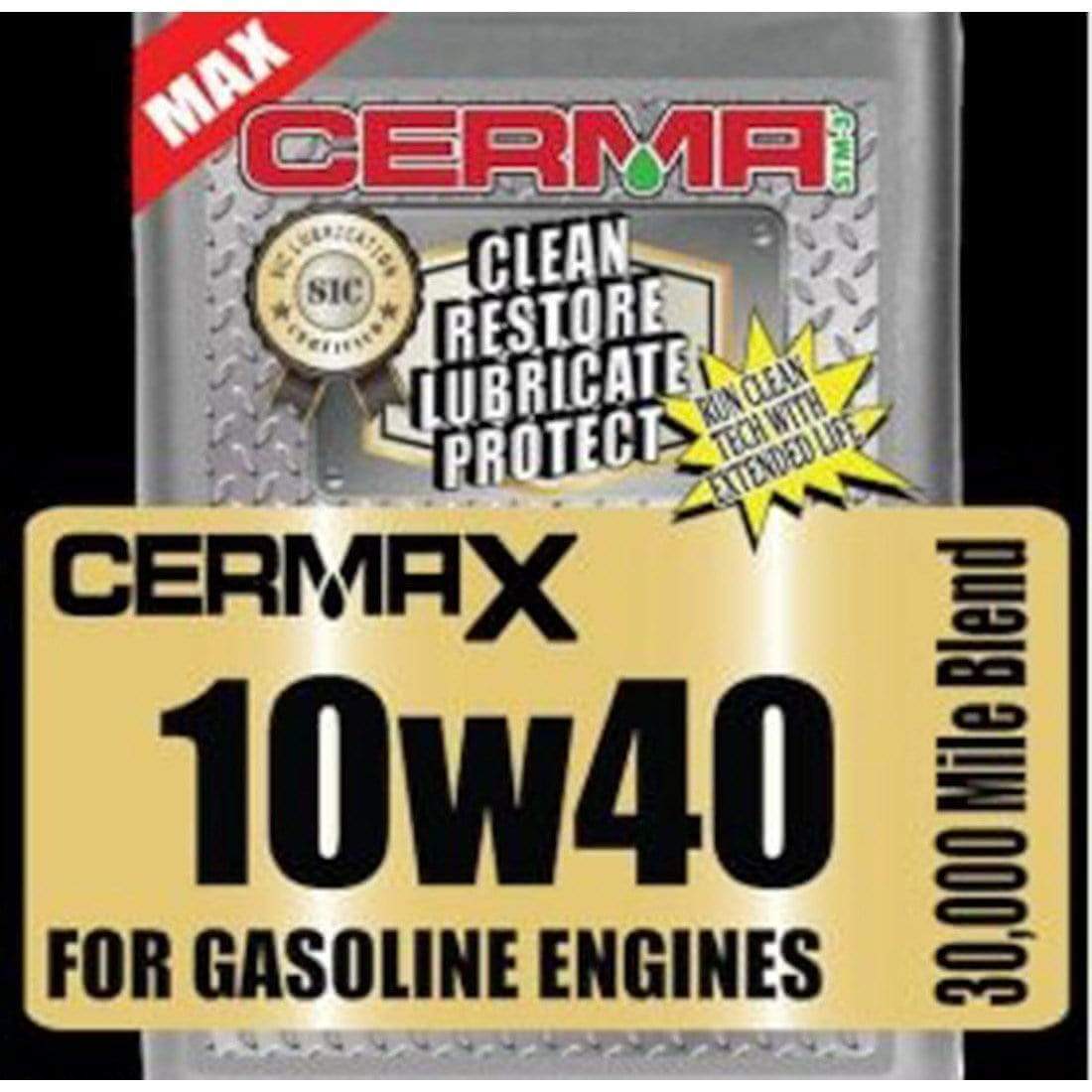
Cermax Ceramic 10W-40 Synthetic Motor Oil — STM-3 Nano Silicon Carbide Technology | Quad-Action Run Clean Protection | Heavy-Duty Viscosity | Up to 30,000-Mile Oil Changes
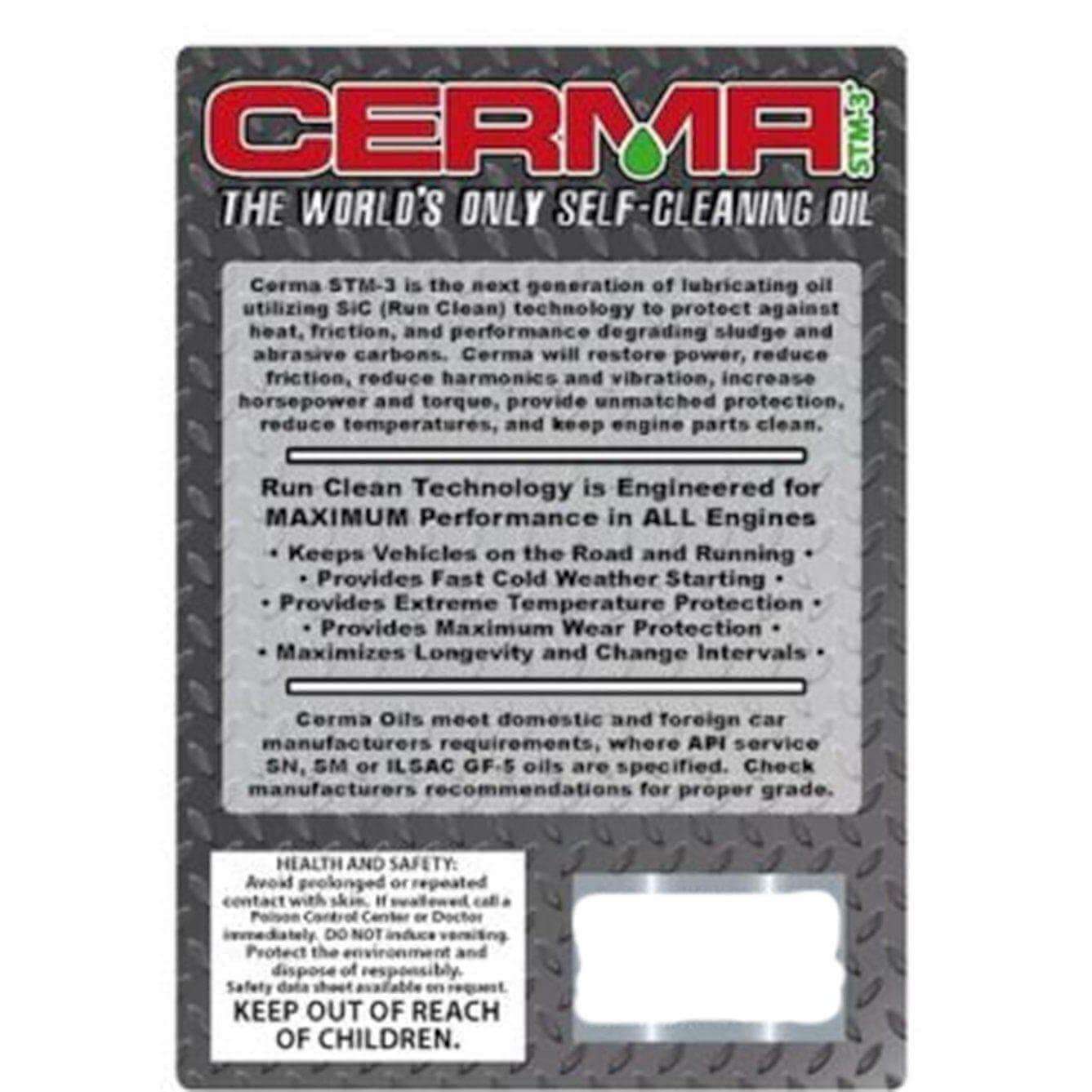
The heavy-duty member of the Cermax motor oil family — for engines that demand the strongest possible protection. Cermax Ceramic 10W-40 Synthetic Motor Oil is engineered with Cerma STM-3 Run Clean Technology — Nano Silicon Carbide (SiC) ceramic particles in a premium full synthetic base with extended-performance additive package, delivering up to 30,000-mile drain intervals* in the thickest hot-film viscosity in the Cermax gasoline lineup. The diamond-hard SiC ceramic matrix permanently bonds to engine metal surfaces, continuously cleaning, protecting, and restoring your engine with every mile.
10W-40 is the workhorse viscosity for demanding applications: high-mileage engines with widened clearances, hot-climate vehicles where thinner oils lose film strength, heavy-duty towing and hauling, marine gasoline engines (inboard and outboard), gas-powered golf carts (Club Car, EZ-GO, Yamaha — 10W-40 is the standard cart grade), dry-clutch motorcycles, performance engines, and outdoor power equipment. When you need maximum oil film strength combined with ceramic SiC protection, Cermax 10W-40 is the specialist's choice. Available in 6 sizes with automatic volume discounts on multi-unit purchases.
🎯 Cermax-Only Viscosity: 10W-40 is available in the premium Cermax 30,000-mile tier only — it's not offered in the Cerma 15,000-mile value tier. If you're looking for 10W-40 ceramic protection, this is the product. For lighter viscosities (5W-20, 5W-30) the 15K-mile Cerma line is available as a value alternative; see all motor oil options.
✅ Quad-Action Run Clean Protection Technology
Cermax 10W-40 performs four distinct protective functions simultaneously:
| Action | How It Works |
|---|---|
| Action 1: CLEAN | SiC ceramic attracts carbon, varnish, and lacquer into filterable masses — the oil filter removes them, so your engine gets cleaner over time, not dirtier |
| Action 2: RESTORE | SiC particles bond to microscopic wear sites on cylinder walls, bearings, and cam lobes — especially valuable for high-mileage engines where this restoration action matters most |
| Action 3: PROTECT | Bonded ceramic layer (Mohs 9.5, 2,730°C melting point) provides ongoing wear protection plus the extra film thickness of SAE 40 hot viscosity for maximum shear strength under heavy load |
| Action 4: EXTEND | Higher SiC concentration + premium extended-performance additive package delivers up to 30,000-mile drain intervals* |
🔬 Advanced Features
- STM-3 Nano Silicon Carbide ceramic technology — Mohs 9.5 hardness, 2,730°C melting point, enhanced concentration for premium tier
- Up to 30,000-mile drain intervals* — 4× the life of conventional oil, 2× the life of standard premium synthetics
- Maximum hot-film strength — SAE 40 hot viscosity (vs SAE 30 in 10W-30 or 5W-30) provides the thickest protective film at operating temperature in the Cermax gasoline lineup
- Restores lost compression in high-mileage engines — SiC fills micro-wear in cylinder walls; the combination of thicker film + SiC ceramic is ideal for aged engines with widened clearances
- Hot-climate capable — maintains film strength in extreme heat where lighter viscosities can thin excessively
- Heavy-load protection — continuous high-torque, towing, and performance driving benefit from 10W-40's robust shear strength
- Superior marine corrosion protection — Moisture Guard chemistry targets marine and storage environments
- Self-cleaning Run Clean action — helps prevent sludge, carbon, and varnish buildup
- Turbocharger & supercharger safe — compatible with all induction types (verify your manufacturer specifies 10W-40 for turbo applications — most modern turbos spec lower viscosity)
- Golf cart standard viscosity — compatible with Club Car, EZ-GO, Yamaha gas golf carts
- Dry-clutch motorcycle compatible (Harley touring models, shaft-drive BMW, scooters with CVT — NOT for wet-clutch motorcycles; see FAQ)
- Formulated to meet API SN/SM performance targets* — verify your manufacturer's current specification requirements
- Lowest cost per mile in the 10W-40 premium synthetic category — fewer changes, less downtime
- PTFE-Free, Solvent-Free, Environmentally Safe formulation — made in the USA
🌡️ Why Choose 10W-40 Specifically? 10W-40 is not a mainstream modern-car viscosity — and that's the point. It's the specialist's viscosity for applications where thinner oils give up film strength under load or heat. The combination of 10W cold-flow (reliable cold startup in most climates) and SAE 40 hot-viscosity film (30% thicker hot film than 10W-30) makes it ideal for: high-mileage engines (100K+ miles) where internal clearances have widened and thicker oil maintains oil pressure; hot climates (Arizona, Texas, Florida summer, tropics) where ambient heat thins oil aggressively; heavy-duty trucks and SUVs used for towing or hauling; marine gasoline engines under continuous load; golf carts (industry-standard grade); performance/classic engines that generate extreme heat; dry-clutch motorcycles; and outdoor power equipment. If your engine spec allows 10W-40 and you value maximum protection over marginal fuel economy, it's the right choice.
⚠️ Do NOT Use Cermax 10W-40 If Your Engine Specifies 0W-20, 5W-20, 5W-30, or Newer OEM Thin-Viscosity Specs: Most gasoline passenger vehicles built 2011 or later require thinner oils (often 0W-20 or 5W-30). Using 10W-40 in those engines can cause variable valve timing (VVT) problems, oil pump overload, reduced fuel economy, cold-start wear, and potential warranty issues. If your owner's manual specifies a thinner viscosity, use a matching-viscosity Cerma or Cermax oil instead. 10W-40 is only correct if your manufacturer specifies or permits it.
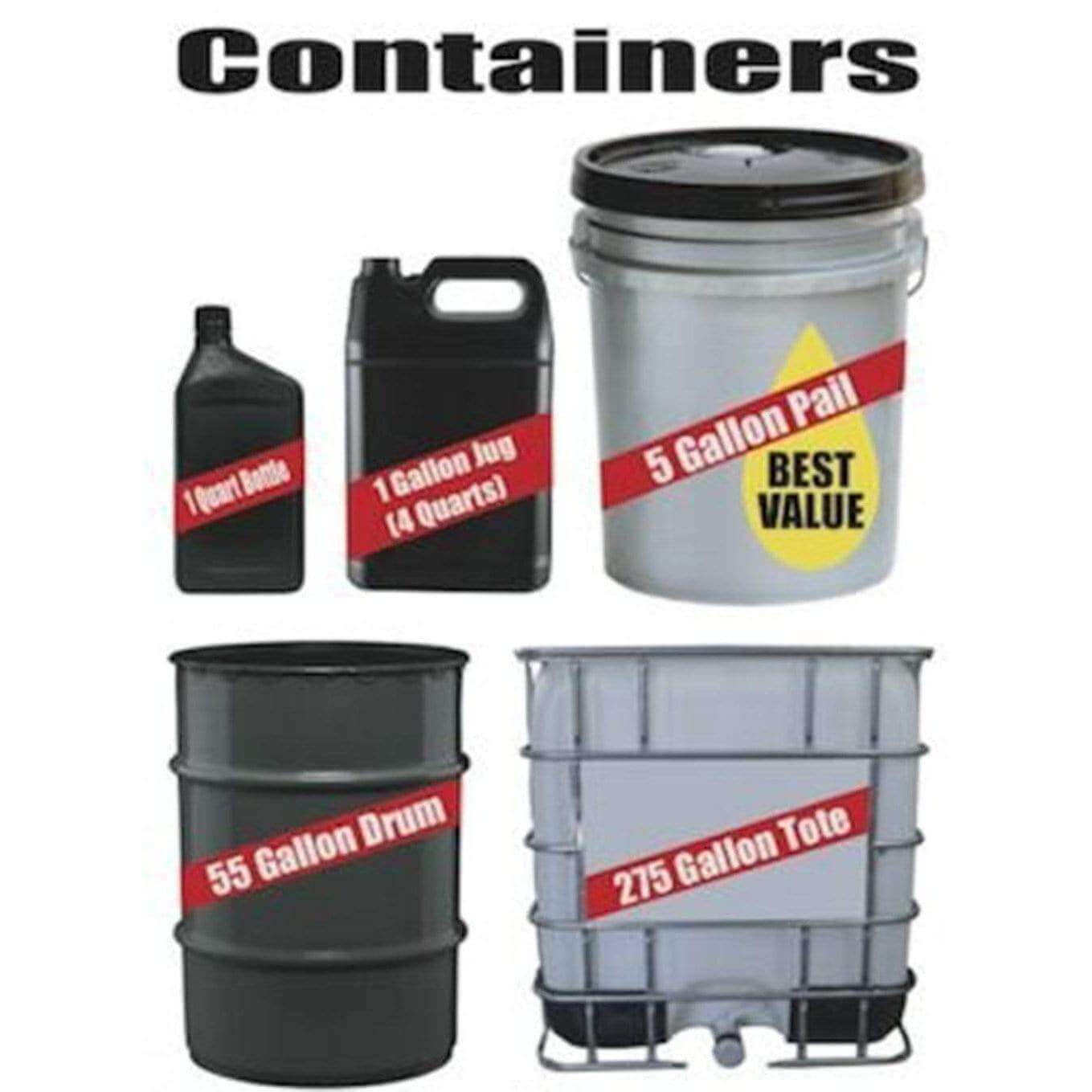
📦 Choose Your Size — 6 Variants Available
| Size | Best For |
|---|---|
| Quart (32 fl oz) | Individual oil changes, top-offs, motorcycle oil changes, trial before bulk |
| 12 Quart Case | Multiple oil changes, long-term personal supply, motorcycle shop stock |
| 1 Gallon (128 fl oz) | Most 4-cylinder and V6 oil changes, marine outboard top-offs, golf cart fleet service |
| 4 Gallon Case | Multi-vehicle households, golf course fleets, marina supply, V8 oil changes |
| 5 Gallon Pail | Shops, garages, marine service centers, golf course maintenance |
| 55 Gallon Drum | Commercial fleets, golf course operations, marine dealers, high-volume shops |
See variant dropdown above for current pricing. Automatic volume discounts apply on multiple-unit purchases — see the product page below variant selection for current quantity pricing tiers. For fleet, marina, or golf course volume pricing beyond listed sizes, call 239-344-9861.
📋 How to Use Cermax 10W-40
💡 For Best Results — Recommended Enhancement: For the deepest SiC ceramic protection, treat your engine first with Cerma STM-3 Engine Treatment (a one-time, permanent application), then use Cermax 10W-40 for all subsequent oil changes. The engine treatment establishes the initial deep ceramic bond; Cermax oil continuously maintains and reinforces it. Especially valuable for high-mileage engines that could use compression rejuvenation. Check our Value Packages for bundled savings.
- Verify viscosity spec — confirm your owner's manual recommends or permits SAE 10W-40. For most modern vehicles (2011+) the spec is thinner — use a matching-viscosity Cermax oil instead of 10W-40.
- Warm the engine — drive 5–10 minutes before draining so old oil flows freely and carries contaminants. For stored marine or cart engines, let the engine reach operating temperature first.
- Drain old oil — park on level ground, set parking brake, drain through the oil pan drain plug. Allow full drainage (10–15 minutes). For marine engines with fluid extraction through the dipstick tube, use an extractor pump.
- Replace the oil filter — always install a new filter at every change. For 30K-mile intervals, use a premium extended-performance filter (Mobil 1 EP, Amsoil EaO, Royal Purple, Fram Ultra Synthetic, Wix XP, or equivalent).
- Reinstall drain plug — use a new crush washer if required; torque to manufacturer specification.
- Fill with Cermax 10W-40 — add the correct capacity per your owner's manual. Start the engine and let it idle 30 seconds, then check the dipstick with engine off.
- Verify level and inspect for leaks — top off as needed. Check under the vehicle after 5–10 minutes.
- Operate normally — Cermax provides up to 30,000 miles of protection per change (or equivalent engine hours for marine/cart/equipment). Monitor oil level between changes.
- Consider oil analysis for critical applications — for marine engines, fleet vehicles, expensive classics, or any high-value application, send a used oil sample to a lab (Blackstone Labs, Polaris Labs) at 15K miles to confirm performance and validate your interval. Typically $30–$35 per sample.
- Do not add additional oil additives — Cermax is a complete protection system. Do not combine with other oil additives, treatments, or supplements.
📊 Technical Specifications
| Specification | Details |
|---|---|
| Type | Premium full synthetic ceramic motor oil with STM-3 SiC Run Clean Technology |
| Viscosity Grade | SAE 10W-40 (multi-grade — cold flow of SAE 10W, hot film strength of SAE 40) |
| Oil Change Interval | Up to 30,000 miles or manufacturer's recommended interval, whichever comes first* |
| API Service Classification | Formulated to meet performance targets of API SN, SM* |
| Ceramic Technology | STM-3 Nano Silicon Carbide (SiC) — Mohs 9.5 hardness, 2,730°C melting point, enhanced concentration |
| Base Stock | Premium full synthetic (Group III/IV) with extended-performance additive package |
| Turbo / Supercharger Safe | Yes — compatible with all induction types (verify 10W-40 is the spec for your engine) |
| Engine Type | Gasoline engines specifying SAE 10W-40 viscosity |
| Motorcycle Compatibility | Dry-clutch motorcycles only — NOT for wet-clutch motorcycles (requires JASO MA/MA2 rating) |
| Not Suitable For | Engines requiring 0W-20, 5W-20, 5W-30 (use matching-viscosity Cermax); diesel engines (use Cermax diesel grades); 2-cycle engines; wet-clutch motorcycles; some marine engines requiring 25W-40 marine-specific oil |
| Additive Properties | PTFE-Free, Solvent-Free, Environmentally Safe |
| Made In | USA — Fort Myers, FL (Bijou Inc.) |
🚗 Vehicle, Engine & Equipment Compatibility
| Application | Compatible? |
|---|---|
| High-mileage gasoline engines (100,000+ miles) where 10W-40 is acceptable per OEM | ✅ Excellent — thicker film + SiC restoration ideal for aged engines |
| Hot-climate vehicles (AZ, TX, FL summer, tropics) | ✅ Ideal — 10W-40 maintains film strength at extreme ambient temperatures |
| Gasoline trucks/SUVs for heavy towing or hauling | ✅ Yes — extra film protection for high-load operation (verify 10W-40 is spec) |
| Marine gasoline engines (inboard, I/O, most outboards) | ✅ Yes — Moisture Guard protects marine corrosion; verify manufacturer spec |
| Gas-powered golf carts (Club Car, EZ-GO, Yamaha) | ✅ Ideal — 10W-40 is the standard golf cart viscosity |
| Dry-clutch motorcycles (Harley touring, shaft-drive BMW, scooters with CVT) | ✅ Yes — verify your motorcycle uses dry clutch before use |
| Wet-clutch motorcycles (most Japanese sport/adventure/naked bikes) | ❌ No — requires JASO MA/MA2 rated oil to prevent clutch slippage |
| Classic/performance engines specifying 10W-40 or thicker | ✅ Yes — ideal for the combination of heat and performance stress |
| Older passenger vehicles (pre-2005) specifying 10W-40 or 10W-30 | ✅ Yes — 10W-40 is a valid choice for these engines, especially in hot climates |
| Outdoor power equipment (generators, pressure washers, pumps) where 10W-40 is spec | ✅ Yes — verify manufacturer recommendation |
| Modern passenger cars specifying 0W-20, 5W-20, or 5W-30 | ❌ Do not substitute — use matching-viscosity Cermax |
| Marine engines specifying 25W-40 marine-specific oil (e.g., Mercury Quicksilver) | ❌ Not compatible — use manufacturer's specified marine oil |
| Diesel engines | ❌ Not compatible — use Cermax Diesel oils |
| 2-cycle engines (older outboards, chainsaws, string trimmers) | ❌ Not for 2-cycle — use Cermax Air 2-Cycle Oil |
🛡️ Cermax 10W-40 vs Leading Premium Synthetics vs Conventional
| Feature | Cermax 10W-40 | Premium Synthetic 10W-40 (Mobil 1, Amsoil, Castrol Edge) | Conventional 10W-40 |
|---|---|---|---|
| Oil Change Interval | Up to 30,000 mi* | 7,500–15,000 mi | 3,000–5,000 mi |
| Ceramic SiC Technology | ✅ Yes | ❌ None | ❌ None |
| Run Clean Self-Cleaning | ✅ Yes | Detergent only | ❌ Limited |
| Restores Compression in High-Mileage Engines | ✅ Yes | ❌ No | ❌ No |
| Hot-Climate Film Strength | Superior (40-wt + SiC) | Good | Degrades faster |
| Marine Corrosion Protection | ✅ Moisture Guard | Partial | ❌ No |
| Permanent Ceramic Bond | ✅ Cumulative | ❌ Additives deplete | ❌ No |
| Price Per Quart | Premium | Moderate–premium | Lowest |
| Cost Per Mile | Lowest overall | Moderate | Highest (frequent changes) |
| Best For | Heavy-duty, high-mileage, marine, hot-climate, fleet/golf course | Standard extended-drain, enthusiast 10W-40 buyers | Budget basic service |
🔗 Complete Your Cerma Engine Protection
Pair Cermax 10W-40 with other Cerma ceramic products for total vehicle coverage:
- Cerma STM-3 Gas Engine Treatment — one-time permanent ceramic treatment (especially valuable for high-mileage engines needing rejuvenation)
- All Cermax Motor Oil Viscosities — 0W-20, 5W-20, 5W-30, 5W-40, 10W-30, 10W-40, diesel 10W-30/15W-40
- Cerma Transmission Treatments — automatic and manual transmission ceramic protection
- Cerma Gas Fuel Treatment — clean injectors, stabilize ethanol fuel (especially valuable for marine and stored equipment)
- Cerma Turbo Nano Treatment — ceramic protection for turbochargers
- Cerma Power Steering Treatment — protect power steering systems
- Cerma Blue Ice A/C Treatment — improve A/C compressor performance
- Cerma Gear Box & Axle Treatment — protect differentials and gear sets
🔬 Technical & Application FAQs
Yes — under normal operating conditions, Cermax 10W-40 is engineered for drain intervals up to 30,000 miles. That's 4× the typical conventional synthetic interval. Three factors make it possible: (1) enhanced SiC ceramic concentration that builds a robust permanent ceramic layer; (2) premium extended-performance additive package with oxidation inhibitors and anti-wear chemistry chosen for long service life; and (3) Run Clean self-cleaning action that prevents sludge/varnish degradation. Important caveats specific to 10W-40 applications: (1) Severe-duty use (heavy towing, continuous high-load, marine operation under power, hot-climate operation) typically shortens the interval to 15,000–20,000 miles — these are also the applications most likely to choose 10W-40 in the first place; (2) Marine engines should follow hour-based intervals (typically 50–100 engine hours per change for gasoline marine, regardless of oil) since marine oil is subject to moisture intrusion and fuel dilution; (3) Golf carts are usually hour-based (manufacturer typically specifies 100–125 hours or annually, whichever comes first); (4) Oil filter replacement is required at each change — use a premium filter rated for extended service; (5) Oil level monitoring matters — 10W-40 engines are often high-mileage with oil consumption, so check the dipstick frequently and top off. For critical or severe-duty applications, used oil analysis (Blackstone Labs, Polaris Labs, ~$30–35) validates your specific interval.
Both are legitimate choices for high-mileage gasoline engines, and the decision depends on your specific situation. Check your owner's manual first — some manuals list both 10W-30 and 10W-40 as acceptable, while others specify only one. If your manual allows both: Choose 10W-40 when (1) your engine has significant wear with widened clearances (often 150,000+ miles with noticeable oil consumption or reduced oil pressure); (2) you live in a hot climate (Arizona, Texas, Florida summer, tropical); (3) you do heavy towing, hauling, or continuous high-load driving; (4) you're running a marine, golf cart, or performance application; (5) you've noticed oil pressure dropping at hot idle; (6) your engine burns oil and you want thicker film to slow consumption. Choose 10W-30 when (1) your engine is in good condition with normal compression and oil pressure; (2) you're in a moderate or cold climate; (3) fuel economy matters to you (10W-40 has a small fuel economy penalty vs 10W-30); (4) you want balanced performance rather than maximum protection. Both use the same STM-3 SiC ceramic technology — the difference is hot-viscosity film thickness, not protection philosophy. For engines on the edge of needing 10W-40 (say 120K miles, moderate climate, light duty), either works well.
No — do not substitute 10W-40 for an engine that requires a thinner viscosity. This is the most common wrong-application mistake for 10W-40 oil. Modern engines designed for 0W-20, 5W-20, or 5W-30 (the majority of gasoline vehicles built 2011+) have tight internal clearances, precision variable valve timing (VVT) hardware, and oil-cooled components that depend on the specified oil flowing correctly at the specified viscosity. Substituting 10W-40 — which is significantly thicker at all temperatures — can cause: (1) Variable valve timing problems — VVT phasers and solenoids depend on specific oil flow; they can fail to actuate properly or become damaged with thicker oil; (2) Oil pump overload — the pump is sized for the specified viscosity and may fail prematurely moving thicker oil; (3) Reduced fuel economy — noticeably (2–5%) worse than specified viscosity; (4) Cold-start wear — thicker oil takes longer to reach upper-end components (cam lobes, rocker arms, VVT hardware), causing accelerated wear; (5) Warranty issues — if a covered component fails while you're running non-spec viscosity, the manufacturer has strong grounds to deny the claim; (6) Increased oil consumption — some engines have ring packages designed for thinner oils and actually consume more 10W-40 than they would 5W-30. Use a matching-viscosity Cermax oil instead — see the full motor oil collection for 0W-20, 5W-20, 5W-30, 5W-40, 10W-30 options with the same SiC ceramic technology.
Using Cermax should not void your warranty if (and only if) your manufacturer specifies or permits SAE 10W-40 viscosity for your engine. Under the Magnuson-Moss Warranty Act (US federal law), a manufacturer cannot void your warranty simply because you used an aftermarket oil — they must prove the specific oil caused a specific failure. But this protection depends on using the correct viscosity. For engines that specify 10W-40, Cermax 10W-40 is a reasonable, documented full-synthetic substitute. For warranty-covered vehicles — practical guidance: (1) Verify 10W-40 is specified or acceptable for your engine per the owner's manual; (2) Do not use 10W-40 in a warranty-covered vehicle that specifies thinner oil — the viscosity violation creates a strong warranty-denial case; (3) Keep all purchase receipts showing Cermax 10W-40 with dates and odometer readings; (4) Save used filters from each oil change (sealed in plastic bags) for potential inspection; (5) Extended drain intervals require documentation — if you're running 30K miles but the manufacturer schedule says 5,000 miles, oil analysis reports protect you; (6) Consider dealer notation — many service advisors will note your Cermax use in your record. For vehicles beyond powertrain warranty, this is a non-issue. 10W-40 is most commonly used in older vehicles (often out of warranty), high-mileage applications, and specialty equipment where warranty concerns are minimal.
Cermax 10W-40 alone provides significant SiC ceramic benefits — using it without the separate engine treatment is a valid choice. Cermax has higher SiC concentration than Cerma, so the ceramic layer builds progressively with each oil change. Over 1–2 oil change cycles of normal driving, you'll see most of the ceramic benefit. However — for deepest and fastest initial bond, especially in high-mileage applications (which is where 10W-40 is most commonly used), we strongly recommend starting with Cerma STM-3 Engine Treatment as a one-time application, then switching to Cermax 10W-40 at your next oil change. Why this matters more for 10W-40 applications: the buyers most likely to choose 10W-40 are those with high-mileage engines, aging marine engines, older trucks, classic cars, or heavy-duty equipment — all applications where the accelerated ceramic rebuild from the treatment provides the most dramatic benefit. The treatment is one-time only — its ceramic bond survives all future oil changes, so cost is incurred once and benefits continue indefinitely. Recommendations: (1) High-mileage engine (100K+ miles) with any oil consumption, compression loss, or performance fade → treatment + Cermax is the strongest combination; (2) Marine engine, golf cart fleet, or commercial equipment where downtime is costly → treatment + Cermax maximizes protection from day one; (3) Classic/collector car being maintained long-term → treatment + Cermax gives the deepest protection; (4) New-to-you high-mileage purchase → treatment during first service to establish the ceramic foundation; (5) Current engine in good condition, no unusual wear → Cermax alone works well; can add treatment later.
Cermax 10W-40 is fully compatible with standard conventional and synthetic 10W-40 motor oils from major brands (Mobil 1, Castrol Edge, Valvoline, Quaker State Defy/Full Synthetic, Pennzoil High Mileage, Shell Rotella T6 multi-grade, Amsoil, Royal Purple, etc.). For emergency top-off between oil changes, it's safe to add Cermax to your existing oil. For full SiC ceramic benefit and to justify 30K-mile drain intervals, a complete drain-and-fill is strongly recommended rather than a mixed top-off. Three reasons: (1) enhanced SiC concentration works best at full strength; (2) ceramic bonding is faster when the fluid is entirely Cermax; (3) old oil carries contaminants and depleted additives that dilute Cermax's performance. For high-mileage engines specifically — which is the most common 10W-40 application — a clean switchover is extra valuable because the SiC restoration action benefits most from starting fresh. Best practice: do a complete drain-and-fill at your next scheduled oil change (including a new premium filter), then run Cermax forward from that point. Don't mix viscosities: never combine 10W-40 with 10W-30, 5W-30, or 20W-50 — the resulting mixture won't match your engine's specification. Don't mix with specialty oils: racing oils, break-in oils, or classic car oils with high ZDDP concentrations should be fully drained rather than mixed.
Each application has specific guidance. MARINE GAS ENGINES — Generally YES, with caveats: Cermax 10W-40 works in most inboard/outboard gasoline marine engines (Mercruiser gas sterndrives, Volvo Penta gas, PCM, Crusader, Indmar, etc.) where 10W-40 is the specified or acceptable viscosity. The Moisture Guard chemistry is particularly valuable for marine use. However — some marine engines specify 25W-40 marine-specific oil (most commonly Mercury Mercruiser gas, Mercury Quicksilver) — follow that recommendation, not Cermax 10W-40, in those cases. For marine use, follow hour-based intervals (typically 50–100 engine hours, regardless of calendar time). GOLF CARTS — YES (ideal): 10W-40 is the industry-standard viscosity for gas-powered golf carts including Club Car DS/Precedent/Onward, EZ-GO RXV/TXT/Express, Yamaha Drive. Cermax 10W-40 provides the same SiC ceramic benefits as it does in automotive engines. Follow manufacturer hour-based or annual intervals (typically 100–125 hours or yearly). MOTORCYCLES — DEPENDS on clutch type: Critical distinction: (a) Dry-clutch motorcycles (most Harley-Davidson touring models, many BMW shaft-drive bikes, scooters with CVT transmissions, some older European bikes) — YES, Cermax 10W-40 works; (b) Wet-clutch motorcycles (MOST modern Japanese sport/adventure/naked bikes: Honda, Yamaha, Kawasaki, Suzuki, most Triumph, most Ducati, most KTM) — NO, do not use Cermax 10W-40. Wet-clutch motorcycles require JASO MA or MA2 rated motorcycle-specific oil to prevent clutch slippage; friction modifiers and anti-wear additives in automotive oil (including Cermax) can cause wet-clutch failure. Cermax is not JASO MA rated. When in doubt, consult your motorcycle's manual — if it specifies JASO MA or MA2, use motorcycle-specific oil. POWER EQUIPMENT — YES where 10W-40 is spec: generators, pressure washers, pumps, and other outdoor power equipment typically use 10W-30 or 10W-40; check your manufacturer's spec. Not for 2-cycle engines (use Cermax Air 2-Cycle Oil).
At the premium synthetic 10W-40 tier, Cermax competes with Mobil 1 High Mileage 10W-40, Mobil 1 Extended Performance 10W-40 (where offered), Amsoil OE 10W-40 and Signature Series 10W-40, Castrol Edge High Mileage 10W-40, Pennzoil Platinum High Mileage 10W-40, and Royal Purple HPS 10W-40. These are all excellent oils — premium synthetic base stocks, strong anti-wear packages, and extended-drain capability typically ranging from 7,500 to 15,000 miles depending on product. What makes Cermax 10W-40 different: the addition of STM-3 Nano Silicon Carbide ceramic technology not found in competitor extended-drain 10W-40 oils. Practical differences: (1) Drain interval — Cermax claims 30,000 miles vs 7,500–15,000 for competitors; (2) Ceramic bonding — Cermax deposits a non-depleting SiC layer on engine metal, while competitors protect through depleting chemistry only; (3) Restoration of worn surfaces — especially relevant for 10W-40 buyers (most of whom have high-mileage engines) — SiC bonds into micro-wear sites in a way standard additives cannot; (4) Cumulative protection — builds with each oil change rather than starting over. When competitor 10W-40 oils may be preferable: (1) if you're running a motorcycle that requires JASO MA/MA2 — look for motorcycle-specific 10W-40 with JASO rating (Amsoil MC motorcycle line, Castrol Power1 4T, Mobil 1 Racing 4T, Shell Rotella T6 in the multi-grade versions — Cermax is NOT JASO-rated); (2) if you want formal API certification for warranty documentation; (3) if local availability matters (major brands are at every auto parts store); (4) Mercury-specific marine engines that call for 25W-40. When Cermax 10W-40 is the better choice: automotive high-mileage applications where the ceramic restoration action provides benefits competitors don't offer, fleet/golf course operations where lowest cost per mile matters, and anyone wanting cumulative protection that improves with each oil change. Honest positioning: "premium synthetic 10W-40 with ceramic technology competitors don't offer."
Made in the USA by Cerma Treatment (Bijou Inc.), Fort Myers, FL. 30-day return policy. Free shipping on orders over $150. Ships to US & Canada. Fleet, marina, golf course, and commercial volume pricing available beyond listed sizes. Questions? Call 239-344-9861 or email info@cermatreatment.com.
*"Up to 30,000-mile drain interval" represents the maximum recommended interval under normal operating conditions — severe-duty operation (heavy towing, continuous high-load, extreme temperatures, dusty environments, taxi/rideshare service, track use) requires shorter intervals, typically 15,000–20,000 miles. Marine and equipment applications should follow manufacturer hour-based intervals (typically 50–100 engine hours for marine gas, 100–125 hours or annually for golf carts). Always follow your vehicle or equipment manufacturer's recommended interval when shorter than 30,000 miles; use periodic used-oil analysis (Blackstone Labs, Polaris Labs, etc.) for critical or extended-service applications. Performance claims — including restored compression, reduced friction, 30K drain capability, and Run Clean self-cleaning action — represent formulation targets and typical results; individual results vary based on engine condition, age, mileage, operating style, climate, and maintenance practices. API SN/SM reference represents performance targets against which Cermax is formulated — verify your manufacturer's current specification requirements. Cermax 10W-40 is formulated to SAE 10W-40 viscosity for gasoline engines specifying this grade — do NOT substitute for engines requiring 0W-20, 5W-20, 5W-30, diesel-specific grades, 25W-40 marine-specific grades, or wet-clutch motorcycles requiring JASO MA/MA2 motorcycle-specific oil. Cermax is NOT JASO MA/MA2 rated; wet-clutch motorcycles require motorcycle-specific oil to prevent clutch slippage. Third-party brand references (Mobil 1, Amsoil, Castrol, Valvoline, Pennzoil, Quaker State, Royal Purple, Shell Rotella, Mercruiser, Volvo Penta, PCM, Crusader, Indmar, Mercury Quicksilver, Club Car, EZ-GO, Yamaha, Harley-Davidson, BMW, Honda, Kawasaki, Suzuki, Triumph, Ducati, KTM) are property of their respective owners and are used for compatibility identification and comparison only — Cermax is not affiliated with or endorsed by any of these brands. Always verify your vehicle or equipment manufacturer's specified oil viscosity and performance category before installation, and follow your owner's manual for oil change intervals and procedures.
Share
