


Cerma
Turbo Nano Engine Treatment Increases performance Reduces harmonic
Turbo Nano Engine Treatment Increases performance Reduces harmonic
Couldn't load pickup availability
Cerma Turbo Nano Engine Treatment — Ceramic SiC Protection for Turbocharger & Non-Ferrous Engine Components
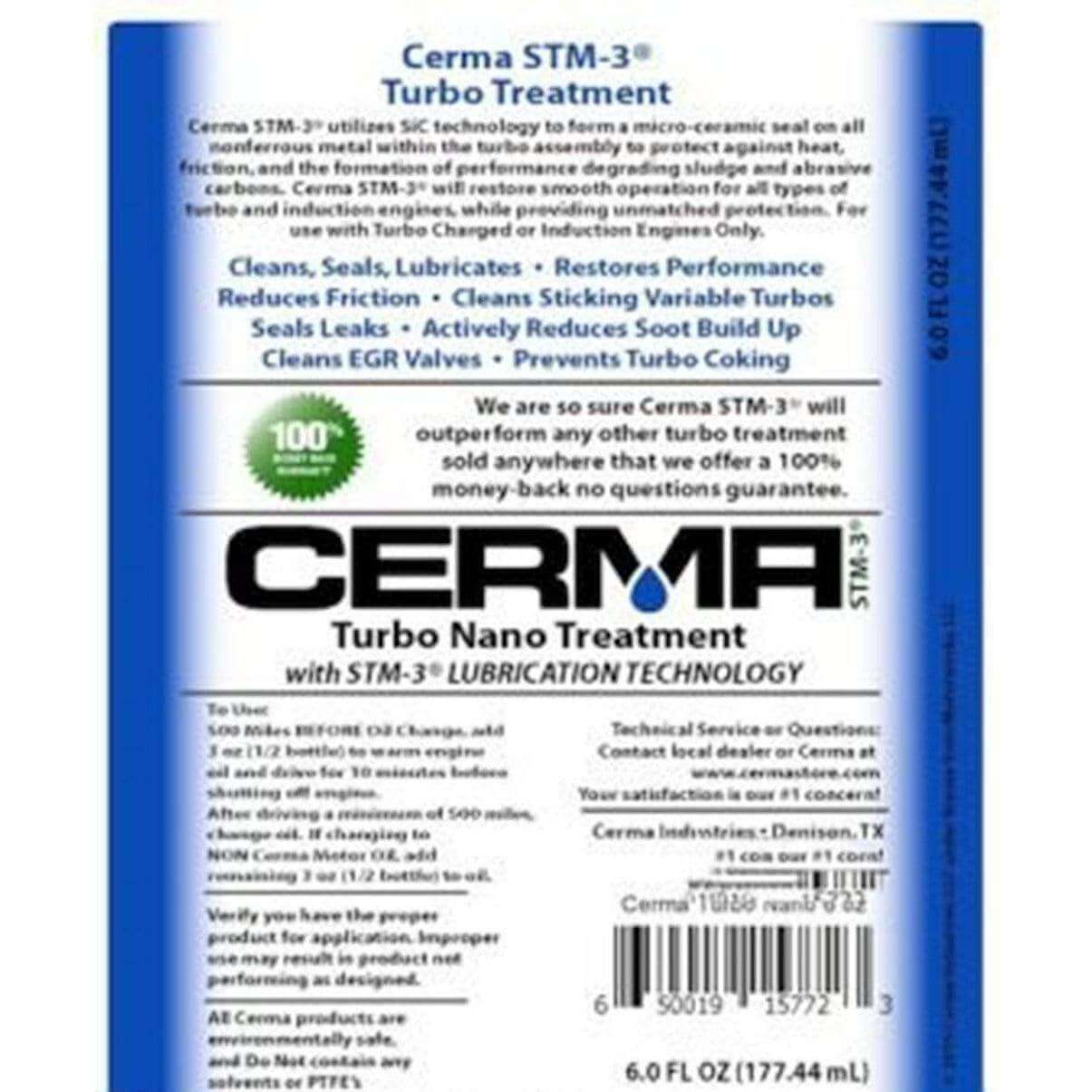
Cerma Turbo Nano Treatment is a specialized ceramic application designed specifically for turbochargers and non-ferrous engine components. Using Nano Silicon Carbide (SiC) technology, it creates a micro-ceramic protective coating on turbo bearings, bushings, and housings — reducing heat damage, reducing harmonic instability, and delivering faster spool-up times.
Important: This product is an add-on to Cerma STM-3 Engine Treatment, not a standalone treatment. Apply after completing the Cerma Engine Treatment protocol.
✅ What Cerma Turbo Treatment Does
- Protects turbocharger internals — ceramic coating on bearings, bushings, and shaft surfaces
- Faster spool-up times — reduced friction means the turbo spins up quicker
- Reduces harmonic instability — helps eliminate turbo whine, flutter, and vibration
- Reduces bushing and bearing wear — SiC ceramic is harder than any turbo component
- Heat protection — SiC melting point of 2,730°C protects against extreme turbo temperatures
- Prevents sludge buildup — ceramic barrier keeps turbo oil passages clean
- Protects non-ferrous components — coats aluminum, bronze, and other non-ferrous metals that STM-3 doesn't treat
- Helps extend turbo life — permanent protection against the #1 turbo killer: oil starvation damage on hot shutdown
⚡ Why turbo engines need this: Turbochargers spin at up to 250,000 RPM and reach temperatures exceeding 1,000°F. When you shut off a hot engine, oil stops flowing but the turbo is still hot — this is when the most damage occurs. Cerma Turbo Treatment provides a permanent ceramic barrier that protects even when oil isn't flowing, helping prevent the coking and bearing damage that kills turbos.
🔬 How Turbo Nano Treatment Works
Cerma STM-3 Engine Treatment bonds SiC to ferrous (iron/steel) engine components. Cerma Turbo Nano Treatment is formulated specifically for non-ferrous components — the aluminum housings, bronze bushings, and specialized alloys used in turbochargers and other high-temperature engine parts.
The Nano SiC particles create a permanent micro-ceramic coating on these non-ferrous surfaces, providing:
- A self-lubricating ceramic barrier that protects during hot shutdowns
- Extreme heat resistance (SiC handles 2,730°C — far beyond turbo operating temps)
- Reduced friction coefficient on bearing and bushing surfaces
- Help preventing carbon coking in turbo oil feed and drain passages
Contains no solvents and no PTFE (Teflon). Environmentally safe.
📦 Available Sizes
| Size | Best For | Price |
|---|---|---|
| 1 oz | Cars & pickup trucks — single vehicle application | $38.50 |
| 2 oz | Cars & pickup trucks — two applications or two vehicles | $70.40 |
| 6 oz | Semi trucks, Class 8, commercial diesel turbos | $193.60 |
📋 How to Apply
| Scenario | Instructions |
|---|---|
| Cars & pickup trucks | Complete Cerma STM-3 Engine Treatment first. At next oil change, add 1oz of Turbo Treatment to engine oil. |
| Semi trucks / Class 8 | Complete Cerma STM-3 Diesel Truck Engine Treatment first. At next oil change, add the full 6oz Semi Truck bottle to engine oil. |
| Using your own oil brand | Add at your next scheduled oil change after completing the Cerma Engine Treatment protocol. Pour through the oil fill port. |
| Switching to Cerma Motor Oil | Cerma Synthetic Motor Oil already contains SiC protection for non-ferrous components — no additional Turbo Treatment needed. |
Dosage: 1oz per car/pickup application. Full 6oz bottle for a single semi truck. Add to engine oil through the oil fill port. Drive normally.
🚗 Works on All Turbocharged Vehicles
| Vehicle Type | Examples |
|---|---|
| Turbo Gas Cars | BMW, Audi, VW, Mercedes, Ford EcoBoost, Subaru WRX, Honda Civic Type R |
| Turbo Diesel Trucks | Ram Cummins, Ford Power Stroke, Chevy Duramax, all turbodiesel pickups |
| Turbo Diesel Cars | VW TDI, BMW diesel, Mercedes diesel, Audi TDI |
| Semi Trucks | All Class 8 turbodiesel (Cummins X15, Detroit DD15, PACCAR MX, Volvo D13, Mack MP8) |
| Performance / Modified | Any aftermarket turbo setup, twin turbo, compound turbo, supercharger |
| Heavy Equipment | Turbocharged diesel generators, marine engines, industrial equipment |
🛡️ Complete Turbo Engine Protection Stack
For maximum turbo engine protection, use all three Cerma products together:
| Step | Product | What It Protects |
|---|---|---|
| 1 | Cerma STM-3 Engine Treatment | Ferrous (iron/steel) engine internals — cylinders, pistons, cams, bearings |
| 2 | Cerma Turbo Nano Treatment (this product) | Non-ferrous components — turbo bearings, bushings, aluminum housings |
| 3 | Cerma Ceramic Fuel Treatment | Fuel system — injectors, fuel pump, upper engine (continuous use) |
🔬 Technical & Compatibility FAQs
Yes. Cerma Turbo Nano Treatment is designed as a companion to Cerma STM-3 Engine Treatment, not a replacement. The Engine Treatment handles ferrous (iron/steel) components. The Turbo Treatment handles non-ferrous components (aluminum, bronze) found in turbochargers and other high-temperature parts. Use both for complete protection.
No. Cerma Synthetic Motor Oil already contains SiC protection for non-ferrous components built into the oil formula. If you're switching to Cerma Motor Oil after your Engine Treatment, the Turbo Nano Treatment is not needed. This product is for users who continue using their preferred oil brand.
Ferrous metals contain iron — engine blocks, crankshafts, camshafts, cylinder liners. These are treated by Cerma STM-3 Engine Treatment. Non-ferrous metals don't contain iron — aluminum turbo housings, bronze turbo bushings, aluminum pistons (in some engines). These require the Turbo Nano Treatment for ceramic bonding.
Yes. By reducing friction on turbo bearings and bushings, Cerma Turbo Treatment allows the turbo to spool up faster — reducing the delay between throttle input and boost delivery. The reduction in harmonic instability also makes boost delivery smoother and more predictable. The biggest noticeable gains are typically on small-displacement turbo engines (Ford EcoBoost 2.3L, VW/Audi 2.0T) where even a small reduction in rotational friction translates to meaningful spool-up improvement.
Yes — this is one of the most important benefits. When you shut off a turbocharged engine after hard driving, the turbo is extremely hot but oil stops flowing. Without protection, residual oil cokes (carbonizes) on the turbo bearings and shaft. Cerma's permanent ceramic coating provides a self-lubricating barrier that protects even when oil isn't circulating, helping prevent the coking damage that leads to premature turbo failure. This is especially valuable for daily drivers who don't let their turbo cool down before shutoff, and for tow vehicles that shut down after heavy load work.
Yes. Cerma Turbo Nano Treatment works on any forced induction system — turbochargers, superchargers, twin-scroll setups, compound turbos, and twincharger configurations. Any non-ferrous component that contacts engine oil will benefit from the SiC ceramic coating. This includes roots-style superchargers (GM LSA/LT4), twin-screw superchargers (TVS), and centrifugal superchargers (Vortech, ProCharger, Paxton).
Yes — and these three turbos are some of the most common Cerma Turbo Treatment applications. The Ford Power Stroke 6.7L uses a Garrett GT37 VGT turbo. The Duramax 6.6L uses a BorgWarner S300V or Garrett VGT. The Cummins 6.7L uses a Holset HE351VE or HE300VG VGT turbo. All three are compatible with Cerma Turbo Treatment — use the 6oz Semi Truck variant for Class 8 Cummins ISX/X15, Detroit DD15, and PACCAR MX turbos; use the 1oz or 2oz variant for pickup-truck applications. Cerma treats the aluminum compressor housings, bronze bushings, and thrust bearings across all major turbo manufacturers including Garrett, BorgWarner, Holset, IHI, Mitsubishi, and Precision.
Yes. Cerma Turbo Nano Treatment is safe for variable geometry turbos (VGT) and variable nozzle turbines (VNT) found in most modern diesel pickups (Power Stroke 6.0/6.4/6.7, Duramax LMM/LML/L5P, Cummins 6.7) and many European gasoline turbos (VW/Audi, BMW, Porsche). The ceramic coating bonds to metal surfaces — it does not affect the moveable vane mechanism, actuator, or unison ring that control VGT geometry. Because the SiC particles are sub-micron sized, they pass through turbo oil passages without clogging the precision clearances that VGTs depend on. No special procedure needed — apply the same way as on fixed-geometry turbos.
Made in the USA by Cerma Treatment (Bijou Inc.), Fort Myers, FL. Environmentally safe. Solvent-free. PTFE-free. 30-day return policy. Free shipping on orders over $150. Ships to US & Canada. Questions? Call 239-344-9861 or email info@cermatreatment.com.
Share
Frequently Asked Questions
- 5 stars: 1 (100%)
- 4 stars: 0 (0%)
- 3 stars: 0 (0%)
- 2 stars: 0 (0%)
- 1 star: 0 (0%)
This IS great stuff. I use it in every car I have. 👍