Cerma
Ceramic Clean • Seal • Lube System for Firearms — STM-3® SiC Technology
Ceramic Clean • Seal • Lube System for Firearms — STM-3® SiC Technology
Couldn't load pickup availability
Ceramic Clean • Seal • Lube System for Firearms — STM-3® SiC Technology
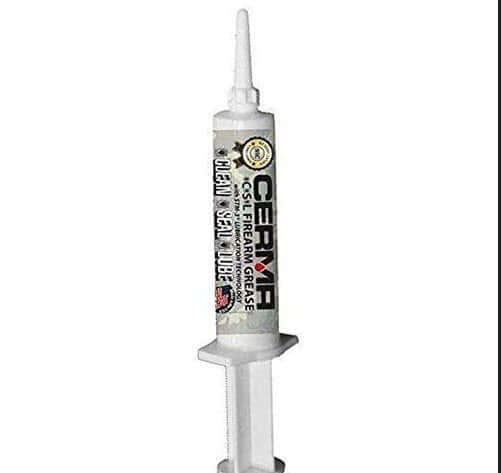
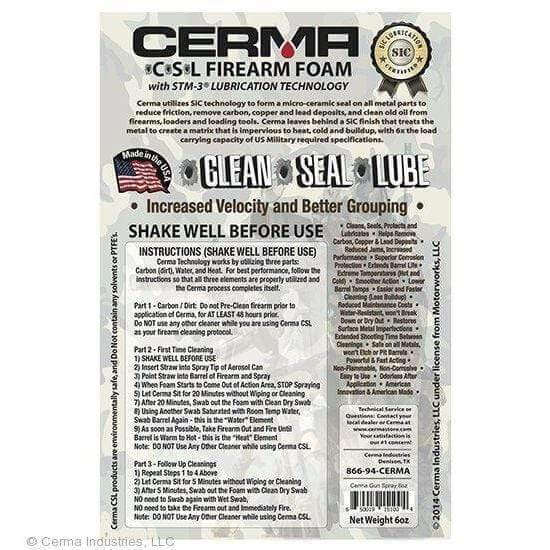
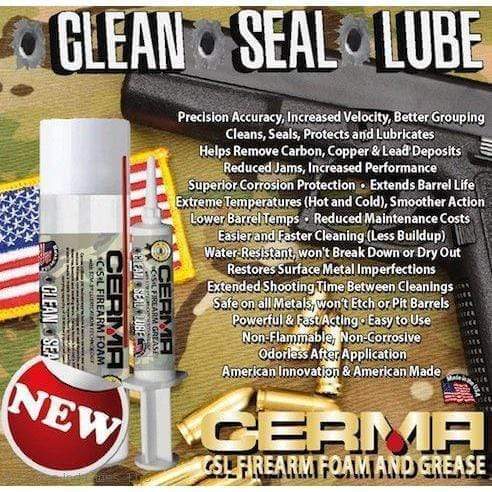
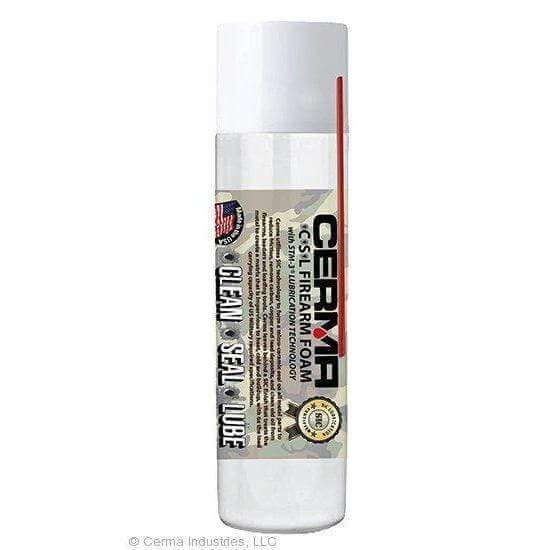
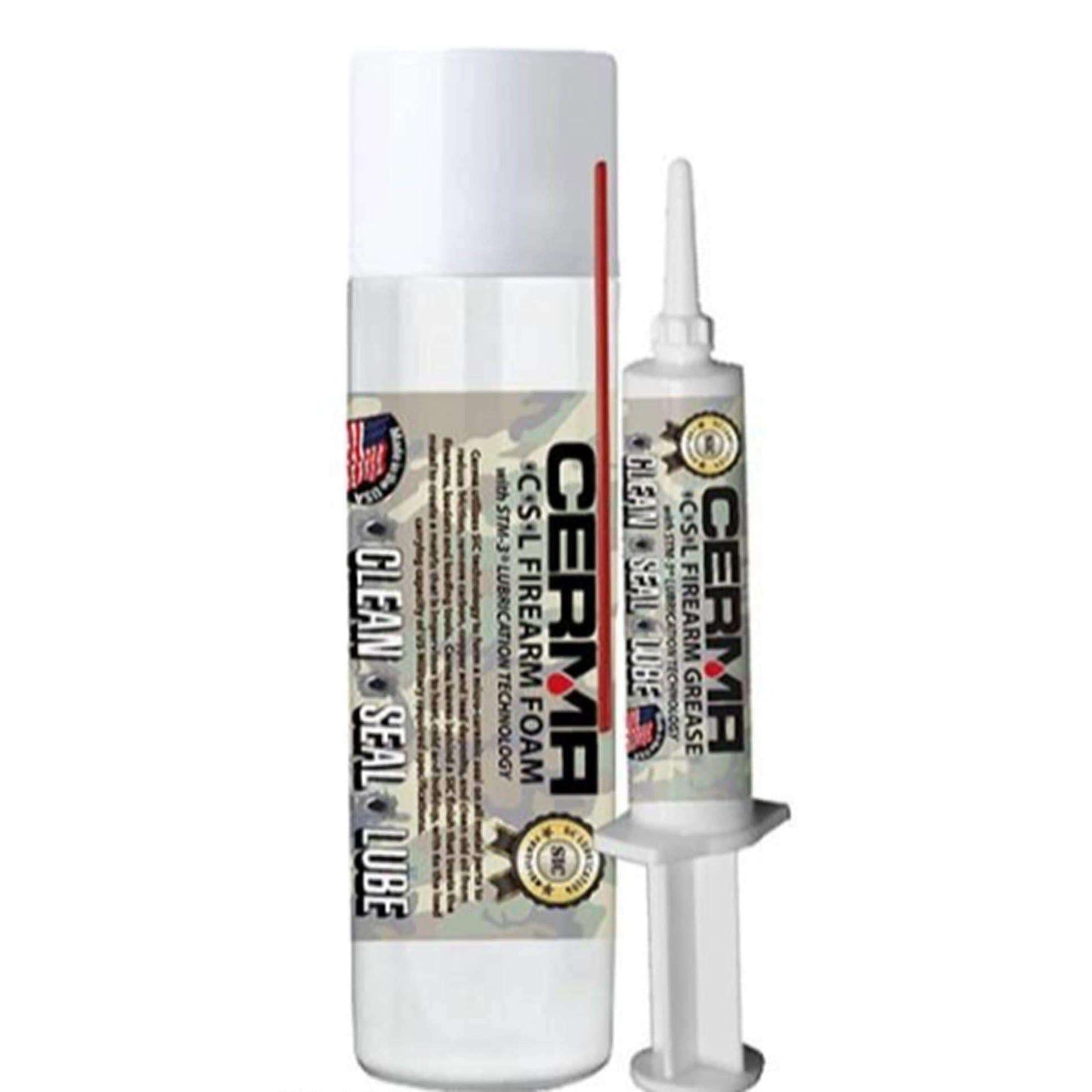
Cerma Ceramic C•S•L Firearm Foam & Grease Treatment is a two-component firearms care system that cleans, seals, and lubricates all metal components on pistols, rifles, shotguns, and reloading equipment. The foam penetrates the bore and action, helping lift carbon residue and depositing STM-3® Nano Silicon Carbide (SiC) ceramic particles on metal surfaces. The grease applies SiC-enhanced lubrication to action, slide rails, locking lugs, and other metal-to-metal contact points. Together they help build a persistent ceramic protective layer that reduces friction, helps resist fouling buildup, and supports smoother cycling — across temperature ranges typical of firearms use and storage.
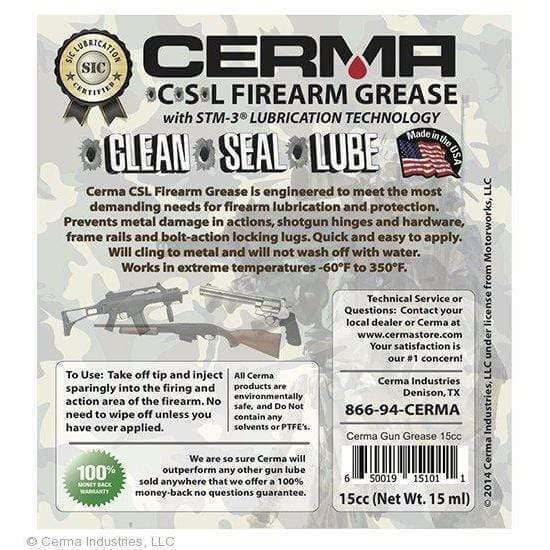
Three options: 15cc Grease Only (syringe applicator), 6oz Foam Only, or the Complete Kit (6oz foam + 15cc grease). Bundle discounts on multiple kits. Made in the USA by Bijou Inc. in Fort Myers, FL. PTFE-free, solvent-free in the ceramic carrier formulation. Safe on all common firearm finishes.
What Cerma C•S•L Delivers
- STM-3® Nano Silicon Carbide ceramic protection — SiC particles (Mohs 9.5 hardness, 2,730°C melting point) help build a permanent ceramic layer on bore, action, slide rails, locking lugs, and other metal surfaces. The ceramic layer persists across cleaning sessions; protection accumulates with continued use rather than washing away with each cleaning.
- Reduces internal friction in moving actions — semi-auto slide cycling, bolt action travel, lever and pump action operation, revolver cylinder rotation. Lower friction supports consistent function across the round count of a range session.
- Helps resist fouling buildup — the ceramic layer creates a smoother surface that helps carbon and combustion residue release more easily during cleaning. Many users report needing less aggressive cleaning between range sessions.
- Persistent lubrication across temperature range — formulated to maintain protective film stability from cold-storage to elevated-use temperatures typical of high-round-count range sessions and tactical/duty carry conditions.
- Won't run, drip, or migrate from application points — unlike thin oils that migrate to gravity-low spots in the firearm, Cerma's ceramic chemistry stays where applied and bonds to metal rather than running off.
- Corrosion protection during storage — the ceramic layer plus oil carrier provides a protective barrier against atmospheric moisture, salt, sweat, and the corrosive residues from older corrosive-primed ammunition (relevant for milsurp shooters).
- Two-component system — foam for bore and large surfaces, grease for precision action lubrication points. The two components target different surfaces with appropriately formulated viscosity for each.
- PTFE-free, solvent-free carrier — no Teflon particles, no petroleum solvents that could affect polymer frames, grips, or finish.
- Compatible with all common firearm finishes — bluing, Parkerizing, nitride (Melonite, QPQ), Cerakote, DLC, hard chrome, stainless, NP3, and traditional steel. Will not etch or damage any common firearms metal or finish.
Documented Customer Testing — Velocity Improvement
"After applying Cerma C•S•L to a 16-inch AR-15, chronograph testing showed approximately 200 fps velocity gain. On a 40-cal Sig P-229R, approximately 150 fps improvement was measured."
— Personal range testing by a law enforcement officer in Connecticut
Cerma's STM-3 ceramic chemistry is the same family of SiC technology used across our automotive and industrial product line, where it's been documented in third-party testing to reduce friction at metal-to-metal contact points. In firearms applications, friction reduction at the bore-projectile interface and at action contact points provides the technical basis for the smoother operation and easier cleaning that customers consistently report. The magnitude of any specific outcome — velocity, group size, function reliability — depends on the individual firearm, ammunition, and shooting context.
The Two-Component System
The 6oz foam is applied after standard bore cleaning. Apply a small amount to a bore brush or patch and run through the bore; the foam penetrates rifling grooves and barrel internal surfaces. The foam carrier helps lift residual carbon and fouling that solvents leave behind, and deposits SiC ceramic particles on the bore surface. Also used on external metal surfaces — slide exterior, frame, barrel exterior, action — for general protection and finish maintenance. Important: for heavy copper or lead fouling, use traditional copper solvent (Sweet's, Wipe-Out, KG-12) or lead solvent (Lead Away cloth, dedicated lead solvent) first; Cerma C•S•L Foam is best applied to a properly cleaned bore.
The 15cc syringe applicator delivers SiC ceramic grease to specific lubrication points: slide rails on semi-auto pistols, bolt locking lugs on rifles, charging handle and bolt carrier group surfaces on AR-platform rifles, action bars on pump shotguns, hinge points on break-action firearms, and trigger group contact surfaces (where manufacturer specifies lubrication — many trigger groups should run dry). Apply sparingly — a thin film is sufficient. Excess grease attracts dust and fouling and provides no additional protection. Follow your firearm's owner's manual for specified lubrication points.
Compatible Firearms & Equipment
| Category | Examples |
|---|---|
| Semi-automatic pistols | Glock, Sig Sauer, Smith & Wesson, Beretta, CZ, FN, HK, Springfield, Kahr, Walther, Colt 1911 platform, Ruger, Taurus — all common striker-fired and hammer-fired designs |
| Revolvers | Smith & Wesson J/K/L/N/X frames, Ruger GP-100/SP-101/Redhawk, Colt Python/King Cobra/Anaconda, Taurus, Charter Arms — single and double action |
| AR-platform rifles | AR-15, AR-10, M4-pattern, mil-spec and commercial buffers — all major brands (Colt, FN, Daniel Defense, BCM, LMT, LaRue, Aero, PSA, Ruger, S&W M&P-15, Sig MCX/M400, etc.) |
| Bolt-action rifles | Remington 700 platform, Tikka, Sako, Bergara, Howa, Savage, Ruger American/Hawkeye, Winchester 70, Browning X-Bolt, custom builds — hunting and precision rifle |
| Pump & semi-auto shotguns | Remington 870/1100, Mossberg 500/590/930, Benelli M-series, Beretta, Browning, Winchester SXP/Super X, FN, Stoeger |
| Lever-action rifles | Marlin, Henry, Winchester, Rossi, Henry Big Boy — all calibers |
| Break-action firearms | O/U and SxS shotguns (Beretta, Browning Citori, Caesar Guerini, Perazzi, etc.), single-shot rifles, derringers |
| Reloading equipment | Single-stage and progressive presses (Dillon, RCBS, Hornady, Lee, Forster), case prep tools, bullet seating dies, primer-pocket tools — wherever metal-to-metal lubrication is appropriate |
Compatible finishes and metals
Bluing (cold and hot), Parkerizing/phosphate, nitride (Melonite, Tenifer, QPQ, salt-bath), Cerakote, DLC (diamond-like carbon), hard chrome, stainless steel, NP3, traditional carbon steel, aluminum frames, polymer frames (carrier formulation is polymer-safe), wood furniture (apply to metal only — keep oils off wood). Will not etch, pit, discolor, or damage any common firearm finish or material.
📋 How to Use the C•S•L System
Step 1 — Standard cleaning first
- Verify firearm is unloaded. Remove magazine, lock action open, visually and physically confirm chamber is empty.
- Disassemble per manufacturer's owner's manual instructions.
- Clean bore with standard bore cleaning protocol — patches, bore brush, bore cleaner appropriate to the fouling type. For heavy copper fouling: use copper solvent first. For lead fouling: use lead solvent or Lead Away cloth first. Get the bore as clean as your normal protocol achieves.
- Wipe down action, slide, and external surfaces with a clean rag to remove any solvent residue.
Step 2 — Apply Cerma C•S•L Foam (bore and surfaces)
- Apply a small amount of Cerma C•S•L Foam to a clean patch or bore brush.
- Run through the bore from breech to muzzle (preferred direction). Several passes ensure full coverage of rifling grooves.
- Run a clean dry patch through to remove excess foam — leave a thin film, not pooled product.
- For external metal surfaces: apply foam to a clean rag and wipe down slide, frame, barrel exterior, and action. Buff lightly to leave a thin protective film.
Step 3 — Apply Cerma C•S•L Grease (lubrication points)
- Identify lubrication points from your firearm's owner's manual. Different designs have very different lubrication requirements — Glocks need very little grease; AR-15 BCGs need moderate amounts at specific points; 1911s have specific rail and barrel-link points.
- Apply a small amount of grease from the syringe applicator to each specified point. Use a thin film, not blobs.
- Cycle the action several times to distribute grease evenly across contact surfaces.
- Wipe any excess grease from areas where it shouldn't be (trigger group on most designs, magazine well, optic/sight surfaces).
Step 4 — Reassemble & function check
- Reassemble per manufacturer's instructions.
- Perform appropriate function check (slide cycling, dry-fire if safe and appropriate to design, action operation).
- For first-use range testing, start with familiar ammunition and conduct standard pre-flight verification at the range.
Available Options & Pricing
| Option | Price | Best For |
|---|---|---|
| 15cc Grease Only (syringe applicator) | $13.16 (sale from $18.14) | Existing C•S•L users replenishing grease, customers who already use other quality bore cleaners and want to add SiC action lubrication, multi-firearm households doing routine action lubrication |
| 6oz Foam Only | $72.68 | Existing C•S•L users replenishing foam, gunsmiths and shops, range officers maintaining inventory, customers focused on bore treatment and surface protection |
| Complete Kit (6oz Foam + 15cc Grease) ⭐ | $79.29 | First-time users — the complete C•S•L system. Includes both components with discount vs. buying separately. Recommended starting point. |
Bundle discounts: Buy 2 of any variant save 5%; Buy 5 save 10%. For range, club, agency, or gunsmith volume orders, call 239-344-9861 for commercial pricing.
Cerma C•S•L vs. Conventional Gun Care Products
| Feature | Cerma C•S•L | Conventional CLP / Gun Oil / Grease |
|---|---|---|
| STM-3 SiC ceramic technology | ✓ Yes | ✗ No |
| Persistent ceramic layer (survives cleaning) | ✓ Yes | ✗ Wipes away with cleaning |
| Cumulative protection across applications | ✓ SiC builds with continued use | ✗ Each application starts from zero |
| Resists migration from application point | ✓ Yes | ⚠ Thin oils migrate; greases vary |
| Two-component (foam + grease) | ✓ Yes — purpose-formulated for each | ⚠ Most CLPs are single-product compromises |
| Solvent properties | ⚠ Light surface cleaning; not a heavy-fouling solvent | Varies — CLPs often have stronger solvent action |
| Polymer/Cerakote/finish-safe | ✓ Yes | Varies — some solvents attack finishes |
| PTFE-free / solvent-free carrier | ✓ Yes | Varies |
Important honest note on cleaning: Cerma C•S•L is not a heavy-duty bore solvent. For removing copper fouling from heavy-use rifle bores, established copper solvents (Sweet's 7.62, Wipe-Out, KG-12) outperform any general-purpose cleaning chemistry. For lead removal from revolver chambers and pistol bores, dedicated lead solvents or Lead Away cloths are more effective. Cerma C•S•L works best as the final step of cleaning — applied after solvent-based cleaning has removed heavy fouling — to deposit the SiC ceramic protective layer and provide finish protection. Customers using Cerma alongside their existing solvent routine typically get the best results.
Related Cerma Products
- Cerma Ceramic Multi-Purpose Grease — SiC ceramic grease for general equipment and industrial lubrication
- Cerma STM-3 Engine Treatment — one-time ceramic engine protection for your vehicle
- Cerma Gas Fuel Treatment — fuel system protection
- Cermax Ceramic Synthetic Motor Oils — extended-interval ceramic-enhanced engine oils
Frequently Asked Questions
Honest answer: very unlikely for most users. The 150–200 fps figures come from one customer testimonial — personal range testing by a law enforcement officer in Connecticut on specific firearms (16" AR-15 and 40-cal Sig P-229R) under their personal testing methodology. That result is not typical and should not be interpreted as the outcome you should expect. Velocity gains from lubrication alone depend on many factors: bore condition before treatment (heavily-fouled bores can show larger gains as fouling is removed), ammunition consistency (chronograph variation between rounds is often 30+ fps even with premium match ammo), barrel break-in state, chronograph methodology, and statistical sampling (single-shot comparisons are not statistically meaningful). Most customers report the primary benefits as smoother action cycling, easier cleaning, and reduced fouling buildup over high-round-count use — these are the consistent, repeatable benefits across users. If you're hoping to gain 200 fps from a lubricant treatment, please don't buy this product expecting that result. If you want a quality SiC ceramic gun lube/grease system that helps maintain a clean bore and smoother action, this is a defensible choice.
Yes. Cerma C•S•L is formulated to be safe on all common firearm finishes and materials: Cerakote (won't soften, dissolve, or affect Cerakote ceramic coating), nitride finishes (Melonite, Tenifer, QPQ, salt-bath nitride), DLC (diamond-like carbon), hard chrome and NP3, traditional bluing (cold and hot), Parkerizing/phosphate, stainless steel, polymer frames (Glock, M&P, Sig P-series, FN, HK, etc. — the carrier formulation is polymer-safe), and aluminum receivers. Will not etch, pit, discolor, soften, or damage any common firearm finish. Avoid getting product on: wood furniture (oils can stain or affect wood finish — apply to metal only), optic lenses (clean optics with appropriate lens cleaner), and trigger group internals on designs that specify dry operation (read your manual — many modern striker-fired triggers are designed to run with minimal or no lubrication in the trigger pack).
Generally no — Cerma C•S•L Foam is best used as the final step of cleaning, after your regular solvent has done the heavy work. For light carbon fouling (a few hundred rounds of pistol shooting, low-volume rifle use), the foam alone may be sufficient cleaning. For heavy copper fouling (high-volume rifle shooting, especially with copper-jacketed match ammunition), use a dedicated copper solvent first (Sweet's 7.62, Wipe-Out, KG-12, Boretech Eliminator, etc.) — these solvents target copper specifically and remove it more effectively than any general-purpose cleaner. For lead fouling (revolver chambers, lead-bullet shooting), use dedicated lead solvents or Lead Away abrasive cloth first. After removing heavy fouling with the appropriate solvent, apply Cerma C•S•L Foam to deposit the SiC ceramic protective layer on the cleaned bore. Some users have reported that consistent use of Cerma reduces the frequency of needing aggressive copper or lead removal, but it doesn't replace those products for heavy fouling situations.
Yes — the AR-platform is one of the most common applications. The grease is well-suited for the specific lubrication points on the BCG: bolt locking lugs (small amount on the front of the lugs and in the bolt cam pin track), bolt body and gas rings (light film on the bolt body where it slides in the carrier), cam pin (small amount), charging handle (light grease on the rails), buffer and buffer spring (very light film if any — many shooters run these dry), and buffer tube interior (light film). Apply sparingly. For high-round-count training carbines and duty rifles, the SiC ceramic protection helps reduce wear on the bolt lugs and cam pin track — common wear points. Avoid over-greasing — excess grease on the BCG attracts powder residue and can contribute to the "AR-15 runs wet" myth that's actually causing reliability issues, not solving them. Pat Rogers' often-quoted "an AR-15 wants to be wet" was specifically about thin oils on a high-volume training rifle in a controlled range environment — for general use, modest amounts of high-quality grease at correct points outperform soaking the BCG in oil.
Yes — corrosion protection during storage is one of the strongest use cases. After cleaning, apply Cerma C•S•L Foam to all metal surfaces (bore interior, action, slide exterior, barrel exterior, internal frame surfaces) and apply C•S•L Grease to lubrication points. The ceramic layer plus carrier oil provides a protective barrier against atmospheric moisture, salt air (relevant for coastal and humid climates), perspiration residue (relevant for daily-carry firearms in summer heat), and the corrosive primer residues from older corrosive-primed surplus ammunition (relevant for milsurp shooters running 7.62×54R, 7.62×39, .30-06 surplus, etc.). For long-term storage (months to years), check stored firearms periodically — even with quality protection, climate-control issues can affect long-stored firearms. Storage in a climate-controlled safe or cabinet with desiccant or active dehumidification is preferable to heavy lubrication as the primary corrosion strategy. Cerma adds protection on top of good storage practice; it doesn't replace good storage practice.
The SiC ceramic layer accumulates with continued use rather than wearing off after each cleaning. Practical reapplication recommendations: after every cleaning session for high-round-count training rifles, duty/carry pistols, and competition firearms — the small amount of foam and grease used per cleaning supports the cumulative ceramic protection and replenishes the working oil/grease film. Every 2–4 cleanings for casual range firearms, hunting rifles in the off-season, and lower-volume use. Once or twice per year for safe-queens and rarely-used collection firearms — primarily for storage corrosion protection. The grease syringe (15cc) goes a long way at correct-application quantities — most firearms need very small amounts of grease at specific points, not large quantities. Many users report a single 15cc grease syringe lasting through dozens of cleaning sessions on a single firearm, or covering routine maintenance on multiple firearms in a household.
Cerma C•S•L is suitable for any firearm where premium lubrication and ceramic wear protection are desired, including duty and training firearms. For law enforcement and agency procurement, verify that Cerma C•S•L is permitted under your department's approved lubricant and cleaning supply policy — some agencies maintain specific approved-product lists and require lubricants procured through approved vendors. We can provide product technical information for agency review and approval — call 239-344-9861 for documentation. For military or government purchase, Cerma C•S•L is not currently on a federal procurement schedule (GSA Schedule, DLA approved) — purchasing requires individual procurement processes appropriate to your unit or agency. For surplus and milsurp firearms, the corrosion protection is especially relevant for firearms that may have been exposed to corrosive-primer ammunition — bore neutralization with traditional surplus-bore cleaner (Ed's Red, Hoppe's #9, USGI bore cleaner) followed by Cerma C•S•L Foam application provides good protection during continued use and storage.
Always follow your firearm manufacturer's lubricant recommendations as the baseline standard. Most manufacturer recommendations (Glock specifying "high-quality firearms grease," Sig recommending Sig-branded lubricants, AR-15 manufacturers specifying mil-spec grease or oil) are general and Cerma C•S•L is consistent with these general specifications. However, a few specific situations require careful attention: (1) firearms under warranty — using non-manufacturer-specified lubricants may affect warranty coverage in some cases; check your warranty terms. (2) firearms with manufacturer-specific maintenance contracts (some department-issued duty pistols, some serialized military/government firearms) — follow contract requirements. (3) firearms with specific design quirks that affect lubricant choice — for example, some 1911 builds with very tight tolerances may behave differently with grease vs. oil at specific points; consult your gunsmith. For the vast majority of modern civilian and law enforcement firearms, Cerma C•S•L is consistent with standard manufacturer lubrication recommendations and provides additional benefits from the SiC ceramic technology beyond conventional gun grease and oil.
Made in the USA by Cerma Treatment (Bijou Inc.), 15880 Summerlin Road #300 Box #301, Fort Myers, FL 33908. 30-day return policy. Free shipping on orders over $150. Ships to US & Canada. Range officer, gunsmith, agency, and law enforcement volume pricing available. Questions? Call 239-344-9861 or email info@cermatreatment.com. Use discount code C10 for 10% off.
Cerma STM-3® is a trademark of Bijou Inc. Cerma Ceramic C•S•L Firearm Foam & Grease Treatment is a wear-protection and friction-reduction lubricant system for firearms — it is not a substitute for proper firearms safety practice, mechanical inspection, or qualified gunsmith service for damaged, malfunctioning, or out-of-spec firearms. Velocity, accuracy, and performance claims: the velocity gain figures (approximately 200 fps on a 16" AR-15, approximately 150 fps on a 40-cal Sig P-229R) reported in this product description are from one customer's personal range testing under their own methodology and are presented as a customer testimonial. These results are not typical and should not be interpreted as the typical outcome customers should expect. Individual results vary based on bore condition, ammunition consistency, barrel break-in state, chronograph methodology, sample size, and many other factors. The primary, consistent benefits reported by customers across diverse firearms include smoother action cycling, easier cleaning, reduced fouling buildup, and persistent corrosion protection — the velocity figures above represent an exceptional individual result rather than a representative outcome. The "exceeds common firearms lubricant performance specifications" language in the marketing material reflects formulation targets and the SiC ceramic technology's friction-reduction characteristics rather than a specific comparative test against any single named military or industry specification. Always verify firearm is unloaded before any cleaning, lubrication, or maintenance procedure. Follow your firearm manufacturer's recommended disassembly, cleaning, and lubrication procedures including specified lubrication points and quantities — over-lubrication is a common cause of malfunctions and is not corrected by use of premium lubricants. Compatibility: safe on bluing, Parkerizing, nitride finishes (Melonite, Tenifer, QPQ), Cerakote, DLC, hard chrome, NP3, stainless steel, polymer frames, and aluminum receivers; avoid prolonged contact with wood furniture and optic lenses. Third-party brand references (Glock, Sig Sauer, Smith & Wesson, Beretta, CZ, FN, HK, Springfield Armory, Kahr, Walther, Colt, Ruger, Taurus, Charter Arms, Daniel Defense, BCM, LMT, LaRue, Aero Precision, Palmetto State Armory, Remington, Tikka, Sako, Bergara, Howa, Savage, Winchester, Browning, Marlin, Henry, Rossi, Mossberg, Benelli, Stoeger, Caesar Guerini, Perazzi, Dillon Precision, RCBS, Hornady, Lee Precision, Forster, Cerakote, Sweet's, Wipe-Out, KG-12, Boretech, Hoppe's, Lead Away, M193, 5.56 NATO, 7.62, .30-06, 7.62×54R, 7.62×39, .40 S&W, mil-spec) are trademarks of their respective owners and are used for compatibility identification only — Cerma is not affiliated with, endorsed by, or sponsored by any of these manufacturers, agencies, or specifications.
Frequently Asked Questions
Cerma Ceramic C•S•L Firearm Foam & Grease Treatment is a two-component firearms care system using STM-3® Nano Silicon Carbide (SiC) ceramic technology. C•S•L stands for Clean, Seal, Lube — describing the three-step protective process the system supports when used as part of regular firearms maintenance. The foam component (6oz) is applied after standard bore cleaning to deposit SiC ceramic particles on bore and external metal surfaces and provide a protective film. The grease component (15cc syringe applicator) provides SiC-enhanced lubrication for action lubrication points — slide rails, bolt lugs, AR-15 bolt carrier group surfaces, action bars, hinge points, and other metal-to-metal contact areas. Together they help build a permanent ceramic protective layer on firearm metal that helps reduce friction during operation, helps resist fouling buildup, and provides corrosion protection during storage. Available as 15cc Grease Only ($13.16), 6oz Foam Only ($72.68), or the Complete Kit with both components ($79.29). Made in the USA by Bijou Inc. in Fort Myers, FL. PTFE-free, solvent-free carrier, safe on all common firearm finishes including Cerakote, nitride, DLC, polymer, and traditional bluing/Parkerizing.
Cerma C•S•L is compatible with virtually all firearms across all common categories. Semi-automatic pistols: Glock, Sig Sauer, Smith & Wesson, Beretta, CZ, FN, HK, Springfield Armory, Kahr, Walther, Colt 1911-platform, Ruger, Taurus, Charter Arms — all common striker-fired and hammer-fired designs. Revolvers: Smith & Wesson, Ruger, Colt, Taurus — single and double action. AR-platform rifles: AR-15, AR-10, M4-pattern from Colt, FN, Daniel Defense, BCM, LMT, LaRue, Aero Precision, PSA, Ruger, S&W, Sig, and all major AR manufacturers. Bolt-action rifles: Remington 700 platform, Tikka, Sako, Bergara, Howa, Savage, Ruger American/Hawkeye, Winchester 70, Browning X-Bolt, custom builds. Pump and semi-auto shotguns: Remington 870/1100, Mossberg 500/590/930, Benelli, Beretta, Browning, Winchester, FN, Stoeger. Lever-action rifles: Marlin, Henry, Winchester, Rossi. Break-action firearms: O/U and SxS shotguns from Beretta, Browning, Caesar Guerini, Perazzi; single-shot rifles; derringers. Reloading equipment: single-stage and progressive presses (Dillon, RCBS, Hornady, Lee, Forster), case prep tools, dies. Compatible finishes: bluing, Parkerizing, nitride (Melonite, Tenifer, QPQ), Cerakote, DLC, hard chrome, NP3, stainless steel, polymer frames, aluminum receivers — will not etch or damage any common firearm finish.
The C•S•L system uses two purpose-formulated components for different surfaces and applications. The foam (6oz) is designed for bore treatment and external metal surface protection. After standard bore cleaning with your regular solvent (and for heavy fouling, copper or lead solvent first), apply Cerma C•S•L Foam to a clean patch or bore brush and run through the bore from breech to muzzle in several passes. The foam penetrates rifling grooves and deposits SiC ceramic particles on the bore surface; the carrier helps lift residual carbon that solvents leave behind. Run a clean dry patch through to leave a thin film. The same foam is applied to a clean rag for wiping down slides, frames, barrel exteriors, and external action surfaces — providing finish protection and corrosion resistance. The grease (15cc syringe) is designed for precision lubrication at specific action contact points: slide rails on semi-auto pistols, bolt locking lugs and cam pin track on rifles, charging handle and bolt carrier group surfaces on AR-platform rifles, action bars on pump shotguns, hinge points on break-action firearms. Apply a small amount at each manufacturer-specified lubrication point — a thin film, not blobs. Cycle the action several times to distribute. Wipe excess grease from areas where it shouldn't be (most trigger groups specify dry operation; magazine wells; optic surfaces). The two components together create a comprehensive protective and lubrication system; many users find they reach for Cerma C•S•L for routine post-range maintenance and use traditional copper/lead solvents only when heavy fouling demands it.
Three options to match different user needs and existing-supply situations. 15cc Grease Only — $13.16 (sale from $18.14): the syringe applicator delivers SiC ceramic grease for action lubrication points. Best for existing C•S•L users replenishing grease, customers who already use other quality bore cleaners and want to add SiC action lubrication, or multi-firearm households doing routine action lubrication. The 15cc syringe goes a long way at correct-application quantities — many users report a single syringe lasting through dozens of cleaning sessions on a single firearm. 6oz Foam Only — $72.68: the foam component for bore treatment and external surface protection. Best for existing C•S•L users replenishing foam, gunsmiths and shops, range officers maintaining inventory, or customers focused on bore treatment and surface protection without needing additional grease. Complete Kit (6oz Foam + 15cc Grease) — $79.29 ⭐ recommended starting point for first-time users: includes both components at a discount versus buying separately. The complete C•S•L system in one purchase. Bundle discounts stack across all variants: Buy 2 save 5%, Buy 5 save 10% — applicable for multi-firearm households, gun club bulk orders, range officer inventory builds, and gunsmith shop stocking. For range, club, agency, gunsmith, or law enforcement department volume orders, call 239-344-9861 for commercial pricing and account setup.
Four-step process. Step 1 — Safety and standard cleaning: verify firearm is unloaded (remove magazine, lock action open, visually and physically confirm chamber is empty), disassemble per owner's manual, clean bore with your standard solvent protocol (use copper solvent first for heavy copper fouling; lead solvent first for lead fouling), wipe down with clean rag. Step 2 — Apply C•S•L Foam: small amount on patch or bore brush, run through bore breech to muzzle in several passes for full coverage of rifling grooves, follow with clean dry patch to leave thin film (not pooled product). For external surfaces apply foam to clean rag and wipe slide, frame, barrel exterior, action — buff lightly to leave thin protective film. Step 3 — Apply C•S•L Grease at specified points: identify lubrication points from your firearm's owner's manual (different designs have very different requirements — Glocks need very little; AR-15 BCGs need moderate amounts at specific points; 1911s have specific rail and link points), apply small amount from syringe to each point, cycle action several times to distribute, wipe excess. Step 4 — Reassemble and function check: reassemble per manufacturer's instructions, perform appropriate function check, conduct first-use range testing with familiar ammunition. Critical principle: less is more. Over-lubrication causes more malfunctions than under-lubrication on most modern firearms — excess grease attracts dust, lint, and powder residue, leading to reliability issues especially in dusty/sandy conditions. Apply Cerma sparingly per manufacturer-specified quantities; don't exceed your firearm manufacturer's lubrication amounts. The SiC ceramic protection accumulates with continued correct use rather than requiring large quantities at any single application.
Share
Frequently Asked Questions
I’ve used this for years now. And it’s amazing. I used it on all my weapons now. Some many times. My EDC i practice weekly with 60-100 rounds. Even with this all I have to do is take a paper towel and wipe off the carbon on the slide and barrel. To be truthful I have 9-12 applications of this on it. My. Pistol slides like glass, even with 10-18K rounds through it. My rifles especially my ARs I’ve used multiple coats on and they are smooth as silk and again usually a simple wipe down after use is all you need except the bolt. A little plastic brushing and WAMO it’s like new. I do load my own ammo so it’s clean burning powder but still, this is amazing stuff. My 22LR I shoot nearly daily and again I’ve used many coats of cerma on it. My receiver is so so smooth and super easy to clean even after many hundreds of rounds. I have another review which I will still stick to. This is the only treatment that I have to rezero my scopes for. It make the barrels so smooth your velocity is fast so I’ve hit high on all my rifles when first treating them. I put Cerma on about every 3-8 time I clean my weapons, depending if they are bolt or semi auto. And after the second or third treatment I don’t use any grease or oil, nothing and still flawless functionalityof my weapons. Love this stuff. Best I’ve used especially for the price!! Oh one more thing from one bottle of Cerma I’ve coated probably 30-50 weapons with multiple applications on most. And I’ve still have about 1/8 of my first can left. Amazing. It takes so little of this after you figure out what your doing.
I wasn’t really expecting too much. I’ve used all sorts of oils and greases of many kinds and I do have my favs but none have ever made me go wow.
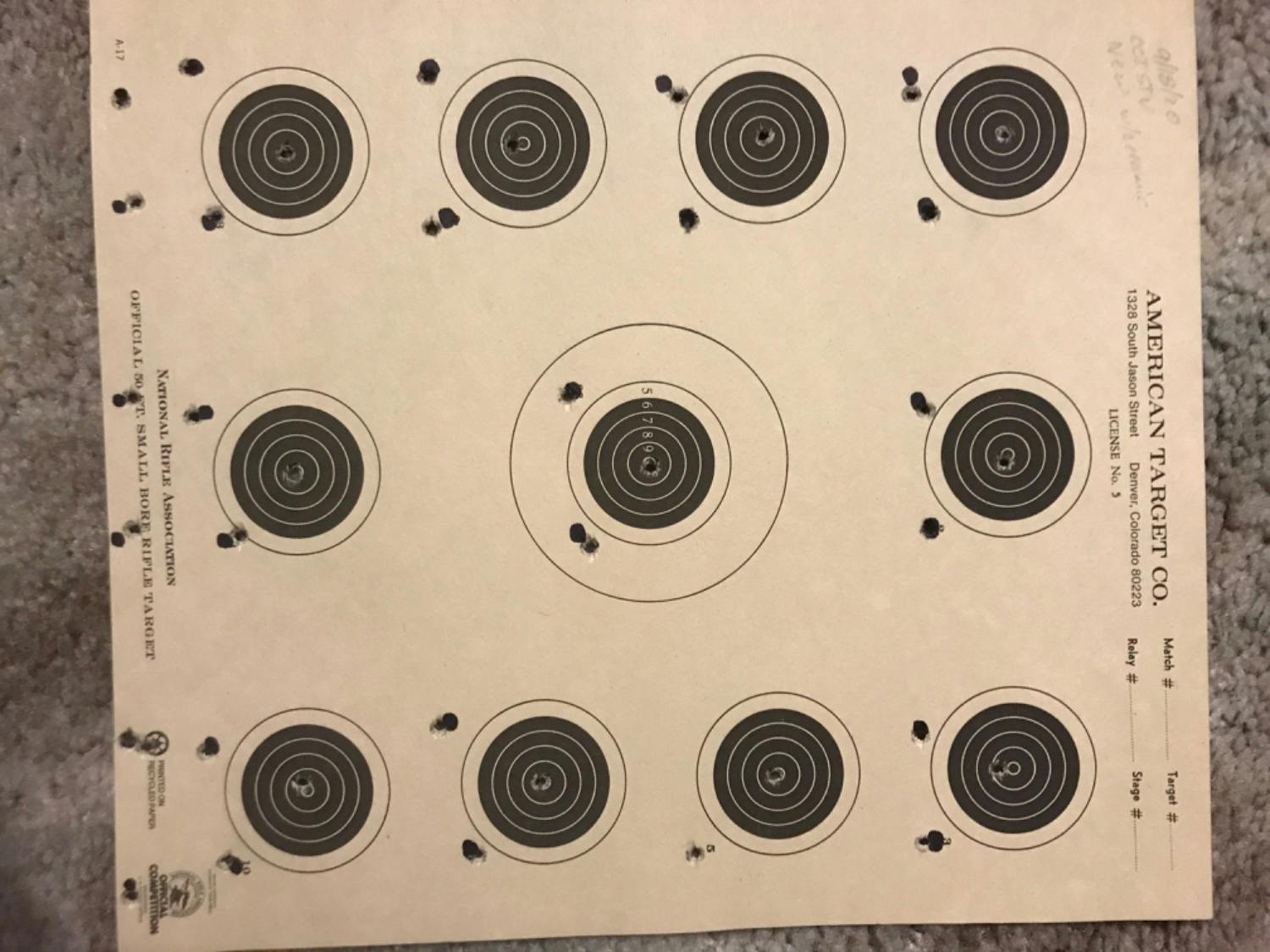
I shoot a good bit, anywhere from 150-350 rounds a week. This is the only treatment that I’ve had to reset my zero on my scopes. It took about 10-15 shots to really get a real tight pattern on my bullseye. I was at first hitting high which means I was getting better velocities. Although that’s wonderful in itself the thing that I was so surprised at was how smooth my action is. I treated the inside of my barrel of course but also did my receiver and bolt and all moving parts.
My semiautomatic are like they are made from glass. So smooth. My bolt actions are as well. I treated one of my semi auto pistols an XD and also treated all moving parts and barrel. It has thousands of rounds threw it and it didn’t feel this smooth when it was new.
Time will tell if it holds up but from a month of shooting I am very impressed with this product. Your weapon doesn’t have really any excess oil or grease to get dirty which is very nice when ya go to clean them after a good shooting session. There’s just not much to clean. Maybe a little powder residue and that’s it and it just wipes off. I’m amazed.