Cerma
Ceramic Engine Protection Built for High-RPM Motorcycle Duty Cycles
Ceramic Engine Protection Built for High-RPM Motorcycle Duty Cycles
Couldn't load pickup availability
Ceramic Engine Protection Built for High-RPM Motorcycle Duty Cycles
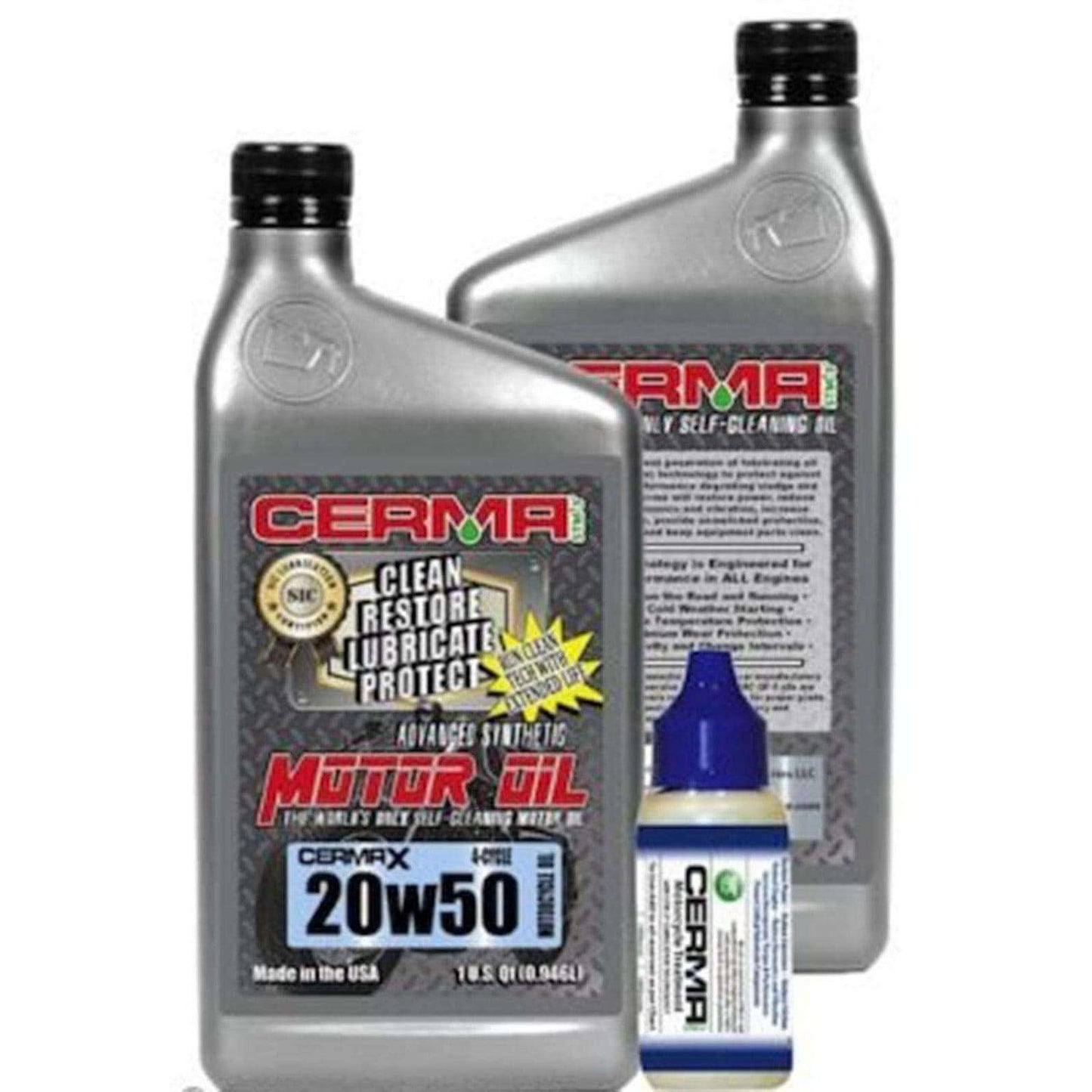
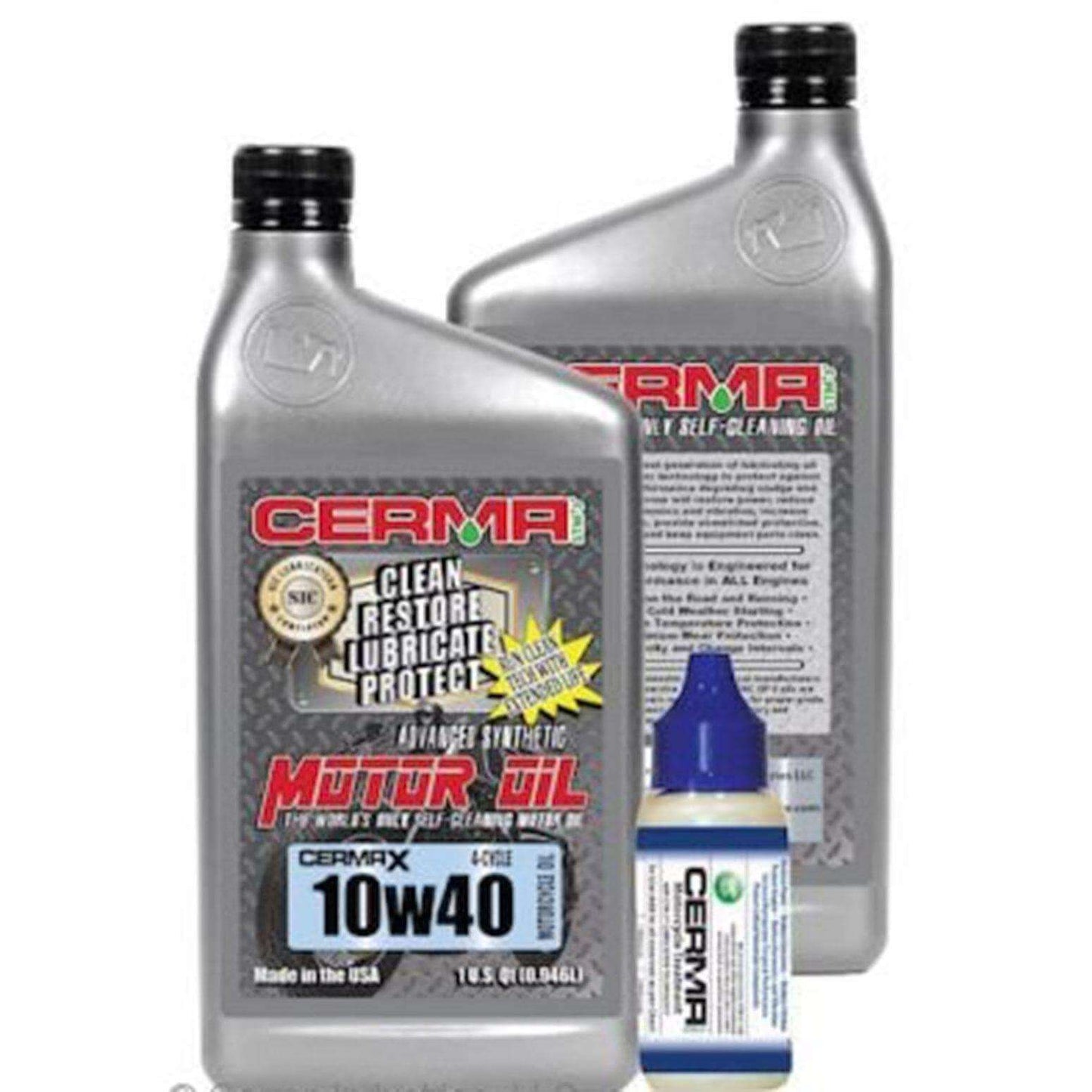
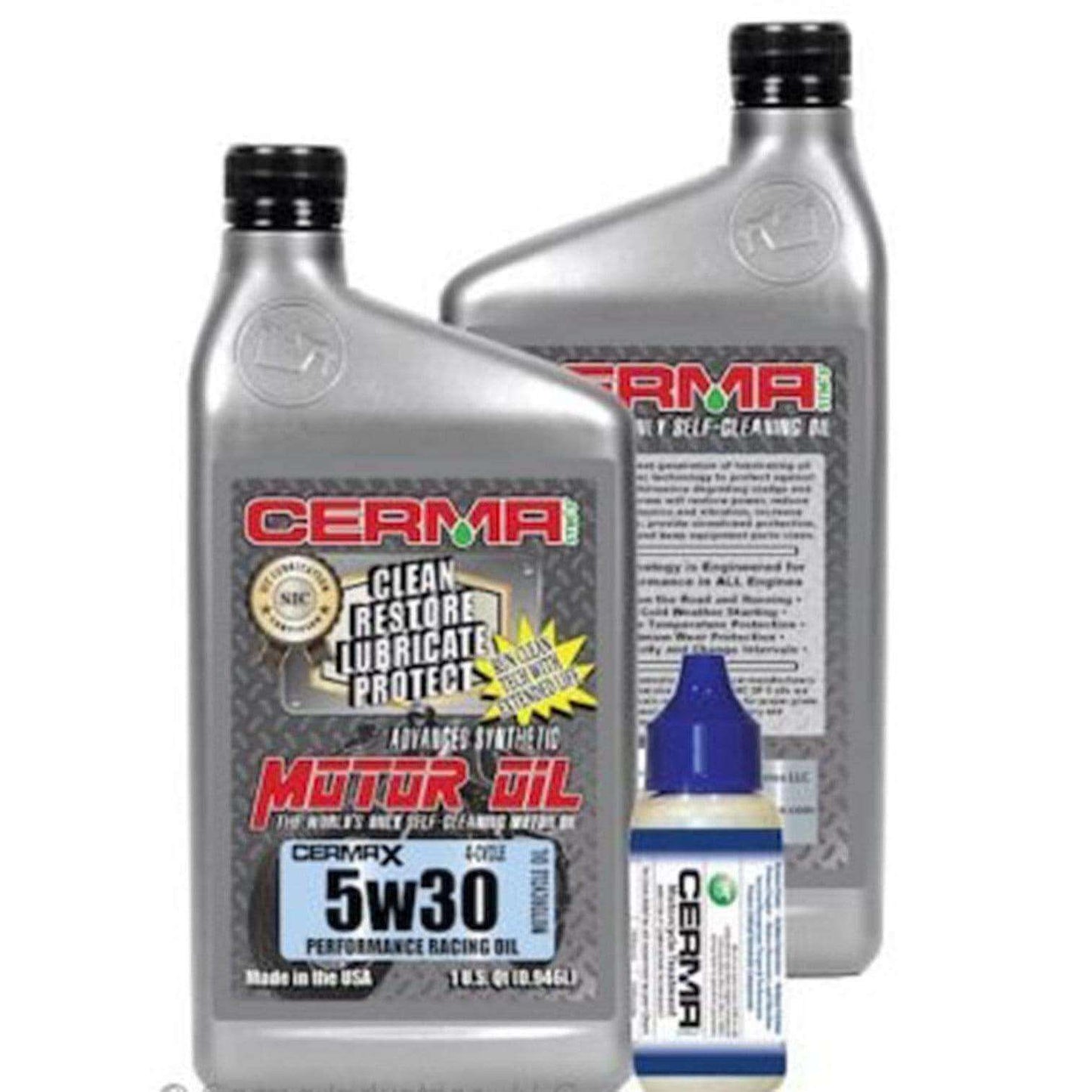
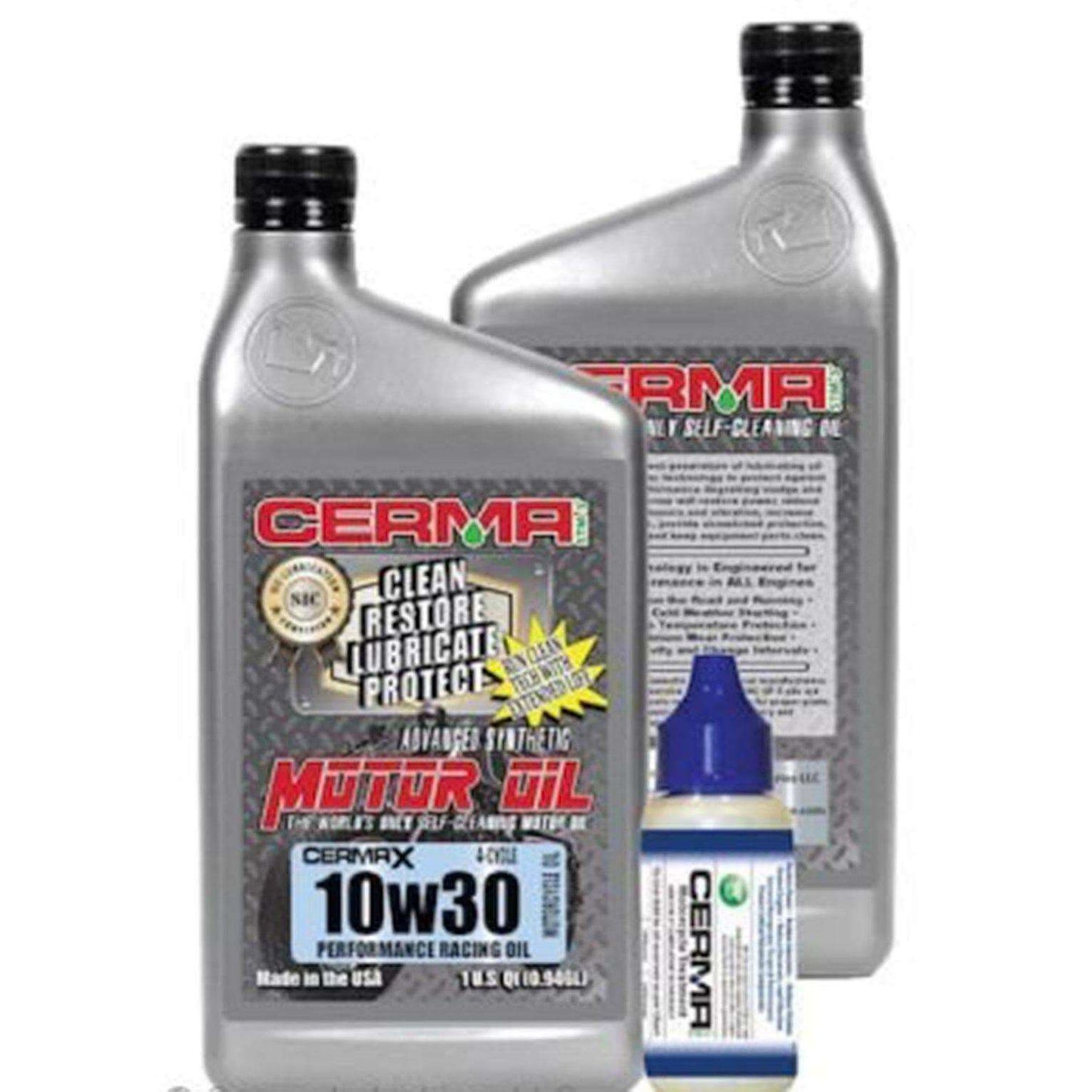
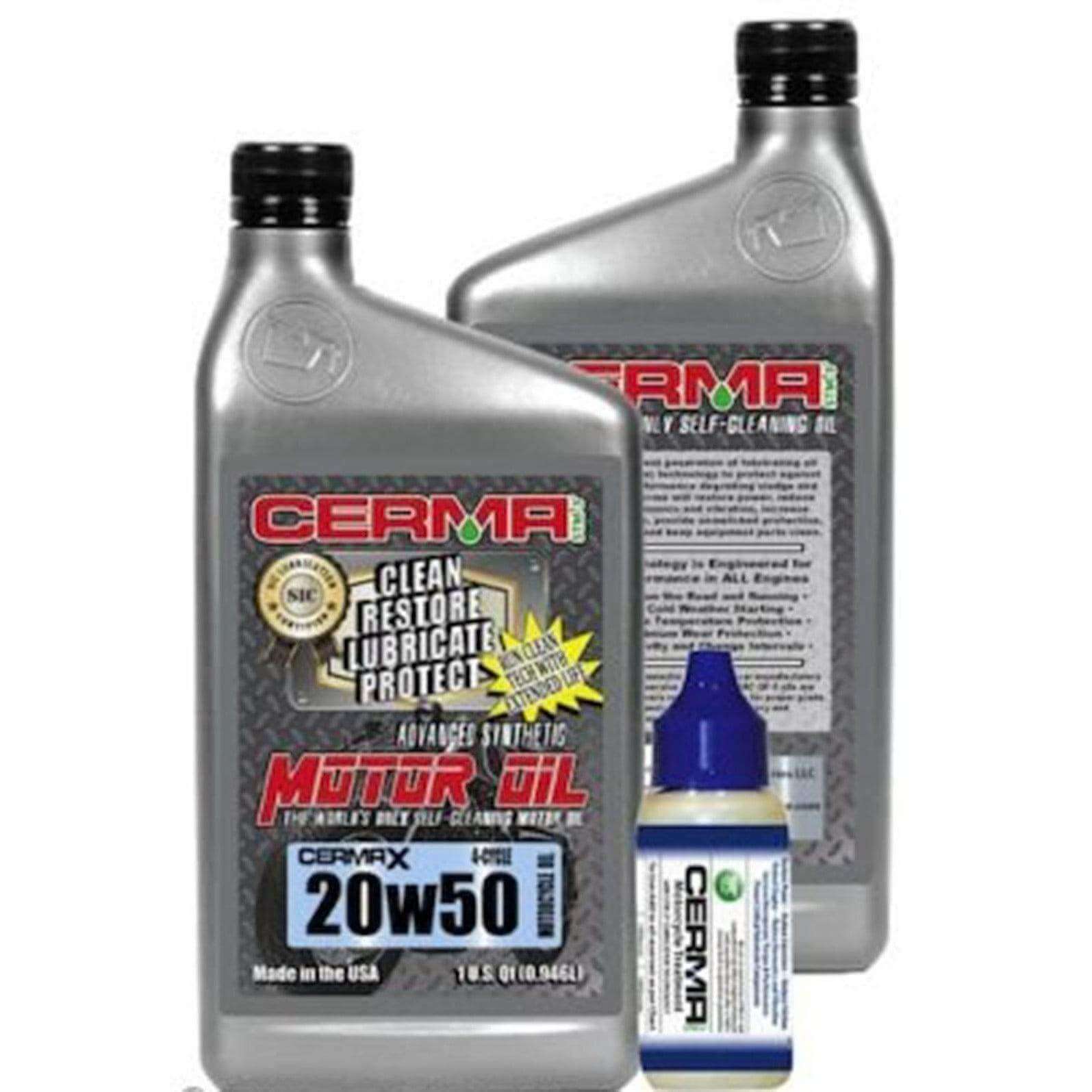
The Cerma Ceramic Synthetic Oil Value Package for Motorcycles combines Cerma STM-3® Motorcycle Engine Treatment (1.25 oz) with Cermax Ceramic Synthetic Motorcycle Oil (2–5 quarts) in your choice of four motorcycle viscosities — 20W-50, 10W-40, 5W-30, or 10W-30. Engineered specifically for the high-RPM, high-heat, wet-clutch operating environment of modern motorcycles. JASO-MA–friendly formulation means no clutch slip on shared-sump machines. Made in the USA by Bijou Inc. in Fort Myers, FL.
Covers air-cooled and liquid-cooled engines, V-twins and inline-fours, Harley-Davidson and Indian cruisers, Japanese sport bikes, European adventure tourers and standards.
What's Included
| Product | Size | Purpose |
|---|---|---|
| Cerma STM-3® Motorcycle Engine Treatment | 1.25 oz (single bottle) | One-time ceramic bonding, sized for motorcycle engine displacement. Nano Silicon Carbide permanently bonds to cylinder walls, pistons, rings, bearings, and cam lobes. Mohs 9.5 hardness, 2,730°C melting point, survives oil changes. Wet-clutch safe. |
| Cermax Ceramic Synthetic Motorcycle Oil | 2–5 quarts | SiC-enhanced synthetic motorcycle oil in your choice of 20W-50, 10W-40, 5W-30, or 10W-30. Formulated to meet JASO MA/MA2 wet-clutch compatibility requirements and API SP performance specifications. Delivers fresh ceramic particles with every oil change. |
Choose Your Viscosity
| Viscosity | Best For |
|---|---|
| 20W-50 Value Package | Air-cooled V-twins (Harley-Davidson Milwaukee-Eight, Twin Cam, Sportster, Evolution; Indian Thunderstroke 111/116, PowerPlus); hot-climate riding; heavy touring and two-up loads. Maximum film strength under sustained high engine temperature. |
| 10W-40 Value Package | Most sport bikes, standards, and adventure bikes — Japanese inline-fours (CBR, GSX-R, YZF-R, ZX-series), European parallel-twins and triples (Triumph, KTM, BMW R-series), and most modern liquid-cooled streetbikes. The most-versatile year-round choice. |
| 5W-30 Value Package | Newer liquid-cooled lightweight and mid-weight motorcycles specifying low-viscosity formulations; cold-climate touring and daily commuting; scooters and small-displacement bikes where cold-start protection matters. |
| 10W-30 Value Package | Touring motorcycles and mid-weight bikes in moderate climates; some BMW boxer and Japanese touring applications. Balanced protection with improved cold-start behavior vs. 10W-40. |
Always match the viscosity specified in your owner's manual or on your engine oil fill cap — your OEM has engineered the valve train, cam timing, and clutch plate package around a specific viscosity range. Running outside spec can affect wet-clutch behavior, cold-start oil pressure, and in some cases warranty coverage.
How STM-3 Nano Silicon Carbide Works
A catalyst, not an additive. Cerma's STM-3 technology undergoes a thermo-chemical bonding reaction with ferrous engine metal during normal riding under operating temperature and pressure. The nano-sized SiC particles chemically bond to cylinder walls, pistons, rings, bearings, and cam lobes — creating a permanent, self-healing ceramic layer with Mohs 9.5 hardness (harder than cast iron or hardened steel) and a melting point of 2,730°C. Because the bond is chemical, it does not wash out with oil changes. One-time application for the life of the engine. EPA ETV certified.
Cermax Ceramic Synthetic Motorcycle Oil carries additional SiC technology in suspension, delivering continuous ceramic reinforcement with every oil change while maintaining JASO MA/MA2 wet-clutch compatibility.
📋 The Cerma Protocol — How to Apply
Motorcycle Application — Street, Touring, Sport, Cruiser, Adventure
| Step | Action |
|---|---|
| 1 | Bring your motorcycle to full operating temperature — ride for 10–15 minutes under normal conditions, then return to idle. |
| 2 | With engine idling, add the 1.25 oz Cerma STM-3 Motorcycle Engine Treatment directly to the oil fill port, into your existing engine oil. |
| 3 | Ride the motorcycle for 15–20 minutes immediately after adding — varied speeds, a mix of city and highway is ideal for even distribution. |
| 4 | Continue normal riding for a minimum of 500 miles on your existing oil to allow full SiC ceramic bonding. Do not change oil during this period. Do not add any other oil additives. |
| 5 | At the next oil change (after 500+ miles), drain old oil and refill with Cermax Ceramic Synthetic Motorcycle Oil in the specified viscosity and quantity for your bike. |
| 6 | The ceramic layer continues to refine over approximately 90 days of typical riding. Peak performance state is reached after this cure period. |
| 7 | Ongoing: Continue Cermax motorcycle oil changes at your manufacturer's recommended intervals. The STM-3 treatment is one-time — no need to repeat. |
Compatible Motorcycle Platforms
| Make & Family | Typical Models |
|---|---|
| Harley-Davidson | Sportster (Evolution, Revolution Max 1250), Softail, Touring (Road King, Road Glide, Street Glide, Electra Glide), CVO, Dyna, Fat Boy — Milwaukee-Eight 107/114/117, Twin Cam 88/96/103/110 |
| Indian | Scout, Chief, Chieftain, Roadmaster, Challenger, Pursuit, Springfield — Thunderstroke 111/116, PowerPlus 108 |
| Honda | CBR series (600RR, 1000RR, 300R), CB series, Gold Wing, Africa Twin, Rebel, Shadow, Fury, VTX, Valkyrie |
| Yamaha | YZF-R series (R1, R6, R3), MT/FZ series, Tenere 700/1200, Star/V-Star cruisers, VMAX, Bolt, Super Tenere |
| Kawasaki | Ninja series (ZX-10R, ZX-6R, ZX-14R, 400, 650), Z series, Versys, Vulcan cruisers, Concours |
| Suzuki | GSX-R (600, 750, 1000), GSX-S, V-Strom 650/1050, Hayabusa, Boulevard cruisers, DR-Z, SV650 |
| BMW | R-series (R 1250 GS / GSA / RT / R, R nineT), S 1000 RR, S 1000 XR, F-series, K-series (K 1600), C-series scooters |
| European | Ducati (Panigale, Monster, Multistrada, Diavel, Scrambler), Triumph (Street Triple, Speed Triple, Tiger, Bonneville, Rocket 3), KTM (Duke, Adventure, RC), Aprilia, Moto Guzzi, Husqvarna |
| Engine Configurations | V-Twin (45°, 60°, 90°), Inline-4, Inline-3, Parallel-Twin, Single-Cylinder, Opposed-Twin (BMW boxer) — air-cooled, oil-cooled, and liquid-cooled platforms all compatible |
Not sure if your motorcycle qualifies, or if the wet-clutch configuration in your specific model matches our JASO MA formulation? Call 239-344-9861 or email info@cermatreatment.com with your year, make, and model.
Typical Motorcycle Oil Capacities
| Motorcycle Category | Typical Oil Capacity |
|---|---|
| Harley-Davidson Touring (M8, TC, Evo) | 4–5 quarts (unified sump); M8 separated engine/trans sumps are smaller per-sump — check owner's manual |
| Harley-Davidson Sportster / Softail | 3–3.5 quarts |
| Indian Thunderstroke / PowerPlus | 5.5–6 quarts |
| Sport Bike Inline-4 (CBR1000RR, GSX-R1000, ZX-10R, R1) | 3.5–4 quarts with filter change |
| Mid-Size Standard / Naked (MT-07/09, Z650/900, CB650R) | 2.5–3.5 quarts |
| BMW R 1250 GS / GSA | 4 quarts |
| Honda Gold Wing 1800 | 4.6 quarts |
| Adventure Mid-Twin (Africa Twin, Tiger 900, V-Strom 650) | 3.5–4.5 quarts |
| Small-Displacement / Scooter | 1.5–2 quarts |
Always verify against your owner's manual. Consider ordering 1 extra quart for between-change top-offs, especially on high-mileage bikes.
Add More Protection (Optional)
- Cerma Gasoline Fuel Treatment — 6-in-1 ceramic fuel-system protection; keeps injectors and intake valves clean on fuel-injected motorcycles
- Cerma Transmission Treatments — for motorcycles with transmission sumps separated from the engine (specific Harley-Davidson Milwaukee-Eight configurations)
- Cerma Gear Box & Axle Treatment — for shaft-drive motorcycles (BMW boxer, Honda Gold Wing, Yamaha V-Star) — ceramic protection for the final drive
Frequently Asked Questions
No — this is the question most motorcycle owners ask first, and the short answer is that both the STM-3 treatment and Cermax motorcycle oil are formulated for wet-clutch compatibility. Technically, Cermax motorcycle oil is formulated to meet JASO MA/MA2 — the Japanese Automotive Standards Organization specification that defines the coefficient-of-friction window wet-clutches need for normal engagement and disengagement. The SiC ceramic technology in the STM-3 treatment bonds specifically to ferrous metal surfaces (engine steel and cast iron), and the friction plates in your wet clutch are made from organic/composite materials that don't react with SiC. So the ceramic layer builds up on the engine internals where it protects against wear, without depositing on the clutch friction plates where it would cause slip. This is one of the key functional differences between SiC ceramic technology and PTFE/Teflon-based additives, which do deposit slippery film on clutch plates and are the reason motorcycle owners have been told to avoid "engine oil additives" for decades. Cerma is a fundamentally different technology.
Harley-Davidson Milwaukee-Eight, Twin Cam 88/96/103/110, and Sportster models have separate sumps for the engine, transmission (primary case), and in some configurations a third primary chaincase. Each uses different lubricant and each has its own capacity. This 1.25 oz motorcycle engine treatment is sized for the engine oil sump only — add it to your engine oil through the engine oil fill port per the protocol. For the transmission, use a separate Cerma Transmission Treatment dosed to the transmission's oil capacity (typically 2 oz for motorcycle transmissions). For the primary chaincase on Sportsters and certain touring models, do not treat the primary oil — it's a dedicated gear oil specification that interacts with the clutch plates directly, and our motorcycle engine treatment is not formulated for primary chaincase use. Follow OEM specification for primary oil. Unsure about which sumps you have on your specific model? Call 239-344-9861 with your year and model.
Honest expectation-setting: the most meaningful and repeatable effect of the Cerma protocol on an air-cooled V-twin is reduced internally-generated friction heat, which translates to lower oil and cylinder-head temperatures under sustained operation. Typical measured results on a Harley Milwaukee-Eight or Twin Cam running the full protocol: 10–20°F reduction in rear-cylinder head temperature under summer stop-and-go conditions, and 5–15°F reduction in oil temperature at sustained highway speed. These aren't dramatic numbers, but on an air-cooled engine where 230°F cylinder head temperature is a real thermal ceiling, even 10°F of margin is meaningful for engine longevity. What Cerma will not do: fix a root-cause cooling problem from exhaust restriction, poor tuning, or a clogged oil cooler. If your bike is running abnormally hot and you've always suspected a maintenance issue, address that first — then layer Cerma on top of a mechanically healthy engine to extend its thermal margin.
Always match your owner's manual specification — motorcycle OEMs engineer the cam timing, valve train, and clutch package around a specific viscosity range, and running outside spec affects cold-start oil pressure, wet-clutch behavior, and warranty standing. Typical matches: 20W-50 for Harley-Davidson air-cooled V-twins, Indian Thunderstroke, older Triumph Bonnevilles, and hot-climate cruiser use; 10W-40 for the majority of Japanese sport bikes and standards (CBR, GSX-R, YZF-R, ZX-series), most BMW R-series and F-series, and a wide range of European bikes — the single-most versatile motorcycle viscosity; 5W-30 for specific newer liquid-cooled bikes that call for lower viscosity (check your manual; don't assume), scooters, and cold-climate commuting; 10W-30 for certain touring bikes and mid-weight applications in moderate climates. When in doubt, 10W-40 is the safest default across the broadest set of modern motorcycles, but never override an explicit OEM specification.
The Cerma STM-3 bonding reaction is driven by operating temperature, pressure, and fluid circulation. Motorcycles reach full operating temperature much faster than cars (smaller oil capacity relative to combustion heat, less thermal mass to warm up), they sustain higher RPMs for longer periods during typical riding, and the smaller oil volume means the full oil charge circulates through the engine's friction surfaces much more rapidly per mile. The result is a faster, more efficient bonding reaction than in a larger passenger-car engine — 500 miles of typical mixed riding provides enough total exposure for full SiC ceramic bonding in a motorcycle engine. That said: if your riding is primarily very short local rides where the engine barely reaches operating temperature before you shut it off, extend the break-in distance or include some highway riding during this period. Engines that don't reach full operating temperature don't bond efficiently regardless of mileage counted.
Yes, with some practical notes. The SiC ceramic layer is mechanically and thermally superior to any film additive approach — it doesn't break down at track-day oil temperatures (Mohs 9.5 hardness, 2,730°C melting point) and doesn't lose load-carrying capacity under sustained high RPM. High-compression engines, forced-induction (rare on motorcycles, but present on supercharged Kawasaki H2 and some custom builds), and aftermarket-tuned engines all benefit from reduced friction and the wear-protection side of the technology. Two operational notes for track riders: (1) oil change intervals should match your track schedule and the OEM's severe-service recommendation, not the 30,000-mile figures that appear on our car-focused diesel packages — track duty is severe service; (2) always use the correct viscosity for your specific tuned engine (a high-compression engine running 20W-50 in summer heat is different from a stock engine in moderate climate). If you're unsure about your tuned or modified setup, call 239-344-9861 before ordering.
Yes — high-mileage touring bikes are among the best candidates for the Cerma protocol. Engines with 50K, 75K, or 100K+ miles have accumulated wear on cylinder walls, bearings, and cam lobes. The ceramic bonding reaction still works on that accumulated wear surface and typically produces the most noticeable rider-perceivable change: smoother idle, reduced valve train noise, modestly improved fuel economy, lower operating temperature, and reduced oil consumption between changes. Realistic expectations: Cerma reduces friction and slows further wear — it will not restore compression lost to mechanical damage (scored cylinder walls, damaged rings, worn valve guides). If your bike is mechanically healthy but showing age, expect meaningful extended service life. If it's showing active mechanical distress (blue smoke, high oil consumption, rattling top-end), diagnose and repair the root cause before treating. Cerma is an extend-service-life technology, not a rebuild substitute.
Cermax Ceramic Synthetic Motorcycle Oil is formulated to meet API SP performance requirements along with JASO MA/MA2 wet-clutch friction standards. API SP is the current top-tier API passenger-car engine oil classification and is compatible with the performance envelope of modern motorcycle engines. If your motorcycle owner's manual calls for a specific OEM approval beyond API SP — for example, some BMW models specify proprietary BMW approvals, some KTM off-road models specify specific off-road racing standards — contact us at 239-344-9861 with your year/make/model and we'll confirm whether Cermax is appropriate for your specific OEM specification. For the vast majority of street motorcycles requiring JASO MA/MA2 + API SM/SN/SP-class performance, Cermax is a direct fit.
Made in the USA by Cerma Treatment (Bijou Inc.), 15880 Summerlin Road #300 Box #301, Fort Myers, FL 33908. 30-day return policy. Free shipping on orders over $150. Ships to US & Canada. Questions? Call 239-344-9861 or email info@cermatreatment.com. Use discount code C10 for 10% off.
Cerma STM-3® is a registered trademark of Bijou Inc. SiC (Silicon Carbide) technology is EPA ETV certified. Cermax Ceramic Synthetic Motorcycle Oil viscosities 20W-50, 10W-40, 5W-30, and 10W-30 are formulated to meet applicable API SP performance specifications and JASO MA/MA2 wet-clutch friction standards. Cermax motorcycle oil is designed for motorcycle engines treated per the Cerma protocol; use in untreated engines is permitted but does not provide the full performance benefit of the system. The STM-3 Motorcycle Engine Treatment is formulated for motorcycle engine applications using JASO MA/MA2-compatible motorcycle oil; it is not formulated for primary chaincase use on Harley-Davidson Sportster and certain touring configurations that use dedicated primary oil. Cerma products are not repair compounds and cannot correct pre-existing mechanical failures such as scored cylinders, damaged rings, worn valve guides, or failed bearings. Always match the viscosity specified in your owner's manual for your specific motorcycle model, year, and climate. Individual results vary based on motorcycle condition, duty cycle, riding style, and climate.
Frequently Asked Questions
The package includes Cerma STM-3 Motorcycle Engine Treatment (1.25 oz single bottle), correctly sized for motorcycle engine displacement, plus 2 to 5 quarts of Cermax Ceramic Synthetic Motorcycle Oil in your choice of four viscosities: 20W-50, 10W-40, 5W-30, or 10W-30. Cermax motorcycle oil is formulated to meet API SP performance specifications and JASO MA/MA2 wet-clutch friction standards, ensuring full compatibility with shared-sump motorcycle designs. Use the Size dropdown to select viscosity and the Oil Quantity dropdown to select quarts. Made in the USA by Bijou Inc. in Fort Myers, FL.
Four motorcycle-grade viscosities are offered, all formulated to meet API SP and JASO MA/MA2 specifications: 20W-50 (air-cooled V-twins — Harley-Davidson, Indian, older Triumph; hot climates; heavy touring); 10W-40 (the most versatile motorcycle viscosity — sport bikes, standards, adventure bikes across Japanese and European platforms; year-round protection in most conditions); 5W-30 (newer liquid-cooled lightweights, scooters, and cold-climate commuting); 10W-30 (touring bikes and mid-weights in moderate climates). Always match the viscosity specified in your owner's manual or on the oil fill cap — motorcycle manufacturers engineer cam timing, valve train, and wet-clutch packages around specific viscosity ranges, and running outside spec can affect performance and warranty standing.
Yes — wet-clutch compatibility is designed into the formulation from the ground up, not an afterthought. Cermax Motorcycle Oil is formulated to meet JASO MA/MA2, the Japanese Automotive Standards Organization specification that defines the coefficient-of-friction window wet clutches need for normal engagement. The SiC ceramic technology in the STM-3 treatment bonds chemically to ferrous engine metal surfaces only — not to the organic/composite friction material on wet-clutch plates. This is the key technical difference between Cerma's ceramic technology and older PTFE/Teflon-based oil additives, which deposit slippery film on clutch plates and cause clutch slip. The Cerma motorcycle package is safe for all wet-clutch configurations found on Harley-Davidson, Indian, and all Japanese and European motorcycle brands. If you have a dry-clutch motorcycle (certain BMW models, some Ducati, Moto Guzzi), the package is also fully compatible — dry-clutch oil doesn't touch the clutch at all, so compatibility is not a question.
Step 1: Ride your motorcycle for 10–15 minutes to reach full operating temperature, then return to idle. Step 2: Add the 1.25 oz Motorcycle Engine Treatment to your existing engine oil through the oil fill port while idling. Step 3: Ride for 15–20 minutes immediately after adding at varied speeds (a mix of city and highway is ideal) to distribute the SiC particles through the engine. Step 4: Continue normal riding for a minimum of 500 miles on your existing oil — this is the break-in period during which the SiC ceramic permanently bonds to your engine's metal surfaces. Do not change oil during this period and do not add any other additives. Step 5: At the next oil change after 500+ miles, drain old oil and refill with Cermax Ceramic Synthetic Motorcycle Oil in the correct viscosity and quantity for your bike. Step 6: Expect approximately 90 days of typical riding for the ceramic layer to reach its fully cured peak-performance state. Step 7: Ongoing — continue Cermax oil changes at your OEM-specified intervals. The engine treatment is one-time; no need to repeat.
In most cases, yes — with a couple of notes. Most ATVs, side-by-side UTVs, and personal watercraft use wet-clutch motorcycle-grade oil (JASO MA/MA2 spec) and are fully compatible with this package. Specific fits: ATVs with wet clutches (Honda Rubicon, Yamaha Grizzly/Kodiak, Can-Am Outlander, Polaris Sportsman 4×4 — many models use JASO MA motorcycle oil) — compatible. UTVs / side-by-sides (Polaris Ranger/RZR, Can-Am Defender/Maverick, Honda Pioneer, Yamaha Wolverine/Viking) — most use a dedicated side-by-side oil (some JASO MA-spec, some automotive-spec); check your owner's manual and match viscosity. Personal watercraft / jet skis (Sea-Doo, WaveRunner, Jet Ski) — 2-stroke models use specific 2-stroke oil and are not a fit for this 4-stroke motorcycle oil; 4-stroke PWC often use JASO MA motorcycle oil and are compatible. Not a fit: any 2-stroke engine (dirt bikes with 2-stroke engines, 2-stroke snowmobiles, 2-stroke outboards, 2-stroke PWC) — those require dedicated 2-stroke oil. When in doubt, match to OEM viscosity and JASO spec, and call 239-344-9861 with your specific machine.
Share