

Cerma
Reusable Applicator Tool for Cerma Blue Ice A/C & Refrigerant Treatment
Reusable Applicator Tool for Cerma Blue Ice A/C & Refrigerant Treatment
Couldn't load pickup availability
Reusable Applicator Tool for Cerma Blue Ice A/C & Refrigerant Treatment
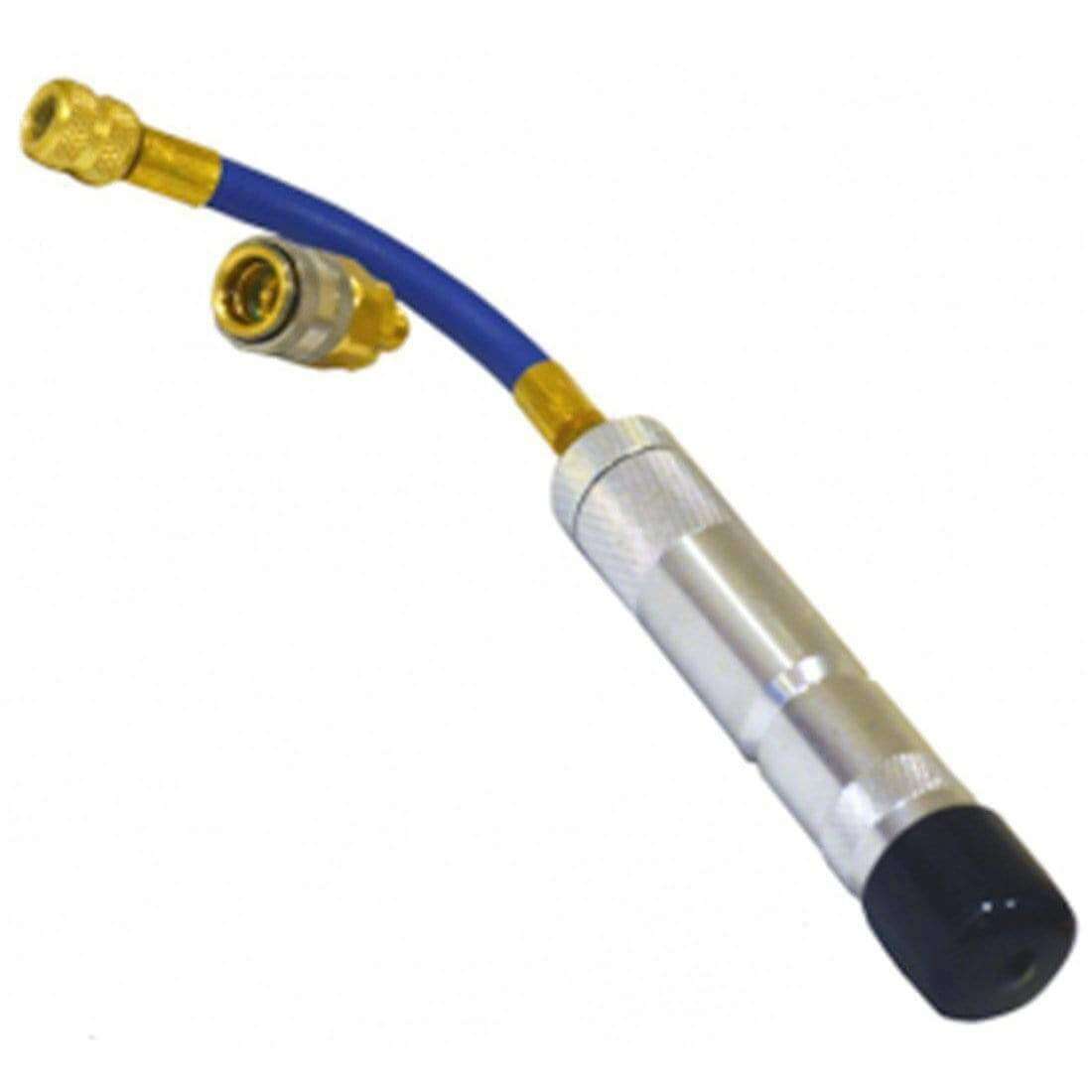
The A/C & Refrigerant Applicator Tool for Cerma Treatment is the reusable injection device for delivering Cerma Blue Ice A/C & Refrigerant Treatment into the refrigerant circuit of automotive A/C, residential HVAC, commercial HVAC, refrigeration, and marine A/C systems. Connects to the system's low-pressure (suction-side) service port and uses the system's normal operating suction pressure to draw the ceramic treatment into the refrigerant circuit during normal operation. Buy the tool once — reuse it for every future Cerma treatment application across any A/C or refrigeration system.
Single-piece reusable design with brass fittings and refrigerant-rated injection hose. MPN: ACTOOLC. Made in the USA by Bijou Inc. in Fort Myers, FL.
EPA Section 608 certification is required to handle refrigerants in residential/commercial HVAC and refrigeration systems including R-22, R-410A, R-454B, R-32, R-404A, R-407C, R-507, and most other HVAC/refrigeration refrigerants.
EPA Section 609 certification is required to purchase and handle motor vehicle A/C refrigerants (R-134a, R-1234yf) in container sizes larger than 2 pounds. Small DIY refrigerant cans (typically under 2 lb) sold at auto parts stores are exempt for individual consumer use on personal vehicles, but service businesses still require Section 609 certification.
If you do not hold appropriate EPA certification, have the Cerma Blue Ice treatment applied by a certified HVAC technician (residential/commercial systems) or a certified auto A/C service technician (vehicle systems) — most service shops will perform a treatment application as part of a routine service call. Most A/C shops are familiar with this kind of injection tool and the procedure takes only a few minutes during normal service.
What This Tool Does
- Reusable design — buy once — built for repeated use across multiple Cerma A/C treatment applications. Unlike single-use disposable applicators, the brass fittings and refrigerant-rated injection hose are designed for repeated service cycles.
- Connects to standard low-pressure service port — the suction-side service port on automotive A/C systems and the suction-line service port on residential and commercial HVAC and refrigeration systems. Note the port-fitting compatibility considerations in the FAQ below for R-1234yf and other newer refrigerant systems.
- Uses system's natural suction pressure — when the system is running at normal operating pressure, the low-side suction pressure draws the Cerma treatment from the applicator into the refrigerant circuit. No external pressure source required.
- Compatible with all sizes of Cerma Blue Ice treatment — works with the 1 oz automotive bottle, 2 oz semi-truck dose, 6 oz residential dose, and the 32 oz and 128 oz commercial/industrial sizes.
- Brass fitting construction — refrigerant-rated brass at the service port connection and treatment-side connection points. Flexible refrigerant-rated injection hose between the connection points.
- Made in the USA by Bijou Inc. in Fort Myers, FL.
The tool is the delivery mechanism. The actual ceramic treatment that goes into your A/C system is the separate product Cerma Blue Ice A/C & Refrigerant Treatment. For your first application you'll need both: the tool (this product) and the treatment (sold separately, available in 1 oz, 2 oz, 6 oz, 32 oz, and 128 oz sizes for different system capacities). For all future applications you only purchase additional treatment — the tool is reused.
👉 Buy Cerma Blue Ice A/C & Refrigerant Treatment here
Compatible System Types
| System Category | Examples |
|---|---|
| Automotive A/C | Cars, trucks, SUVs, vans, class 7/8 semi trucks. R-134a systems (1994–2016) and R-1234yf systems (2017+ — fitting compatibility note in FAQ #3). Compatible with Sanden, Denso, Delphi, Valeo, and OEM compressors. |
| Residential HVAC | Central air conditioning, heat pumps, mini-splits, window units, portable A/C. R-410A, R-22, R-454B, R-32 systems from Carrier, Trane, Lennox, Rheem, Goodman, York, Mitsubishi, Daikin, and other major brands. |
| Commercial HVAC | Rooftop packaged units, split systems, chillers, VRF/VRV systems, package units with scroll, reciprocating, screw, and centrifugal compressors. |
| Commercial Refrigeration | Walk-in coolers, walk-in freezers, reach-in coolers, display cases, supermarket refrigeration, ice machines, blast chillers. R-404A, R-407C, R-507, R-448A, R-449A systems. |
| Industrial Cooling | Process cooling, data center CRAC and CRAH units, cold storage warehouse refrigeration, large chillers — for largest industrial systems, additional fitting adapters may be required for specific service-port styles. |
| Marine & RV A/C | Boat A/C systems, yacht chillers, marine refrigeration, RV air conditioning, reefer trailers (refrigerated trucks). |
| Home refrigeration | Refrigerators, freezers, wine coolers, beverage coolers — note that residential refrigerators have smaller refrigerant charges and require less treatment volume; consult dosage guidance. |
The tool's standard low-side service-port connection works on the vast majority of A/C and refrigeration systems built since the 1990s. For specific compatibility questions on older legacy systems or specialty industrial systems with non-standard fittings, call 239-344-9861 before ordering.
📋 How to Apply Cerma Treatment Using This Tool
- Identify the low-pressure service port. On automotive systems: the suction-side fitting on the larger-diameter refrigerant line (typically a blue-capped service port; on R-134a systems uses a 13mm Schrader-style fitting; on R-1234yf systems uses a different physical fitting to prevent cross-contamination — see FAQ #3 for fitting differences). On residential/commercial HVAC: the suction-line service port (typically blue-capped or marked).
- Verify system condition. Confirm the A/C system is operational with normal refrigerant charge and no active leaks. The system needs to be running at normal operating pressure to draw treatment in. Treatment is not a refrigerant top-up; it goes into a properly-functioning system.
- Connect the applicator tool to the low-pressure service port using the quick-connect coupling. Verify the connection is secure before proceeding.
- Connect the Cerma Blue Ice treatment bottle to the applicator's treatment-side fitting. The 1 oz automotive bottle, 2 oz semi-truck size, 6 oz residential size, and larger commercial sizes all use compatible threaded connections.
- Start the A/C system and allow it to reach normal operating pressure. For automotive: A/C set to maximum cool, blower on high, engine at idle or slightly elevated RPM. For residential/commercial HVAC: system running in cooling mode at normal operating temperature.
- Open the applicator valve to inject the Cerma treatment. The system's suction-side pressure draws the ceramic treatment from the bottle through the applicator and into the refrigerant circuit. Allow the bottle to fully empty before closing the valve.
- Close the valve, disconnect the applicator from the service port, and replace the service-port cap. Run the A/C system normally for 15–20 minutes after application to allow the SiC ceramic particles to circulate through the system and begin bonding to compressor metal surfaces.
- Clean and store the applicator tool for future use. Keep stored in a clean dry environment between uses.
What You Need for Your First Application
1. This A/C & Refrigerant Applicator Tool ($65.00) — one-time purchase, reused for all future applications.
2. Cerma Blue Ice A/C & Refrigerant Treatment — sized for your system: 1 oz for typical automotive A/C, 2 oz for semi truck A/C, 6 oz for residential HVAC up to 6 tons, 32 oz for mid-size commercial HVAC up to 32 tons, 128 oz for industrial-scale systems up to 128 tons.
For subsequent applications (new vehicle, additional residential system, future home, additional fleet vehicle): only repurchase the treatment in the appropriate size — the applicator tool is reused.
Product Specifications
| Specification | Details |
|---|---|
| Product type | Reusable A/C and refrigerant treatment applicator tool |
| Purpose | Injects Cerma Blue Ice A/C & Refrigerant Treatment into refrigerant circuits via the system's low-pressure service port |
| Reusability | Designed for unlimited reuse across multiple Cerma treatment applications |
| Service-port connection | Standard low-pressure (suction-side) service port quick-connect |
| Construction | Brass fittings on connection points; refrigerant-rated injection hose |
| MPN | ACTOOLC |
| Treatment included | No — tool only. Treatment sold separately. |
| EPA certification status | Tool itself does not require certification to own; using the tool with refrigerant systems requires appropriate EPA Section 608 (HVAC) or Section 609 (motor vehicle A/C) certification under federal law |
| Country of origin | USA — manufactured by Bijou Inc., Fort Myers, FL |
Related Cerma Products
- Cerma Blue Ice A/C & Refrigerant Treatment — the ceramic treatment this tool applies (required companion purchase)
- Cerma STM-3 Engine Treatment — one-time ceramic engine protection for vehicles
- Cerma Ceramic Power Steering Fluid — ceramic protection for hydraulic power steering
- Cermax Ceramic Synthetic Motor Oils — extended-interval ceramic-enhanced engine oils
- Cerma Transmission Treatment — automatic and manual transmission ceramic protection
- Cerma Gas Fuel Treatment — fuel system protection for gasoline engines
Frequently Asked Questions
For most uses, yes — you need appropriate EPA certification to handle refrigerants under US federal law. The tool itself doesn't require certification to own, but the act of working with refrigerant systems is regulated. EPA Section 608 certification is required to handle refrigerants in residential/commercial HVAC and refrigeration systems — this includes R-22, R-410A, R-454B, R-32, R-404A, R-407C, R-507, and most HVAC/refrigeration refrigerants. EPA Section 609 certification is required to purchase and handle motor vehicle A/C refrigerants (R-134a, R-1234yf) in containers larger than 2 pounds — service technicians and shops require Section 609 certification. Small DIY refrigerant cans (typically under 2 lb) sold at auto parts stores are exempt for individual consumers performing service on their own personal vehicles, but this exemption is limited to top-up situations and doesn't authorize broader refrigerant work. If you don't hold appropriate certification: have the Cerma Blue Ice treatment applied by a certified HVAC technician (residential/commercial systems) or a certified auto A/C service technician (vehicle systems). Most service shops are familiar with this kind of injection procedure and will perform the application as part of a routine service call at reasonable cost. The tool stays with you and can be brought to any service shop you use, or kept for future use if you obtain certification later.
The tool's standard low-side service-port connection works with the vast majority of A/C and refrigeration systems built since the 1990s. Compatible categories: automotive A/C (cars, trucks, SUVs, vans, class 7/8 semi trucks — note R-1234yf fitting differences in FAQ #3); residential HVAC (central air, heat pumps, mini-splits, window units); commercial HVAC (rooftop units, split systems, chillers, package units, VRF/VRV); commercial refrigeration (walk-in coolers/freezers, display cases, ice machines, supermarket refrigeration); industrial cooling (process cooling, data center CRAC/CRAH, cold storage); marine A/C; RV A/C; reefer trailers; home refrigeration (with appropriate dosage scaling for smaller charge sizes). The tool fits standard low-pressure service ports on systems with Schrader-style suction-side fittings (most common automotive R-134a systems and most HVAC), with some fitting variations addressed below. For specialty industrial systems with proprietary or non-standard service ports, additional adapters may be required — call 239-344-9861 with your system's make/model before ordering if uncertain.
Important compatibility note. R-1234yf service ports use a different physical fitting than R-134a service ports — this is intentional, designed by automakers to prevent accidental cross-contamination between the two refrigerants. R-1234yf low-side fittings are physically larger than R-134a fittings. If your tool ships with an R-134a-style fitting (the most common automotive low-side service port standard from 1994 to 2016), you'll need an R-1234yf adapter to use the tool on 2017+ vehicles with R-1234yf systems. R-1234yf adapters are widely available from auto-parts retailers and HVAC supply houses. For R-454B and R-32 residential HVAC systems (2025+ HVAC equipment under EPA AIM Act), the service port fittings are typically standard 1/4" SAE flare or Schrader-style — broadly compatible with standard injection tools. Before ordering, confirm your specific system's service port type if you're unsure — call us at 239-344-9861 with your year/make/model (vehicle) or HVAC equipment make/model (home/commercial) and we can advise on whether additional adapters may be needed.
The tool is designed for unlimited reuse across multiple Cerma A/C treatment applications — buy once and use indefinitely. The brass fittings and refrigerant-rated injection hose are built for repeated service cycles. Realistic service life depends on use and storage — well-cared-for tools should provide many years of service. Best practices for tool longevity: clean the tool between uses (residue from refrigerant oil or treatment can build up over time), store in a clean dry environment, replace any fittings that show signs of wear or leakage. For HVAC contractors and auto A/C shops using the tool weekly or more frequently, periodic inspection of the hose and fitting condition supports continued reliable service. The tool is a one-time hardware purchase; ongoing cost is just the Cerma Blue Ice treatment for each new application.
No — this is the applicator tool only. The actual ceramic treatment that goes into your A/C system is the separate product Cerma Blue Ice A/C & Refrigerant Treatment, which is sold separately. For your first application, you need both: this tool (one-time purchase) plus the appropriate-size treatment for your system (1 oz for typical automotive A/C, 2 oz for semi truck, 6 oz for residential HVAC up to 6 tons, 32 oz for commercial up to 32 tons, 128 oz for industrial up to 128 tons). For all future applications, you only purchase additional treatment — this tool stays with you and is reused. The two-product structure mirrors how many service products work in the HVAC industry: tool is durable hardware, refrigerant-charge consumables are sold separately.
Several options. Option 1 — Have a certified technician perform the application. Most HVAC service companies (residential/commercial systems) and auto A/C shops (vehicle systems) will perform a Cerma Blue Ice application as part of a routine service call. Bring this tool plus the Cerma treatment with you; the procedure takes only a few minutes during normal service. Option 2 — Obtain EPA certification yourself. Section 608 certification requires passing a written exam (4 type-certifications available depending on what equipment you intend to service) — testing is offered by EPA-approved testing organizations and online providers; basic certification typically costs $25–$50 and provides lifetime certification valid across the US. Section 609 certification (for motor vehicle A/C only) is simpler — typically a self-study program followed by a written exam, with online options available for around $20. Certification is a one-time investment that lets you legally service your own vehicles' and home A/C indefinitely. Option 3 — Combine with regular maintenance. Many HVAC contractors will apply Cerma during a routine seasonal A/C service or filter change — schedule the application alongside service you were going to have done anyway, and the ceramic treatment installation cost is modest. For finding a certified technician — most ASE-certified A/C technicians at independent auto repair shops, dealership service departments, and HVAC contractors hold appropriate certification. Ask before scheduling.
Cerma Blue Ice is a one-time treatment per system. The SiC ceramic particles bond permanently to the compressor's internal metal surfaces during the first application; future refrigerant service or recharge events do not affect the ceramic protection. So for any single A/C system (your car, your home HVAC, your boat), you only need to apply Cerma Blue Ice once. You'd need the tool again for: treating a new vehicle (when you buy a different car), treating a new home A/C system (during a move or HVAC replacement), treating fleet additions, treating additional family or business vehicles, or treating commercial properties as you acquire them. For most individual consumers the tool gets used a few times across multiple systems — once for the car, once for the house, once for the boat, etc. — then sits in storage for occasional future use. For HVAC contractors, auto A/C shops, fleet operators, and marine service businesses, the tool gets used many times across customer systems — this is one of the most cost-efficient use cases since the per-application cost of the tool drops to essentially zero across many service jobs.
The tool is specifically designed and intended for Cerma Blue Ice A/C & Refrigerant Treatment application. Other refrigerant additive products (UV dye, oil enhancers, leak sealants from other manufacturers) may have different fitting standards, different injection requirements, or different chemical compatibility considerations. We can't make compatibility guarantees about non-Cerma products with this tool — and we strongly advise against attempting to inject any A/C "stop-leak" or "leak sealer" product (regardless of brand) into a system, as those products are widely associated with clogging orifice tubes and TXVs and damaging A/C systems. If you're considering using this tool with another product, verify with that product's manufacturer that the injection method and fitting compatibility match. For Cerma Blue Ice applications across all sizes (1 oz through 128 oz), this tool is purpose-built and reliable.
Made in the USA by Cerma Treatment (Bijou Inc.), 15880 Summerlin Road #300 Box #301, Fort Myers, FL 33908. 30-day return policy. Free shipping on orders over $150. Ships to US & Canada. HVAC contractor, auto A/C shop, marine service, and fleet account volume pricing available. Questions? Call 239-344-9861 or email info@cermatreatment.com. Use discount code C10 for 10% off.
Cerma STM-3® is a trademark of Bijou Inc. The A/C & Refrigerant Applicator Tool is sold as the application device for Cerma Blue Ice A/C & Refrigerant Treatment, which is sold as a separate product. EPA refrigerant handling regulations: in the United States, refrigerant handling on systems containing R-22, R-410A, R-134a, R-1234yf, R-454B, R-32, R-404A, R-407C, R-507, and other controlled refrigerants is regulated under the Clean Air Act (42 USC §7401 et seq.) and EPA implementing regulations (40 CFR Part 82). Working with refrigerants in residential and commercial HVAC and refrigeration systems generally requires EPA Section 608 certification (40 CFR 82.161); working with motor vehicle air conditioning generally requires EPA Section 609 certification (40 CFR 82.40), with limited exemptions for individual consumer use of small DIY refrigerant cans. Customers are solely responsible for compliance with applicable federal, state, and local refrigerant handling regulations. If you do not hold appropriate certification, have the Cerma Blue Ice treatment applied by a certified service technician — most HVAC contractors and auto A/C shops will perform the application as a routine service. Tool compatibility: the tool's standard low-pressure service-port connection is compatible with the vast majority of A/C and refrigeration systems built since the 1990s, but R-1234yf systems (2017+ US-sold vehicles) use different physical fittings than R-134a systems and may require an R-1234yf adapter (sold separately by auto-parts retailers); for non-standard or proprietary industrial system service ports, additional adapters may be required. Tool is not a refrigerant handling certification or substitute for certification. The tool is a delivery device; safe and legal use depends on operator certification, system condition, and proper handling practice. Third-party brand references (and refrigerant designations R-22, R-134a, R-404A, R-407C, R-410A, R-448A, R-449A, R-454B, R-507, R-1234yf, R-32; equipment manufacturer references including Sanden, Denso, Delphi, Mahle, Valeo, Carrier, Trane, Lennox, Rheem, Goodman, York, Mitsubishi, Daikin, and others) are trademarks of their respective owners and are used for compatibility identification only — Cerma is not affiliated with or endorsed by any of these manufacturers or refrigerant standards bodies.
Frequently Asked Questions
The A/C & Refrigerant Applicator Tool for Cerma Treatment is a reusable injection device designed to deliver Cerma Blue Ice A/C & Refrigerant Treatment into the refrigerant circuit of A/C and refrigeration systems. The tool connects to the system's low-pressure (suction-side) service port and uses the system's natural operating suction pressure to draw the ceramic treatment into the refrigerant circuit during normal A/C operation. Built for reuse — buy the tool once and use it for every future Cerma treatment application across any A/C or refrigeration system: car A/C, home HVAC, commercial systems, marine A/C, RV A/C, reefer trailers, refrigeration equipment, and more. Single-piece reusable design with brass fittings on the service-port and treatment-bottle connection points and refrigerant-rated injection hose between them. MPN: ACTOOLC. Made in the USA by Bijou Inc. in Fort Myers, FL. Tool sold separately from the Cerma Blue Ice treatment that it applies — for your first application you need both products; for subsequent applications you only repurchase the treatment in the appropriate size for your system. Important regulatory note: using the tool with refrigerant systems requires appropriate EPA Section 608 (residential/commercial HVAC) or Section 609 (motor vehicle A/C) certification under US federal law — if you don't hold certification, have a certified service technician perform the application.
The tool's standard low-side service-port connection works with the vast majority of A/C and refrigeration systems built since the 1990s. Automotive A/C: cars, trucks, SUVs, vans, class 7/8 semi trucks. R-134a systems (1994–2016) use the standard fitting; R-1234yf systems (2017+) use a different physical fitting and may require an R-1234yf adapter. Residential HVAC: central air conditioning, heat pumps, mini-splits, window units, portable A/C from all major manufacturers (Carrier, Trane, Lennox, Rheem, Goodman, York, Mitsubishi, Daikin, Fujitsu, LG). Compatible with R-410A, R-22, R-454B, and R-32 residential systems. Commercial HVAC: rooftop packaged units, split systems, chillers, VRF/VRV systems, package units. Commercial refrigeration: walk-in coolers, walk-in freezers, reach-in coolers/freezers, supermarket display cases, ice machines, blast chillers. R-404A, R-407C, R-507, R-448A, R-449A systems. Industrial cooling: process cooling, data center CRAC and CRAH units, cold storage warehouses, large chillers — for largest industrial systems with proprietary service ports, additional adapters may be required. Specialty applications: marine A/C, RV A/C, reefer trailers (refrigerated trucks), home refrigerators, freezers. The tool fits standard low-pressure service ports on systems with Schrader-style suction-side fittings (most common automotive R-134a systems and most HVAC equipment), with R-1234yf adapter availability addressed in the technical FAQ section above. Use the tool only with appropriate EPA certification for the refrigerant type involved.
Yes — the tool is designed for unlimited reuse across multiple Cerma A/C treatment applications. Buy the tool once and use it indefinitely across every future Cerma treatment application you perform. The brass fittings and refrigerant-rated injection hose are built for repeated service cycles. For HVAC contractors, auto A/C shops, fleet operators, and marine service businesses using the tool weekly or more frequently across customer systems, the per-application cost of the tool drops to essentially zero across many service jobs — making it one of the most cost-efficient applicator solutions in the market. For individual consumers, the tool typically gets used several times across personal systems (car, home, boat, family vehicles) over the course of years and then stays in storage for occasional future use. Tool care for longevity: clean the tool between uses (refrigerant oil residue and treatment residue can build up over many uses); store in a clean, dry environment; periodically inspect the hose and fittings for any signs of wear or leakage; replace fittings if they show damage. Well-maintained tools should provide many years of reliable service. For all subsequent Cerma treatment applications, you only purchase additional Cerma Blue Ice A/C & Refrigerant Treatment in the size appropriate to the system — the tool itself doesn't need to be repurchased.
Some kind of injection tool is required to deliver Cerma Blue Ice treatment into the refrigerant circuit through the low-pressure service port — Cerma Blue Ice cannot simply be poured into the system or added through any path other than the refrigerant circuit. You have a few options: (1) This Cerma applicator tool is purpose-built for Cerma Blue Ice application, ensuring proper fitting compatibility, clean treatment delivery, and a tool you can rely on for repeated use across systems. The recommended choice for first-time users and anyone planning to perform multiple applications. (2) Generic refrigerant injection tools from auto parts retailers or HVAC supply houses can work if they have appropriate low-side service-port fittings and connection compatibility with the Cerma treatment bottle threads — quality varies. (3) Manifold gauge sets used by HVAC technicians can be configured to inject treatments through the low-side connection if the technician is experienced with this kind of application. (4) Have a service shop apply it for you — most HVAC contractors, auto A/C shops, and marine A/C service businesses have appropriate tools and will perform the application during a routine service call; bring the Cerma Blue Ice treatment to your appointment and ask the technician to apply it during normal service. This is often the simplest path for first-time users without existing tools or EPA certification. For multi-system or high-volume use cases (HVAC contractors, fleet operators, marine service businesses), owning this dedicated Cerma applicator tool is the cost-effective approach.
The tool uses a simple, reliable injection process leveraging the A/C system's normal operating pressure. Basic operation: connect the applicator's quick-connect coupling to the system's low-pressure (suction-side) service port; connect the Cerma Blue Ice treatment bottle to the applicator's treatment-side fitting; start the A/C system and let it reach normal operating pressure (suction-side typically 25–50 psi on automotive systems, similar pressure ranges on HVAC); open the applicator valve to allow the treatment to flow. The system's natural suction pressure does the work — when the compressor is running, the low-side pressure draws the Cerma treatment from the bottle through the applicator and into the refrigerant circuit, where it joins the circulating refrigerant and oil. No external pressure source, vacuum pump, or special equipment required — just a running A/C system and the tool. Once the treatment bottle is empty, close the applicator valve, disconnect from the service port, and replace the service-port cap. Allow the A/C system to run normally for 15–20 minutes after application — the SiC ceramic particles in the Cerma treatment circulate with the refrigerant and begin the thermo-chemical bonding process to compressor metal surfaces. The full ceramic protective layer develops over the first several days of normal A/C use. The tool is then cleaned and stored for future applications. Detailed step-by-step procedure is provided in the application instructions on this page. The procedure is straightforward for technicians familiar with refrigerant service work; for non-certified individuals, have a certified HVAC or auto A/C technician perform the application.
Share

Frequently Asked Questions
Not used it yet I'm sure it's great I need to get the treatment