Cerma
Premium Synthetic 4-Stroke Motorcycle Oil with STM-3® Ceramic Technology
Premium Synthetic 4-Stroke Motorcycle Oil with STM-3® Ceramic Technology
Couldn't load pickup availability
Premium Synthetic 4-Stroke Motorcycle Oil with STM-3® Ceramic Technology
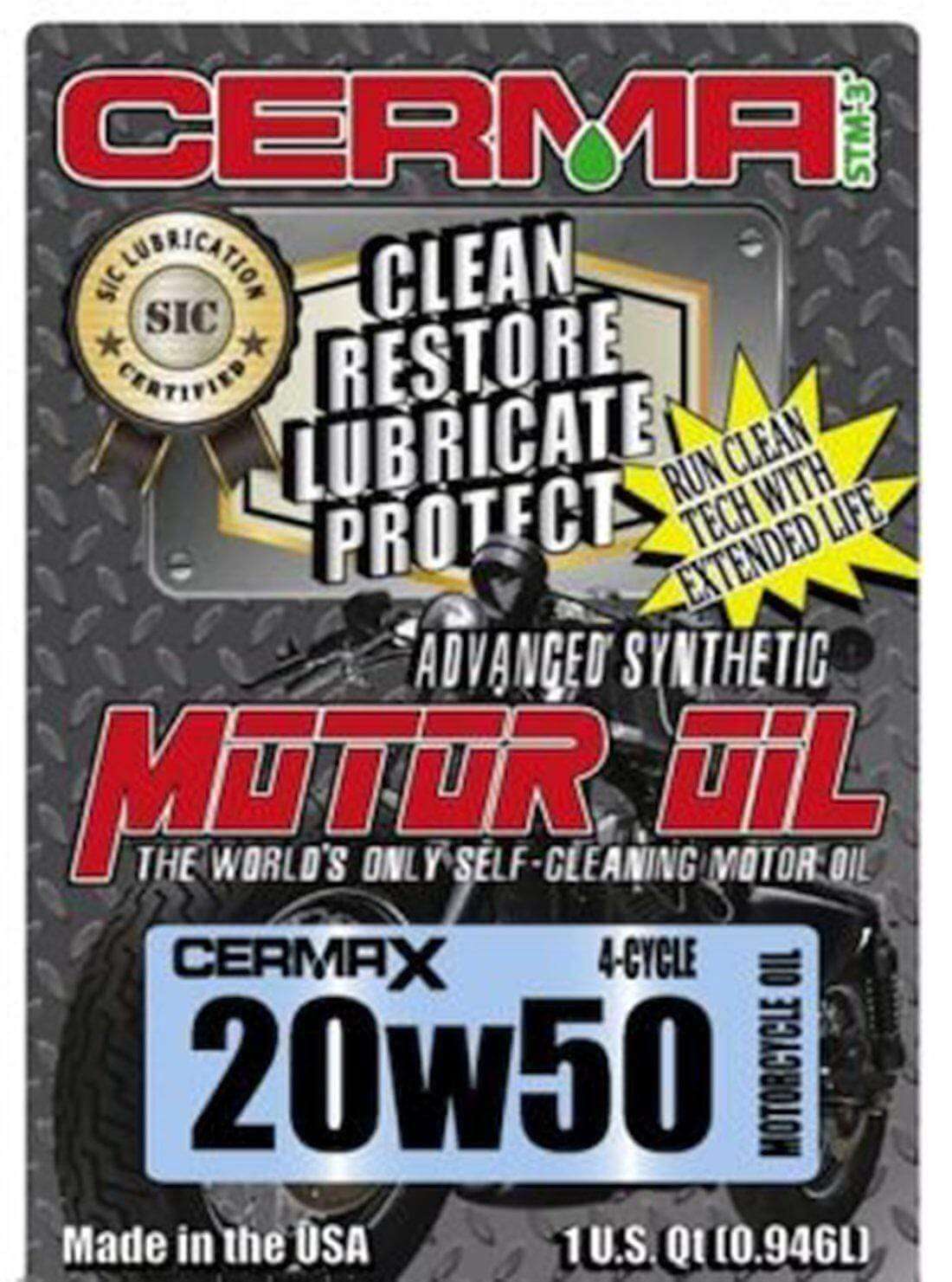
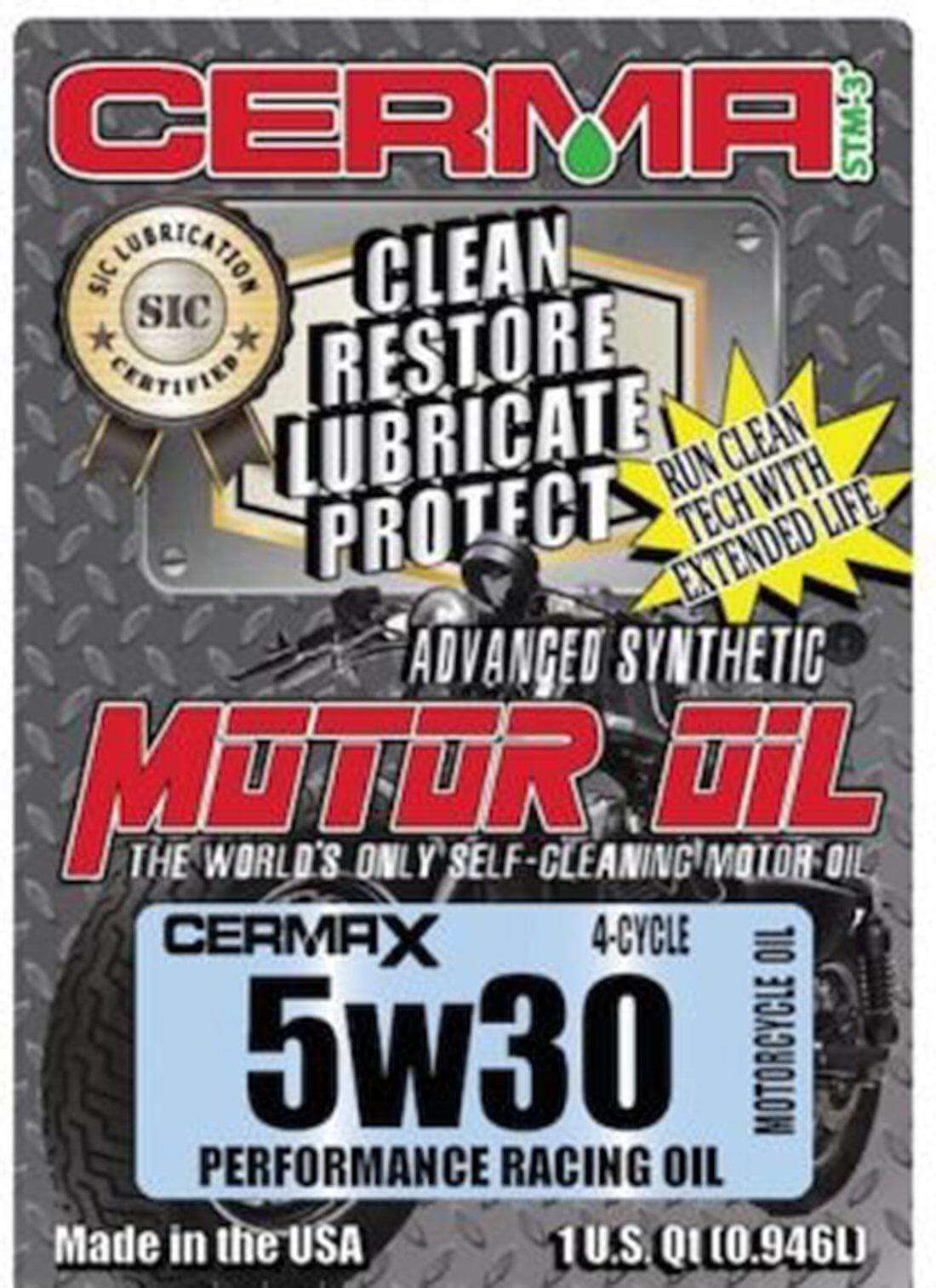
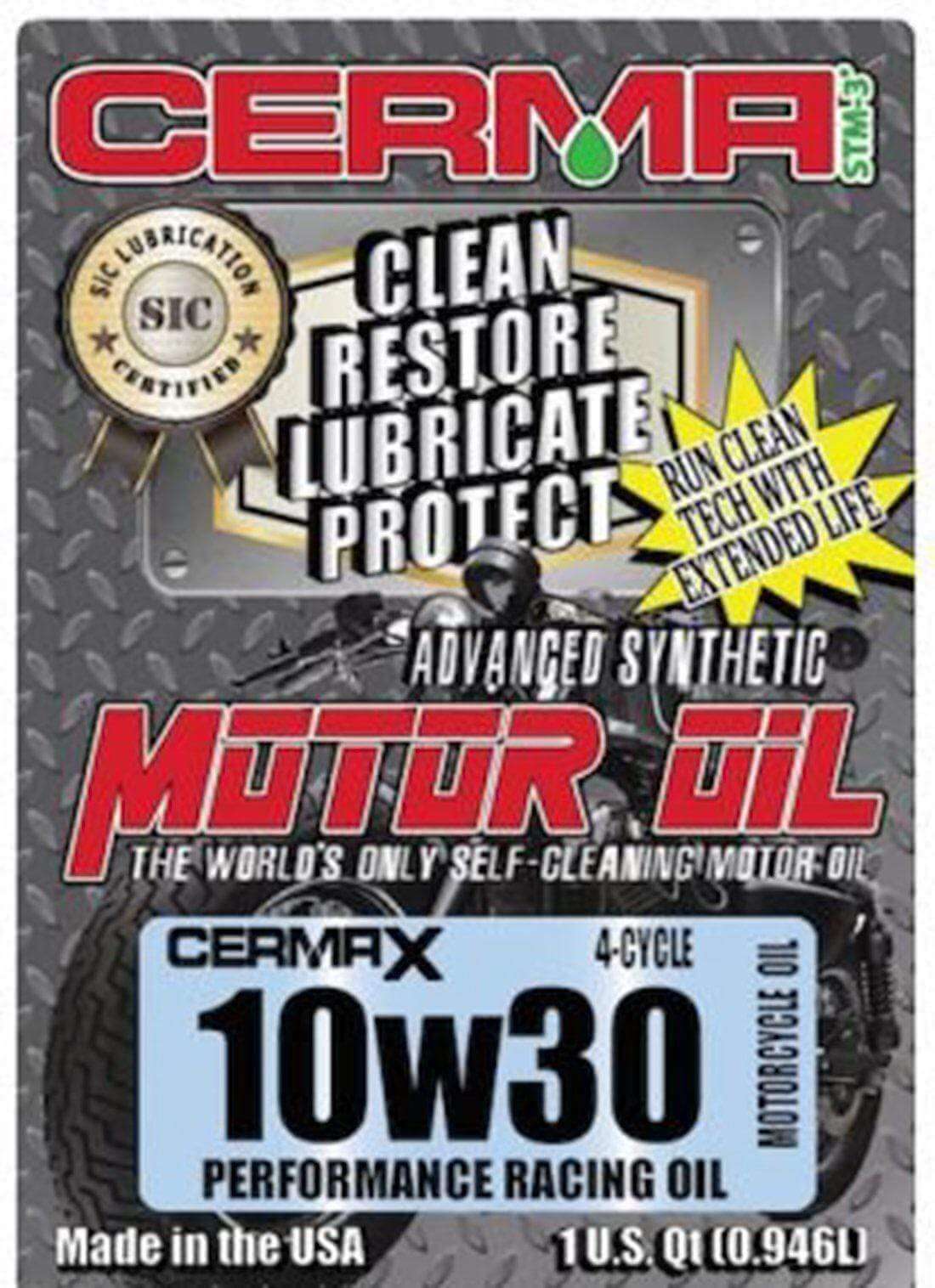
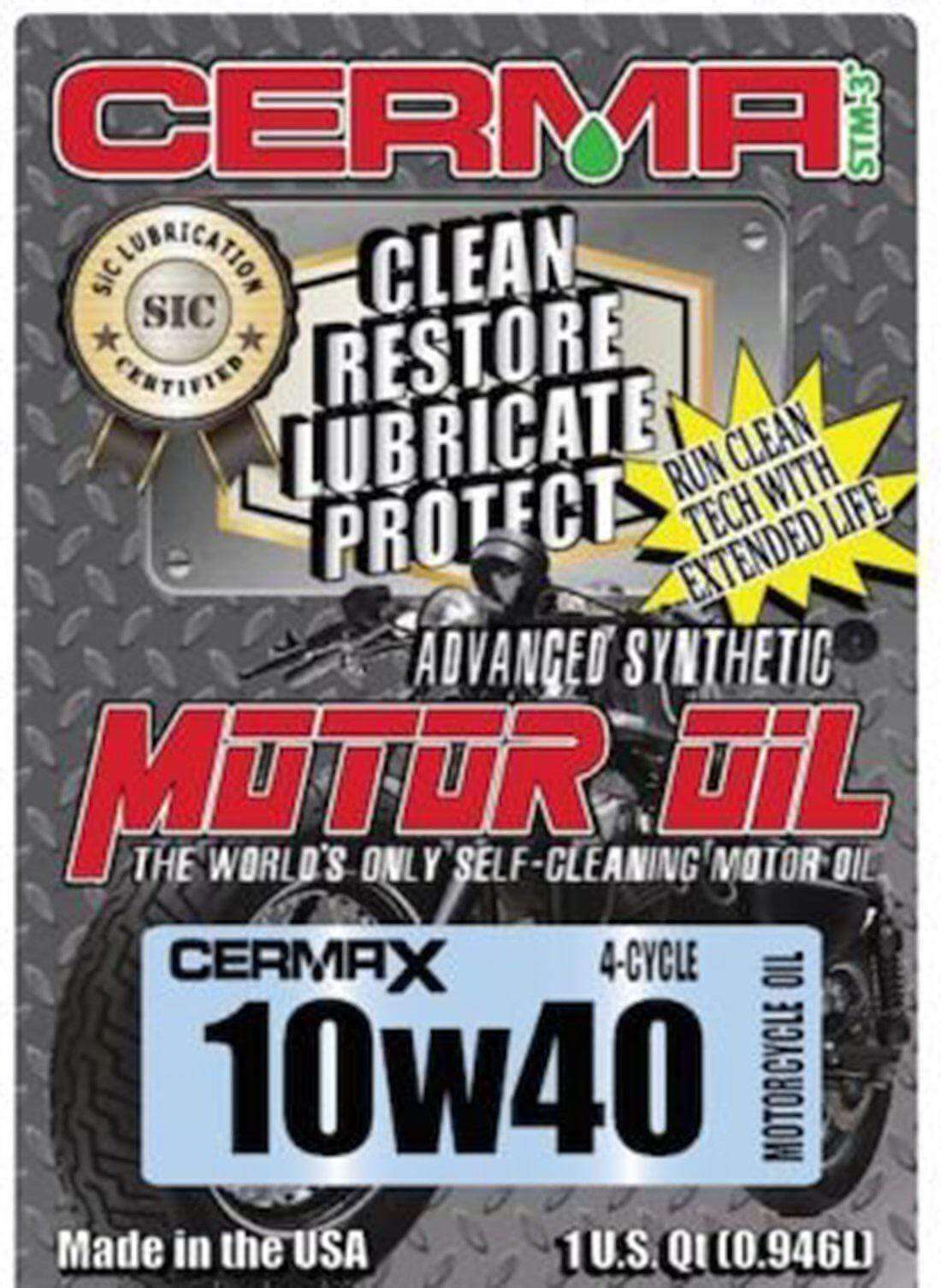
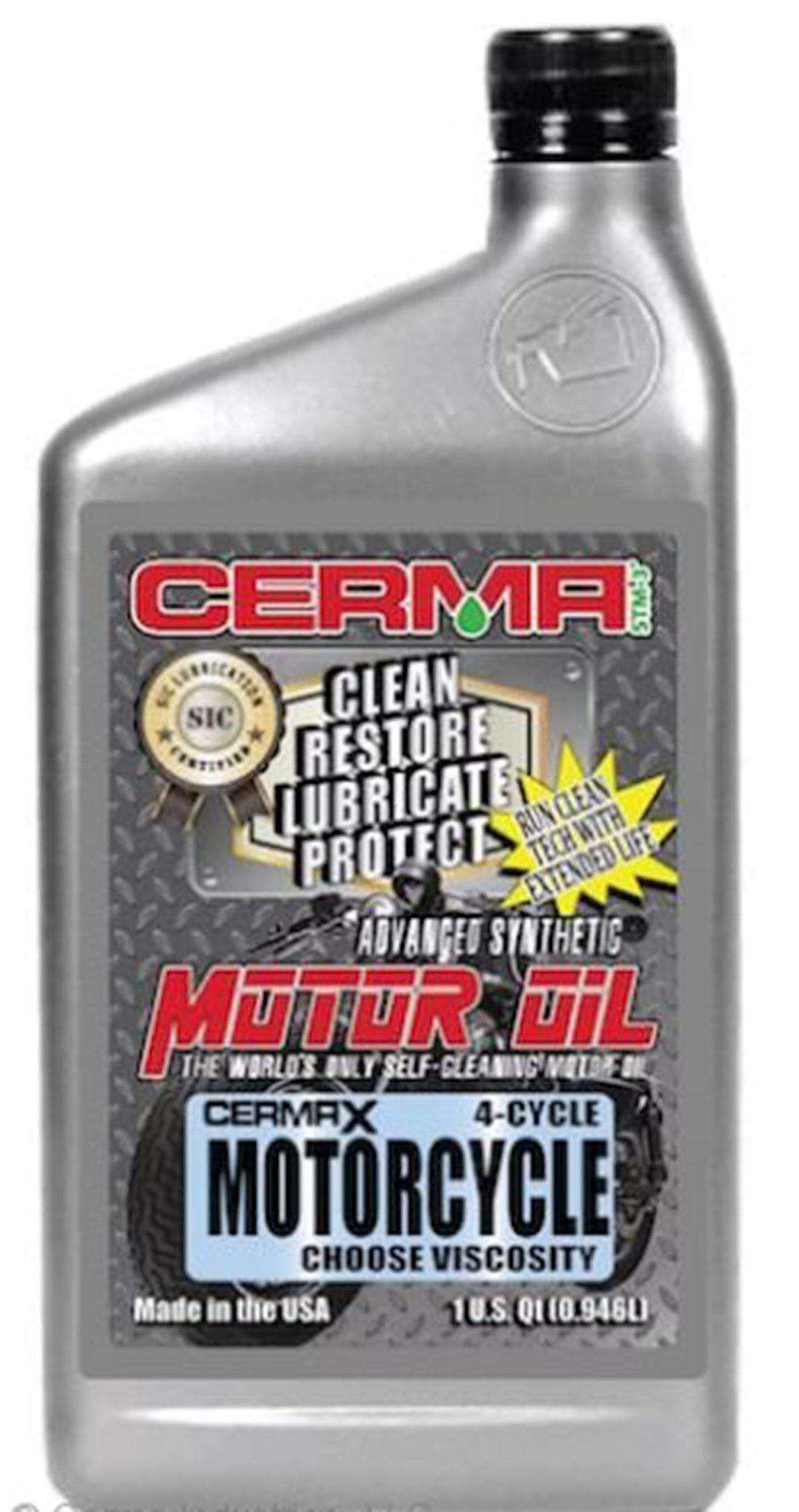
Cermax 4-Cycle Ceramic Synthetic Motorcycle Oil is a premium full-synthetic 4-stroke motorcycle oil enhanced with Cerma's STM-3® Nano Silicon Carbide (SiC) technology. Formulated to meet JASO MA/MA2 wet-clutch and API SN/SP specifications. Designed for the operating conditions motorcycle engines actually face — high sustained RPMs, small oil volumes, extreme oil temperatures in air-cooled engines, and the shared-sump geometry where one oil lubricates engine, transmission, and in many cases the wet clutch.
Available in four viscosity grades — 10W-40, 5W-30, 10W-30, and 20W-50 — and four container sizes (Quart, 12-Quart Case, 5-Gallon Pail, 55-Gallon Drum). Moly-free additive package compatible with wet clutches. PTFE-free. Solvent-free. Made in the USA by Bijou Inc. in Fort Myers, FL.
What Cermax 4-Cycle Delivers
- STM-3® SiC ceramic protection — delivers Nano Silicon Carbide particles that help build a permanent ceramic layer on engine metal sub-surfaces. Ceramic protection remains effective at oil temperatures that push conventional motor oils past their film-strength limit.
- High-RPM sustained protection — SiC and base-oil film work together to protect bearings, cam lobes, and cylinder walls at the sustained elevated RPMs typical of sport bikes, track riding, and small-displacement high-revving engines.
- Air-cooled engine capability — the ceramic layer performs independently of oil temperature, which matters on Harley-Davidson, Indian, older Honda, and BMW air-cooled twins where oil temp is the critical wear variable.
- JASO MA/MA2 wet-clutch compatible — moly-free friction modifier package maintains the clutch friction coefficient that most Japanese motorcycles require. No clutch slip.
- Run Clean Technology — detergent and dispersant package formulated to resist sludge and varnish formation in the tight oil passages of motorcycle engines.
- Strong shear stability — maintains viscosity grade under the gear-train shearing forces present in shared-sump motorcycle engines where oil cycles through both the crankcase and transmission gears.
- Cold-start flow in winter grades — 5W-30 and 10W grades provide faster oil pickup on cold startup compared to straight-weight or thick oils.
- Four viscosity grades to cover every motorcycle from cold-climate sport bikes (5W-30) through mid-temperature general use (10W-30, 10W-40) to hot-climate air-cooled cruisers and Harleys (20W-50).
- PTFE-free, solvent-free additive chemistry — no Teflon, no solvents that could harden seals or affect clutch friction materials.
Choose Your Viscosity Grade
Match the viscosity to your motorcycle manufacturer's recommendation. Verify in your owner's manual before ordering — using the wrong viscosity can affect clutch behavior, cold-start timing, oil pressure, and warranty coverage.
| Grade | Best For | Typical OEM Applications |
|---|---|---|
| 10W-40 | The most common motorcycle viscosity. Factory spec for most Japanese and European bikes in moderate to warm climates — sport bikes, cruisers, touring, adventure, dual-sport. | Honda CBR / CB / Gold Wing / Africa Twin; Yamaha YZF-R6/R1, MT series, Tenere; Kawasaki Ninja, Versys, Z-series, Concours; Suzuki GSX-R, V-Strom, Boulevard; BMW F/R/K series (verify); Triumph Street/Tiger; KTM 4-stroke; most Ducati (select models) |
| 5W-30 | Cold-climate riding, lightweight bikes requiring low-viscosity winter flow, modern sport bikes where OEM specifies 5W-30 for fuel economy and cold-start. | Some Honda sport bikes in cold climates (verify OEM), modern scooters, smaller-displacement machines where manufacturer specs 5W-30 |
| 10W-30 | General-purpose grade balancing cold-start and hot-temp film strength. For smaller motorcycles and dirt bikes in moderate climates where OEM specifies 10W-30. | Some Japanese cruisers; smaller-displacement street and dual-sport motorcycles; some 4-stroke dirt bikes in moderate climate regions |
| 20W-50 | Air-cooled and heavy-duty applications. Required for most Harley-Davidson engines, Indian V-twins, and hot-climate riding where thicker oil maintains film strength at elevated operating temperatures. | Harley-Davidson Evolution / Twin Cam / Milwaukee-Eight / Sportster Evolution; Indian Motorcycle Thunderstroke / PowerPlus; older Honda Gold Wing (older GL-series); older BMW air-cooled twins (R-series boxers); hot-climate riders of any air-cooled motorcycle |
Choose Your Quantity
| Size | Best For |
|---|---|
| Quart (1 qt) | Single oil change. Most motorcycles take 3–5 quarts per change; Harley-Davidson engine sump typically takes 3–4 quarts. Order the number of quarts your change requires, plus one extra for between-change top-offs. |
| 12-Quart Case | Multiple oil changes, riders with more than one motorcycle, or home-shop inventory. Best per-quart economics for individual riders doing 3+ changes per season. |
| 5-Gallon Pail (~20 quarts) | Motorcycle dealerships, service shops, track teams, and fleet operations. Pail pricing available at volume — call 239-344-9861 for dealer accounts. |
| 55-Gallon Drum (~220 quarts) | Large dealerships, multi-location service operations, racing teams, and fleet / commercial service. Drum pricing requires dealer or commercial account — call 239-344-9861. |
Compatibility Matrix
| Engine / Application | Compatible? | Recommended Viscosity |
|---|---|---|
| Air-cooled motorcycle engines | ✓ Yes — SiC stays effective at elevated oil temps | 20W-50 (primary), 10W-40 (cooler climates) |
| Liquid-cooled motorcycle engines | ✓ Yes | Per OEM spec (usually 10W-40 or 5W-30) |
| All 4-stroke motorcycle engines | ✓ Yes | Per OEM spec |
| Wet-clutch motorcycles (most Japanese bikes) | ✓ JASO MA/MA2 formulated | Per OEM spec |
| Dry-clutch motorcycles (most Ducati, some BMW) | ✓ Yes | Per OEM spec |
| Harley-Davidson engines | ✓ Yes — engine sump | 20W-50 (see Harley FAQ for primary/trans) |
| Indian Motorcycle V-twins | ✓ Yes | 20W-50 (Thunderstroke, PowerPlus) |
| 4-stroke ATV/UTV engines | ✓ Yes | Per OEM spec |
| 4-stroke jet ski (PWC) and marine motorcycle engines | ✓ Typically yes | Per OEM spec — verify JASO requirement |
| 2-stroke / 2-cycle engines | ✗ NO — use Cermax 2-Cycle Multi-Ratio Oil | — |
| Shaft drive, chain drive, and belt drive motorcycles | ✓ All compatible | Per OEM spec |
Specifications
| Oil Type | Premium full-synthetic 4-stroke motorcycle oil with STM-3 Nano Silicon Carbide |
|---|---|
| Viscosity Grades | 10W-40, 5W-30, 10W-30, 20W-50 (SAE J300) |
| JASO Classification | Formulated to meet JASO MA/MA2 wet-clutch friction specification |
| API Service Category | Formulated to meet API SN/SP gasoline engine performance requirements |
| Wet-Clutch Compatible | ✓ Yes — moly-free friction modifier package |
| Shared-Sump Compatible | ✓ Yes — safe for engines sharing oil between crankcase, transmission, and wet clutch |
| Additive Chemistry | PTFE-free, solvent-free, moly-free |
| Country of Manufacture | USA — Fort Myers, FL (Bijou Inc.) |
Cermax 4-Cycle vs. Other Motorcycle Oils
| Feature | Cermax 4-Cycle | Premium Motorcycle Synthetic | Conventional Motorcycle Oil |
|---|---|---|---|
| Ceramic SiC technology | ✓ Yes | ✗ No | ✗ No |
| Thermal protection beyond oil film limit | ✓ Yes (SiC) | Limited to base oil | Limited to base oil |
| Run Clean detergent / dispersant package | ✓ Yes | Varies | Basic |
| JASO MA/MA2 wet-clutch compatible | ✓ Yes | Usually yes | Varies — verify label |
| Viscosity grades offered | 4 (5W-30 to 20W-50) | Usually 2–3 | Usually 1–2 |
| Moly-free / clutch-safe friction additives | ✓ Yes | Usually yes | Varies |
Build the Full Motorcycle Protocol
Related Motorcycle Products
- Cerma STM-3 Motorcycle Engine Treatment — one-time ceramic bonding for 4-stroke motorcycle engines
- Cerma Ceramic Fuel Treatment — continuous fuel system protection for motorcycle gasoline engines
- Cerma Manual Transmission Treatment — for motorcycles with separate transmission sumps (some Harley, some BMW, vintage applications)
- Cerma Gear Box & Axle Treatment — for shaft-drive final drives (BMW, some Honda, Yamaha V-twin cruisers)
- All Cermax Motor Oils — gas, diesel, marine, and specialty applications
- Cermax 2-Cycle Multi-Ratio Oil — for 2-stroke engines (NOT this product)
Frequently Asked Questions
Yes — Cermax 4-Cycle is formulated to meet JASO MA/MA2 wet-clutch friction requirements. JASO (Japanese Automotive Standards Organization) MA/MA2 is the industry specification that governs friction coefficient for oils used in wet-clutch motorcycle engines — meaning engines where the clutch plates run in engine oil rather than in dry air or dedicated clutch fluid. Most Japanese motorcycles (Honda, Yamaha, Kawasaki, Suzuki) require JASO MA or MA2; many European bikes require it too. Automotive oils with moly-based friction modifiers will cause wet clutches to slip — Cermax's additive package is moly-free and formulated to maintain the clutch friction coefficient motorcycles need. The STM-3 SiC ceramic technology works inside engine metal (cylinder walls, bearings, cam lobes), not on clutch friction plates, so it does not interfere with clutch behavior. Also formulated to meet API SN/SP gasoline engine performance requirements.
The two numbers describe oil viscosity at different temperatures. The first number (with "W" for "winter") measures oil flow at cold-start temperatures — lower is thinner for easier cold-start pickup. The second number measures film strength at operating temperature (212°F / 100°C) — higher is thicker and maintains more film under heat and load. 10W-40 is the motorcycle default — balanced cold flow and hot-temp film strength, the factory spec for most sport bikes, cruisers, touring bikes, and adventure bikes worldwide. 5W-30 is thinner on both ends — specified only where OEM requires it (specific Honda sport bikes in cold climates, scooters). 10W-30 splits the middle — used on some smaller Japanese cruisers and some 4-stroke dirt bikes. 20W-50 is the thickest — required for most Harley-Davidson engines, Indian V-twins, older Honda Gold Wing, air-cooled BMW boxers, and any hot-climate or air-cooled motorcycle where the oil runs hotter than liquid-cooled engines and needs a thicker hot film. Bottom line: use exactly what your owner's manual specifies. Deviating can cause wet-clutch slip (if too thin), oil pressure issues (if too thin or too thick), or cold-start wear (if too thick for your climate).
Yes — Cermax 4-Cycle in 20W-50 is appropriate for Harley-Davidson engine sumps. Specifically: Evolution Big Twin (1984–1999) and Sportster Evolution (883 and 1200, through 2022); Twin Cam (88, 96, 103, 110 — 1999–2017); Milwaukee-Eight (107, 114, 117 — 2017+); Revolution Max (Pan America, Sportster S, Nightster). All are typically 20W-50 in the engine sump. Important note on Harley-Davidson multi-sump architecture: most Harley-Davidson motorcycles have three separate oil reservoirs — the engine sump, the primary chaincase, and the transmission. This product is for the engine sump only. The primary chaincase uses a specific Harley Primary Chaincase Lubricant (some riders substitute engine oil with acceptable results, others don't; the factory recommendation is the dedicated primary fluid), and the transmission typically uses a dedicated transmission gear oil (again, factory recommendation). Do not use this engine oil in the primary chaincase or transmission unless your owner's manual specifically permits it for your model year. For the transmission, see our Cerma Manual Transmission Treatment. For maximum engine protection on Harleys, also consider the one-time Cerma Motorcycle Engine Treatment.
Yes — Cermax 4-Cycle fits essentially all 4-stroke motorcycle categories. Sport bikes: Honda CBR (600, 1000, Fireblade), Yamaha YZF-R6/R1, Kawasaki Ninja (ZX-6R, ZX-10R), Suzuki GSX-R (600, 750, 1000), Ducati Panigale (select) — typical spec 10W-40. Cruisers: Harley-Davidson (20W-50, engine sump); Yamaha Bolt, V-Star; Kawasaki Vulcan; Suzuki Boulevard; Indian Motorcycle (20W-50 for Thunderstroke/PowerPlus, verify for smaller models) — most 10W-40 to 20W-50. Touring: Honda Gold Wing (check year — older 10W-30, newer often 10W-40), BMW K/R-series, Yamaha FJR1300, Kawasaki Concours 14, Honda ST — typically 10W-40. Adventure / dual-sport: KTM 790/890/1290 Adventure, BMW GS-series, Yamaha Tenere 700, Honda Africa Twin, Suzuki V-Strom, Triumph Tiger — typically 10W-40. 4-stroke dirt bikes: Honda CRF, Yamaha YZ-F, Kawasaki KX-F, Suzuki RM-Z, KTM 4-stroke, Husqvarna FE/FC — typically 10W-40 or 10W-50 (use 10W-40 here). Always verify the exact viscosity in your owner's manual; factory spec changes across model years for many bikes.
It prevents it. Wet-clutch slippage is caused by oils that contain molybdenum-based friction modifiers (common in modern automotive oils because they improve fuel economy). These modifiers reduce friction at metal-to-metal contact points — which is excellent for car engine efficiency but causes motorcycle wet-clutch plates to slip under acceleration because clutches rely on controlled friction to transfer torque. Cermax 4-Cycle uses a moly-free friction modifier package specifically designed for wet clutches, tested to meet JASO MA/MA2 friction specifications. If you've experienced clutch slip with another brand of oil, switching to any JASO MA2-rated motorcycle oil typically resolves it — and Cermax adds the SiC ceramic technology layer beyond just meeting the spec. Separate note: the STM-3 ceramic technology works at the molecular level inside engine metal surfaces (cylinder walls, bearings, cam lobes) — not on clutch friction plate material — so the ceramic component doesn't affect clutch behavior at all.
Yes — this is the design case. Most modern motorcycles use a shared-sump architecture where one oil lubricates the crankcase, the transmission gears, and the wet clutch plates simultaneously. This imposes requirements that automotive oil cannot meet: the oil must have specific friction properties for the wet clutch (JASO MA/MA2), shear stability to survive the gear-train shearing action, and additive chemistry that protects both engine bearings and transmission gear faces. Cermax 4-Cycle is formulated to meet all three requirements. Common shared-sump bikes: virtually all Japanese motorcycles (Honda, Yamaha, Kawasaki, Suzuki), most Italian bikes (except dry-clutch Ducatis), most European sport and touring bikes, most adventure and dual-sport motorcycles. Exceptions: Harley-Davidson (separate sumps for engine, primary chaincase, and transmission); some BMW boxers and Guzzis (separate transmission); dry-clutch Ducatis (clutch outside the oil). For these, Cermax 4-Cycle goes in the engine sump specifically; other sumps use their dedicated fluids.
Yes, and the SiC ceramic technology is especially useful in this context. Older air-cooled engines run hotter than modern liquid-cooled ones, which is exactly where traditional oil film strength is most challenged — and exactly where the temperature-independent ceramic layer adds the most protection. For vintage bikes (pre-1980), many owners prefer 20W-50 regardless of era-specific recommendations because period oil formulations were less capable and required thicker viscosity to achieve equivalent film strength; modern 20W-50 synthetic outperforms period-spec 30W or 40W straight grades in the same application. For 1980s–1990s motorcycles, follow the factory viscosity recommendation — the oil technology of the era was mature enough that the spec was correct. One honest note on ZDDP: modern API SN/SP gasoline oils reduced zinc/phosphorus (ZDDP) content for catalytic converter protection, which some vintage engine owners worry about because ZDDP is the classic anti-wear additive that protected flat-tappet camshafts. Cermax uses the SiC ceramic layer as a primary anti-wear mechanism, which works in addition to whatever ZDDP the base formulation contains, providing older flat-tappet engines with protection through both mechanisms.
Yes, two selections at checkout. (1) Package Type = viscosity grade (10W-40, 5W-30, 10W-30, or 20W-50). Match this to your motorcycle's OEM recommendation. (2) Oil Quantity = container size (Quart, 12-Quart Case, 5-Gallon Pail, or 55-Gallon Drum). Match this to how much oil you need. For a single oil change on most motorcycles (3–5 quarts typical; Harley-Davidson engine sump 3–4 quarts), order the required number of Quart units. For riders with multiple bikes or planning several changes per season, the 12-Quart Case offers better per-quart economics. For dealerships, service shops, track teams, and fleet operations, 5-gallon pails and 55-gallon drums are available with volume pricing — call 239-344-9861 for dealer accounts and drum pricing. Bundle & Save discounts apply to quart purchases: Buy 2 save 10%, Buy 5 save 20%, automatically applied at checkout. Use code C10 for an additional 10% off any order.
Made in the USA by Cerma Treatment (Bijou Inc.), 15880 Summerlin Road #300 Box #301, Fort Myers, FL 33908. 30-day return policy. Free shipping on orders over $150. Ships to US & Canada. Questions? Call 239-344-9861 or email info@cermatreatment.com. Use discount code C10 for 10% off.
Cermax and Cerma STM-3® are trademarks of Bijou Inc. Cermax 4-Cycle Ceramic Synthetic Motorcycle Oil is formulated to meet applicable JASO MA/MA2 wet-clutch and API SN/SP gasoline engine performance specifications. For four-stroke (4-cycle) motorcycle engines only — do NOT use in two-stroke (2-cycle) engines. Use the viscosity grade specified in your motorcycle manufacturer's owner's manual. Extended drain interval capability depends on riding style, operating environment, sustained RPM ranges, climate, fuel quality, and maintenance practices; always follow your motorcycle manufacturer's recommended oil change interval when shorter than any extended-drain expectation. Performance claims represent formulation targets and typical results; individual results vary based on engine type, age, mileage, riding conditions, and maintenance history. Cermax 4-Cycle is designed for the engine sump of motorcycles; use in primary chaincase or separate transmission reservoirs is acceptable only where the motorcycle manufacturer specifically permits it. Third-party brand references (Honda, Yamaha, Kawasaki, Suzuki, Harley-Davidson, Indian Motorcycle, BMW Motorrad, Ducati, KTM, Husqvarna, Triumph, Aprilia, Moto Guzzi, and model names referenced for compatibility identification) are trademarks of their respective owners and are used for compatibility identification only — Cerma is not affiliated with or endorsed by any of these manufacturers.
Frequently Asked Questions
Yes — Cermax 4-Cycle Ceramic Synthetic Motorcycle Oil is specifically formulated for wet-clutch motorcycle engines. It is formulated to meet JASO MA/MA2 wet-clutch friction specifications (the industry standard for motorcycle wet-clutch compatibility), and uses a moly-free friction modifier package that maintains proper clutch engagement without causing slippage. Most Japanese motorcycles (Honda, Yamaha, Kawasaki, Suzuki) have wet clutches and require JASO MA or MA2 oils — Cermax 4-Cycle fits this requirement across all four viscosity grades (10W-40, 5W-30, 10W-30, 20W-50). The STM-3 Nano Silicon Carbide ceramic technology works at the molecular level within engine metal surfaces (cylinder walls, bearings, cam lobes) and does not interfere with wet-clutch friction material. If you've experienced clutch slip with a previous oil, switching to Cermax 4-Cycle typically resolves it because the oil meets the friction spec that wet clutches require.
Four viscosity grades are available (SAE J300 classified): 10W-40 — the most common motorcycle viscosity, factory spec for most Japanese and European sport bikes, cruisers, touring bikes, and adventure bikes in moderate to warm climates; 5W-30 — for cold-climate riding and motorcycles requiring thinner oil for faster cold-start; 10W-30 — general-purpose grade for smaller motorcycles and some 4-stroke dirt bikes in moderate climates; 20W-50 — required for most Harley-Davidson engines (Evolution, Twin Cam, Milwaukee-Eight, Sportster Evolution), Indian Motorcycle V-twins (Thunderstroke, PowerPlus), air-cooled BMW boxers, older Honda Gold Wing, and any hot-climate or air-cooled application where thicker hot film is needed. Always match the viscosity specified in your motorcycle owner's manual. Using the wrong viscosity can affect clutch engagement, cold-start timing, oil pressure, and warranty coverage. If you're unsure which to order, check the oil fill cap or owner's manual for your bike — OEMs typically print the recommended viscosity directly on the cap.
Three things distinguish Cermax 4-Cycle from conventional motorcycle oils. (1) STM-3 Nano Silicon Carbide (SiC) technology — Cermax contains SiC ceramic particles (Mohs 9.5 hardness, 2,730°C melting point) that help build a permanent ceramic layer on engine metal sub-surfaces. The ceramic layer provides wear protection that performs independently of oil film strength, which matters most in air-cooled engines and during sustained high-RPM operation where traditional oil film gets challenged. Conventional motorcycle oils rely entirely on their base oil film for wear protection. (2) Formulation purpose-built for motorcycles — moly-free friction modifier package (compatible with wet clutches), JASO MA/MA2 friction specification compliance, API SN/SP gasoline engine performance, and strong shear stability for shared-sump engines. Many "motorcycle oils" on the market are relabeled automotive oils that cause wet-clutch slip. (3) Run Clean detergent/dispersant package — formulated to resist sludge and varnish formation in the tight oil passages of motorcycle engines. The combined effect: ceramic wear protection plus motorcycle-specific additive chemistry. Positioned in the Cermax premium tier (vs. the Cerma standard tier) for maximum performance.
Yes, for 4-stroke ATVs, UTVs, and side-by-sides. Most modern powersport 4-stroke engines share the same wet-clutch architecture and JASO MA/MA2 requirements as motorcycles, so Cermax 4-Cycle is appropriate where the OEM specifies JASO MA2-rated oil or equivalent motorcycle oil. Common compatible platforms include Honda Pioneer and Talon (4-stroke UTVs), Yamaha Wolverine and YXZ, Kawasaki Mule and Teryx, Polaris Ranger and RZR (verify OEM spec — some Polaris models require specialty fluids), Can-Am Defender and Maverick (verify), Arctic Cat 4-stroke ATVs, and most OEM 4-stroke dirt quads. Match viscosity to OEM spec — typically 10W-40 for most 4-stroke quads, 5W-30 or 10W-30 for some smaller-displacement units. Two exceptions: (1) 2-stroke ATVs and UTVs (older Banshee, Blaster, LT80, etc.) need 2-cycle oil, not this product — use Cermax 2-Cycle Multi-Ratio Oil. (2) Jet skis (PWC) are typically 4-stroke in modern units but verify the JASO requirement in your owner's manual before switching from marine-specific oil; Cermax 4-Cycle can work for JASO MA2-requiring PWC engines but is not marketed as marine oil.
The honest answer: follow your motorcycle manufacturer's recommended oil change interval. OEM intervals for most modern motorcycles range from 3,000 to 7,500 miles for sport bikes and touring bikes, 1,500 to 3,000 miles for dirt bikes under race use, and specific factory intervals for Harley-Davidson and Indian cruisers (typically 5,000 miles). Cermax 4-Cycle's premium synthetic base oil and Run Clean detergent package can support the upper end of your OEM-specified interval under typical riding conditions — and the STM-3 SiC ceramic protection continues working even as the oil approaches its drain interval. Some riders extend intervals modestly beyond OEM spec based on oil analysis results, but motorcycle engines are less forgiving than car engines for extended drains due to small oil capacity, high RPM, and shared-sump conditions that accelerate oil shear. Unless you're doing used oil analysis and have data supporting extended intervals, stick to your OEM schedule for warranty protection and engine longevity. For Harley-Davidson engines with Cerma STM-3 Motorcycle Engine Treatment applied, the ceramic bonding layer provides wear protection that persists across oil changes independent of the oil itself — another reason to pair Cermax 4-Cycle with the one-time treatment for full protocol benefit.
Share