

Cerma
Ceramic-Enhanced Synthetic Racing Oil for 4-Stroke Go-Kart Engines
Ceramic-Enhanced Synthetic Racing Oil for 4-Stroke Go-Kart Engines
Couldn't load pickup availability
Ceramic-Enhanced Synthetic Racing Oil for 4-Stroke Go-Kart Engines
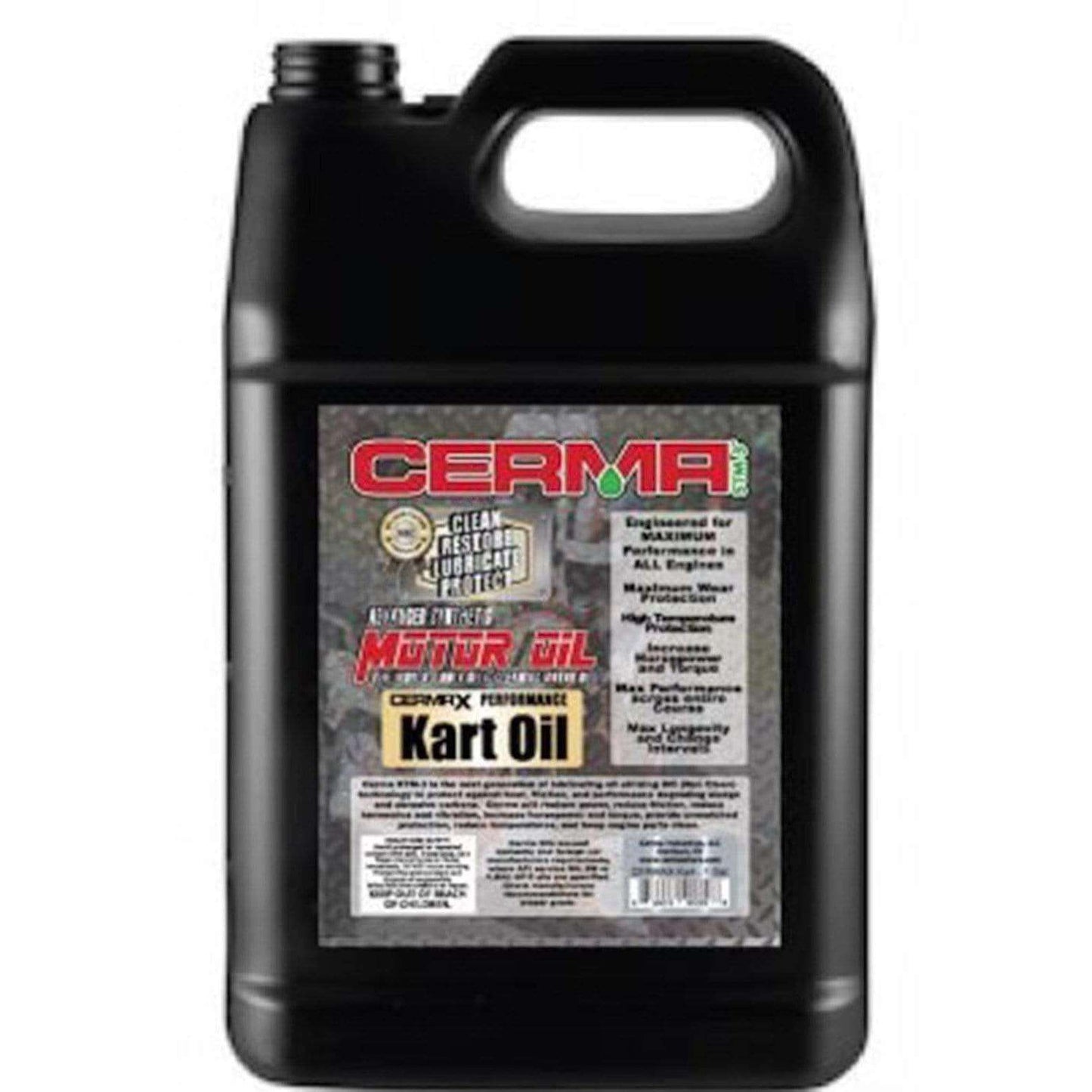
CermaX Ceramic Kart Engine Oil is a premium synthetic racing oil engineered for 4-stroke go-kart competition, enhanced with Cerma's STM-3® Nano Silicon Carbide (SiC) ceramic technology. Formulated for the specific operating conditions of kart engines — small displacement, sustained high RPM, minimal oil capacity, and air-cooled or water-cooled cylinder designs where every drop of oil is working hard. Helps protect against the wear progression that kills kart engines between rebuilds.
Available in 1-Gallon Jug — sized for race teams, kart shops, and serious competitors running multiple oil services per season. Made in the USA by Bijou Inc. in Fort Myers, FL. PTFE-free, solvent-free.
What CermaX Kart Engine Oil Delivers
- STM-3® SiC ceramic protection — Nano Silicon Carbide particles help build a permanent ceramic layer on cylinder walls, piston rings, bearings, cam lobes, and valvetrain surfaces. The ceramic layer persists across oil changes and builds cumulatively with continued use.
- Sustained high-RPM protection — SiC ceramic and premium synthetic base oil together help protect internal metal surfaces under the sustained 10,000–15,000+ RPM conditions typical of 4-stroke kart competition. Reduces wear progression at the metal surfaces that define engine rebuild intervals.
- Lower operating friction — reduced friction at engine internals means less power consumed by internal drag and more power available at the crankshaft. In karting where total HP is small and HP-to-weight matters, small friction reductions from a premium oil can contribute to measurable back-to-back dyno differences.
- Run Clean Technology — detergent and dispersant package helps minimize sludge, varnish, and carbon deposits in the tight oil passages of kart engines. Especially valuable on rental/arrive-and-drive fleet engines running long days at varying RPM/temperature.
- Strong shear stability — maintains viscosity grade under the high-shear conditions of small-sump kart engines where oil cycles rapidly through bearings and valve gear.
- Air-cooled engine capability — the SiC ceramic layer performs at elevated oil temperatures typical of air-cooled kart engines (Briggs & Stratton LO206, Honda GX200/GX270, Tillotson 225RS and similar).
- Cold-start lubricity — maintains film strength for reliable cold starts before sessions.
- Extended oil service compared to basic racing oils — SiC-enhanced synthetic base supports longer useful oil life, though kart racing applications typically still change oil frequently for competition reliability (see FAQ on intervals).
- PTFE-free, solvent-free — no Teflon, no solvents that could affect seals or leave deposits in small passages.
Compatible Kart Applications
| Kart Category | Typical Engine | Notes |
|---|---|---|
| Sprint karts (4-stroke) | Briggs & Stratton LO206, Honda GX270, Tillotson 225RS | Most common 4-stroke sprint applications; check class spec-oil rules |
| Endurance karts | Briggs LO206 fleet, Honda GX-series, Kohler CH-series | Extended-race protection valuable; long sessions stress oil hardest |
| Junior / cadet classes (4-stroke) | Briggs Animal, Comer C50, Honda GXH50 (vintage) | Junior class rules often permit synthetic; verify specific class |
| Rental / arrive-and-drive fleet | Honda GX200/GX270, Subaru EX-series, Kohler CH-series fleet engines | Fleet operators see biggest value — cumulative SiC protection extends rebuild intervals |
| Vintage / classic karting (4-stroke) | Vintage McCulloch 4-stroke, West Bend, vintage Yamaha 4-stroke | Open class / exhibition use — class rules generally more permissive |
| Oval / dirt / speedway karts (4-stroke) | Clone engines, Predator engines, Animal engines, Flathead modifieds | 4-cycle flat karting; verify class spec-oil restrictions |
Popular kart engine brands served: Briggs & Stratton (LO206, Animal, Raptor), Honda (GX120/GX200/GX270 in 4-stroke kart applications), Tillotson (225RS and related), Kohler (CH-series fleet engines), Subaru (EX-series fleet engines), Comer C50 (4-stroke junior), plus vintage and classic 4-stroke kart engines in open classes.
For 2-stroke kart engines — shifter kart 125cc 2-strokes (Rotax Max, IAME X30 2-stroke variants, Vortex 2-stroke, PRD 2-stroke, vintage KT100 Yamaha, Comer K80), 2-stroke sprint karts, and 2-stroke vintage classes — use Cermax Ceramic 2-Cycle Multi-Ratio Oil or Cermax Air 2-Cycle Oil instead. 4-stroke and 2-stroke kart engines have completely different lubrication architectures.
📋 How to Use CermaX Kart Engine Oil
- Warm the engine by running at idle for 5–10 minutes (or after a session) so existing oil drains more completely.
- Drain existing oil into an approved container. If your engine has an oil filter, replace it now. Many kart engines (LO206, Clone, Animal) do not have conventional spin-on filters.
- Fill with CermaX to the capacity specified by your engine manufacturer. Typical 4-stroke kart engines take 20–32 oz; refer to your engine's service manual. Do not overfill.
- Verify oil level with the dipstick or sight glass at the specified check orientation (level ground, engine cold or after brief warm-up as specified by manufacturer).
- Run the engine at idle for 2–3 minutes to circulate oil through all passages before first session.
- Race. The SiC ceramic protection begins working during the first session; the ceramic layer develops cumulatively across subsequent sessions and oil changes.
- Ongoing: continue using CermaX for all oil services. The ceramic protection builds over time — engines with multiple CermaX services have more robust ceramic layer than first-time treatments.
CermaX vs. Conventional Kart Racing Oils
| Feature | CermaX Kart | Standard Racing Oil |
|---|---|---|
| SiC ceramic wear layer | ✓ Yes — permanent bond | ✗ No |
| Run Clean detergent / dispersant | ✓ Yes | Varies |
| Wear protection mechanism | Dual: SiC ceramic + oil film | Oil film only |
| Shear stability | Strong | Varies by brand |
| Air-cooled temperature capability | ✓ SiC layer persists at elevated oil temps | Limited to base oil film strength |
| Ceramic protection across oil changes | ✓ Ceramic stays bonded to metal | ✗ Protection resets with each change |
| PTFE / solvent-free | ✓ Yes | Varies |
Related Cerma Products for Karting
- Cerma STM-3 Engine Treatment — one-time ceramic catalyst for deep initial bonding
- Cerma Gas Fuel Treatment — fuel system protection (race-pump gasoline, ethanol-blended, or VP race fuels)
- Cermax Ceramic 2-Cycle Multi-Ratio Oil — for 2-stroke shifter karts and 2-stroke vintage classes
- Cermax Air 2-Cycle Oil — smaller-quantity alternative 2-stroke option
- Cerma Gear Box Treatment — for gearbox karts, shifter-kart transmissions, and chain-drive components where applicable
- All Cermax Motor Oils — for your tow vehicle, transport van, support trucks, and shop equipment
Frequently Asked Questions
CermaX Kart Engine Oil is a 4-stroke racing oil designed for the full range of 4-stroke competitive kart applications: sprint karts (Briggs LO206 and other 4-stroke sprint classes), endurance karts, junior and cadet 4-stroke classes, oval/dirt/speedway karts (Clone, Predator, Animal, Flathead), rental/arrive-and-drive fleet engines (Honda GX-series, Subaru EX-series, Kohler CH-series), and vintage 4-stroke karting. For 2-stroke karting (shifter karts with 125cc Rotax Max / IAME / Vortex / PRD engines, 2-stroke KT100 classes, 2-stroke vintage classes), use Cermax Ceramic 2-Cycle Multi-Ratio Oil or Cermax Air 2-Cycle Oil — those are formulated for the fundamentally different lubrication requirements of 2-stroke engines where oil burns with fuel. Class legality varies: open classes and stock-class 4-stroke categories typically allow synthetic racing oil. Spec classes (IAME-spec 4-stroke classes, Briggs LO206 spec class, Rotax Max Challenge series, Yamaha KT100 classes) often mandate specific oils for tech compliance — CermaX won't be legal in those specific spec classes. Always verify your specific class's current technical regulations before race day.
Honest answer: measurable friction reduction in back-to-back dyno testing is the mechanism, and the gains are typically small — on the order of 1–3% horsepower at the crankshaft in well-controlled testing — but real. In karting, small HP changes translate to measurable lap-time differences because overall engine output is small and HP-to-weight ratio is directly exposed to segment times. What you should not expect: dramatic top-end gains that transform a slow kart into a fast one, or compensating for engine issues (worn rings, valve-seat issues, carb problems). What you can reasonably expect: consistent smooth power delivery, reduced wear progression between rebuilds, cleaner engine internals at tear-down inspection, and modest friction reduction that contributes to overall engine health. The bigger long-term advantages are reduced wear and extended rebuild intervals rather than a headline horsepower number — for competition budget management, extending rebuild intervals and keeping engines in consistent trim is often more valuable than a small peak-HP gain.
Two meaningful differences. (1) SiC ceramic technology — CermaX contains Nano Silicon Carbide particles that help build a permanent ceramic layer on engine metal surfaces (cylinder walls, bearings, cam lobes). Conventional racing oils rely entirely on their base-oil film for wear protection. The ceramic layer provides a second wear-protection mechanism that stays in place between oil changes, so the engine builds up accumulated ceramic protection over multiple services. (2) Run Clean Technology — the detergent/dispersant package is formulated to minimize sludge and carbon deposits in the tight oil passages of kart engines, which matters more on kart engines than on cars because of small oil capacity and rapid circulation. The rest of the formulation — premium synthetic base, strong shear stability, high-RPM capability, air-cooled temperature resistance — is competitive with other premium racing oils rather than uniquely differentiated. The SiC ceramic layer is what makes CermaX meaningfully different from other racing oils on the market.
It depends on your engine builder's break-in preference. Some builders prefer CermaX from the first fill so the SiC ceramic layer establishes during initial ring-to-bore seating. Other builders prefer a conventional break-in oil for the first few heat cycles (to allow ring seating with less protection before transitioning to the long-term racing oil), then switch to CermaX for subsequent fills. Either approach works — the key is consulting your engine builder's specific break-in protocol for your engine (Briggs LO206, Honda GX270, Tillotson 225RS, etc. all have slightly different break-in recommendations). One honest consideration: if your engine builder specifies their own oil for break-in as part of their engine warranty, follow that recommendation to preserve warranty coverage — switch to CermaX after the builder's break-in period is complete.
Follow your engine manufacturer's and class's recommended oil change interval. For 4-stroke competitive kart applications, typical oil change intervals range from every race weekend (most aggressive — high-stakes competition and engines run near limits) to every few race weekends (typical club-level racing) to every 10–20 hours of runtime for endurance and fleet engines. The SiC ceramic layer persists across oil changes — it's bonded to the metal, not suspended in the oil — so you don't lose accumulated ceramic protection by draining oil. What you do need to change regularly: the oil itself, because oil viscosity and additive package degrade with combustion contamination, heat cycles, and fuel dilution. Karting engines see harsh conditions for oil: small sumps, high circulation rates, sustained high temperatures. Even with CermaX's premium base oil, frequent changes in competition use are normal. For fleet/rental applications where runtime matters more than race-by-race consistency, oil analysis can guide interval extension.
Depends entirely on your specific class. Karting sanctioning bodies — IKF (International Kart Federation), SKUSA (Superkarts! USA), WKA (World Karting Association), CIK-FIA (international), plus regional series and local club rules — have different oil regulations per class. Open and stock classes typically permit any synthetic racing oil meeting the engine manufacturer's viscosity specification. Spec classes (IAME-spec classes, Briggs LO206 spec class, Rotax Max Challenge classes, Yamaha KT100 classes, Vortex-spec classes) often require specific oils for tech compliance — CermaX will not be legal in those specific spec classes, even if the engine manufacturer's spec permits synthetic. Before using in competition: (1) check your specific class's current technical regulations — rules change season-to-season; (2) confirm with your class's tech inspector before race day if there's any ambiguity; (3) for new CermaX users entering a competition, a practice session before committing to a race weekend lets you verify compatibility. CermaX contains no prohibited substances (PTFE-free, solvent-free, no performance-enhancing chemistry beyond the SiC ceramic layer and premium synthetic base).
Yes — fleet operations are one of the strongest use cases. Rental and arrive-and-drive fleet engines run long hours with varying driver skill levels, meaning they take more abuse than typical race engines. CermaX's cumulative ceramic protection builds up over successive oil services and helps extend engine life between rebuilds. The Run Clean detergent package helps prevent the carbon buildup that's common in fleet engines running at varying RPMs. For fleet economics: fewer rebuilds per engine over its service life means lower maintenance labor cost, less downtime per engine, and more uptime for the kart as a revenue-generating asset. Honda GX200/GX270, Subaru EX-series, and Kohler CH-series fleet engines are all compatible. For multi-location or high-volume fleet operations, call 239-344-9861 for volume pricing.
Depends on engine displacement. Typical 4-stroke kart engines take 20–32 oz per fill. Common capacities: Briggs LO206 — approximately 20 oz; Honda GX200 / GX270 — approximately 24 oz (GX200) to 32 oz (GX270); Tillotson 225RS — approximately 20 oz; Kohler CH-series — 32+ oz depending on specific model; Subaru EX-series — approximately 32 oz. Always verify your specific engine's oil capacity in the service manual before filling. Do not overfill. Gallon math: at 20 oz per fill, one gallon (128 oz) gives you approximately 6 oil services; at 32 oz per fill, approximately 4 services. For race teams running multiple engines, one gallon covers a race weekend for a small team. For fleet operators, larger volume pricing applies — call 239-344-9861 for commercial quotes.
Made in the USA by Cerma Treatment (Bijou Inc.), 15880 Summerlin Road #300 Box #301, Fort Myers, FL 33908. 30-day return policy. Free shipping on orders over $150 (this product qualifies automatically). Ships to US & Canada. Race team, kart shop, and fleet volume pricing available. Questions? Call 239-344-9861 or email info@cermatreatment.com. Use discount code C10 for 10% off.
CermaX and Cerma STM-3® are trademarks of Bijou Inc. CermaX Ceramic Kart Engine Oil is a 4-stroke racing oil formulated for 4-stroke go-kart engine applications. Not for 2-stroke engine use — 2-stroke applications require 2-cycle oil formulations. Competition / sanctioning compliance: CermaX is a synthetic racing oil containing STM-3 Nano Silicon Carbide technology. PTFE-free and solvent-free. Class legality varies by sanctioning body (IKF, SKUSA, WKA, CIK-FIA, and regional series) and by specific class regulations — spec classes often require specific class-approved oils. Always verify your specific class's current technical regulations before using in sanctioned competition. Performance claims represent formulation targets and typical results from controlled testing; individual on-track results vary based on engine build, engine tune, driver skill, tire setup, chassis setup, track conditions, fuel quality, and competition environment. Claims of friction reduction and associated horsepower effects reflect controlled dyno testing of ceramic-enhanced oils vs. conventional racing oils and are typically in the 1–3% range; actual gains on specific engines vary. Horsepower, lap time, and rebuild-interval improvements are representative and not guaranteed for every application. For new or rebuilt engines, consult your engine builder's specific break-in protocol — if builder specifies a break-in oil for warranty purposes, follow that protocol before transitioning to CermaX. Third-party brand references (Briggs & Stratton, Honda, Tillotson, Kohler, Subaru, Comer, Yamaha, McCulloch, West Bend, IAME, Rotax, Vortex, PRD, Clone, Predator, Animal, Raptor, LO206, GX120, GX200, GX270, 225RS, CH-series, EX-series, KT100, K80, Rotax Max Challenge, IKF, SKUSA, WKA, CIK-FIA) are trademarks of their respective owners and are used for compatibility identification only — Cerma is not affiliated with, endorsed by, or sponsored by any of these manufacturers, sanctioning bodies, or series.
Frequently Asked Questions
CermaX Ceramic Kart Engine Oil is a 4-stroke racing oil designed for all 4-stroke competitive go-kart applications. Major categories served: sprint karts (4-stroke engines — Briggs & Stratton LO206, Honda GX270, Tillotson 225RS); endurance karts (fleet and race 4-stroke applications — extended-race protection especially valuable); junior and cadet classes (4-stroke junior karting — Briggs Animal, Comer C50, Honda GXH50 vintage); rental and arrive-and-drive fleet engines (Honda GX200/GX270, Subaru EX-series, Kohler CH-series — one of the highest-value use cases due to long fleet runtime); oval and dirt/speedway karts (4-cycle flat-track classes — Clone, Predator, Animal engines); vintage and classic 4-stroke karting (open and exhibition classes). Compatible with all major 4-stroke kart engine brands: Briggs & Stratton, Honda, Tillotson, Kohler, Subaru, Comer, vintage McCulloch/West Bend/Yamaha. For 2-stroke karts (shifter karts with 125cc Rotax Max, IAME X30 2-stroke, Vortex 2-stroke, PRD, Yamaha KT100, Comer K80), use Cermax Ceramic 2-Cycle Multi-Ratio Oil or Cermax Air 2-Cycle Oil — 4-stroke oil and 2-stroke oil are fundamentally different products. Always verify your specific class's current technical regulations before using CermaX in sanctioned competition — spec classes often mandate class-specific oils for tech compliance.
Cerma STM-3 Nano Silicon Carbide (SiC) ceramic technology is the core differentiator of CermaX. The mechanism: SiC ceramic particles in the oil undergo a bonding reaction with ferrous engine metal during normal operation, helping build a permanent ceramic layer on cylinder walls, bearings, cam lobes, piston surfaces, and valvetrain. SiC has a Mohs hardness of 9.5 (harder than most engine metals) and a melting point of 2,730°C (far above any engine operating temperature). Specific benefits for kart engines: (1) Wear-reduction mechanism independent of oil film — the ceramic layer provides protection even when oil film is at its thinnest during maximum-load operation, which matters in kart engines that run at sustained high RPMs. (2) Cumulative protection across oil changes — the ceramic stays bonded to metal when you drain oil, so accumulated SiC protection builds over multiple oil services rather than starting from zero with each change. (3) Air-cooled high-temperature capability — the ceramic layer performs at elevated oil temperatures typical of air-cooled kart engines where traditional oil film gets most challenged. (4) Reduced friction at metal contact points — contributes to modest (typically 1–3%) measurable friction reduction in controlled back-to-back dyno comparisons. (5) Carbon deposit resistance — the Run Clean detergent/dispersant package helps minimize sludge and carbon in the tight oil passages of small-displacement engines. Honest framing: the primary value is wear reduction and extended rebuild intervals, not dramatic peak-horsepower transformation.
Honest framing: CermaX can contribute to competitive advantage through several specific mechanisms, but expect modest gains rather than transformation. What CermaX can realistically contribute: (1) Measurable friction reduction in back-to-back testing, typically on the order of 1–3% HP at the crankshaft — small in absolute terms but measurable in controlled conditions, and in karting where HP-to-weight ratio directly affects lap time, small gains matter. (2) Consistent power delivery throughout a race because the SiC ceramic layer doesn't degrade with heat the way conventional oil film can. (3) Extended engine rebuild intervals from reduced wear progression — for competition budget, fewer rebuilds is equivalent to more track time at the same cost. (4) Cleaner engine internals at tear-down inspection, which helps engine builders assess engine health and tune for the next rebuild. What CermaX cannot do: compensate for a poorly-prepped engine, a bad tune, incorrect gearing, driver limitations, or chassis/tire setup issues. Oil is one variable among dozens that determine kart lap times — don't expect a dramatic transformation from oil alone. Competition results on any specific track with any specific setup depend on many factors; CermaX contributes to the engine side of the equation within the range of what premium racing oil can reasonably provide, plus the SiC ceramic layer as an additional wear-protection mechanism.
CermaX Ceramic Kart Engine Oil is offered in a 1-Gallon Jug — the standard size for race teams, kart shops, and serious competitors running multiple oil services per season. At typical kart engine fill volumes (20–32 oz per service), one gallon covers approximately 4–6 oil services depending on your specific engine. Common capacities: Briggs LO206 ~20 oz (6 services per gallon); Honda GX200 ~24 oz (5 services); Honda GX270 ~32 oz (4 services); Tillotson 225RS ~20 oz (6 services); Kohler CH-series 32+ oz (4 services); Subaru EX-series ~32 oz (4 services). Always verify your specific engine's oil capacity in the service manual before filling — do not overfill. For race teams running multiple engines, one gallon typically covers a race weekend. For fleet operators (rental/arrive-and-drive operations with multiple karts), volume pricing is available — call 239-344-9861 for quotes on multi-gallon orders, larger containers, or fleet-account pricing. 30-day return policy. Free shipping on this product (qualifies automatically at the $100.18 price, above the $150 threshold with any additional item or via Code C10 for 10% off).
Multiple ways to reach Cerma for kart-specific questions. Phone: 239-344-9861 (Mon–Fri, 8:00 AM to 6:00 PM Eastern). Call with your engine make/model, racing class, and any current issues — we can help confirm compatibility, suggest protocol for new vs. rebuilt engines, and discuss class-legality considerations. Email: info@cermatreatment.com — best for detailed questions, class rule references, or engine builder coordination. Fleet and race team inquiries: for multi-kart fleets, race team account pricing, or bulk orders, identify yourself as a fleet/team account when contacting — we have specific volume pricing for rental kart operations, arrive-and-drive businesses, kart dealerships, and race teams. Class legality questions: when asking about whether CermaX is legal for your specific class, have your sanctioning body (IKF / SKUSA / WKA / CIK-FIA / regional series) and specific class designation (e.g., "WKA Briggs LO206 Sportsman" or "SKUSA X30 Masters") available — we can share what we know about current rules, though final tech compliance is always determined by your class tech inspector. Cerma location: 15880 Summerlin Road #300 Box #301, Fort Myers, FL 33908. Made in the USA by Bijou Inc.
Share