

Cerma
Cermax Ceramic Hydraulic Oil AW46 SiC Technology | Cerma
Cermax Ceramic Hydraulic Oil AW46 SiC Technology | Cerma
Couldn't load pickup availability
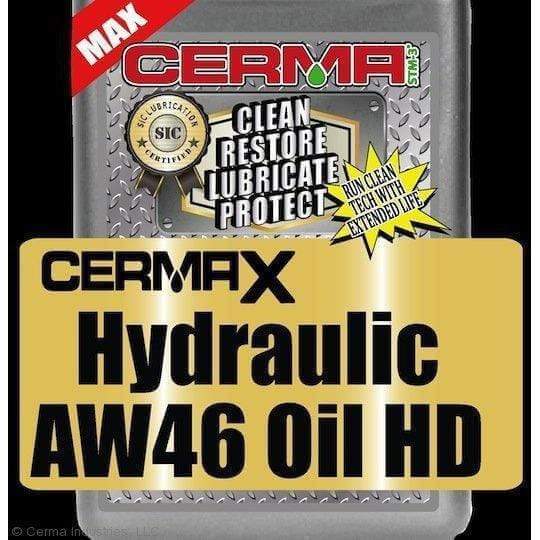
Cermax Ceramic Hydraulic Oil AW46 — STM-3 Nano Silicon Carbide Technology | Triple-Shield Protection for Hydraulic Systems
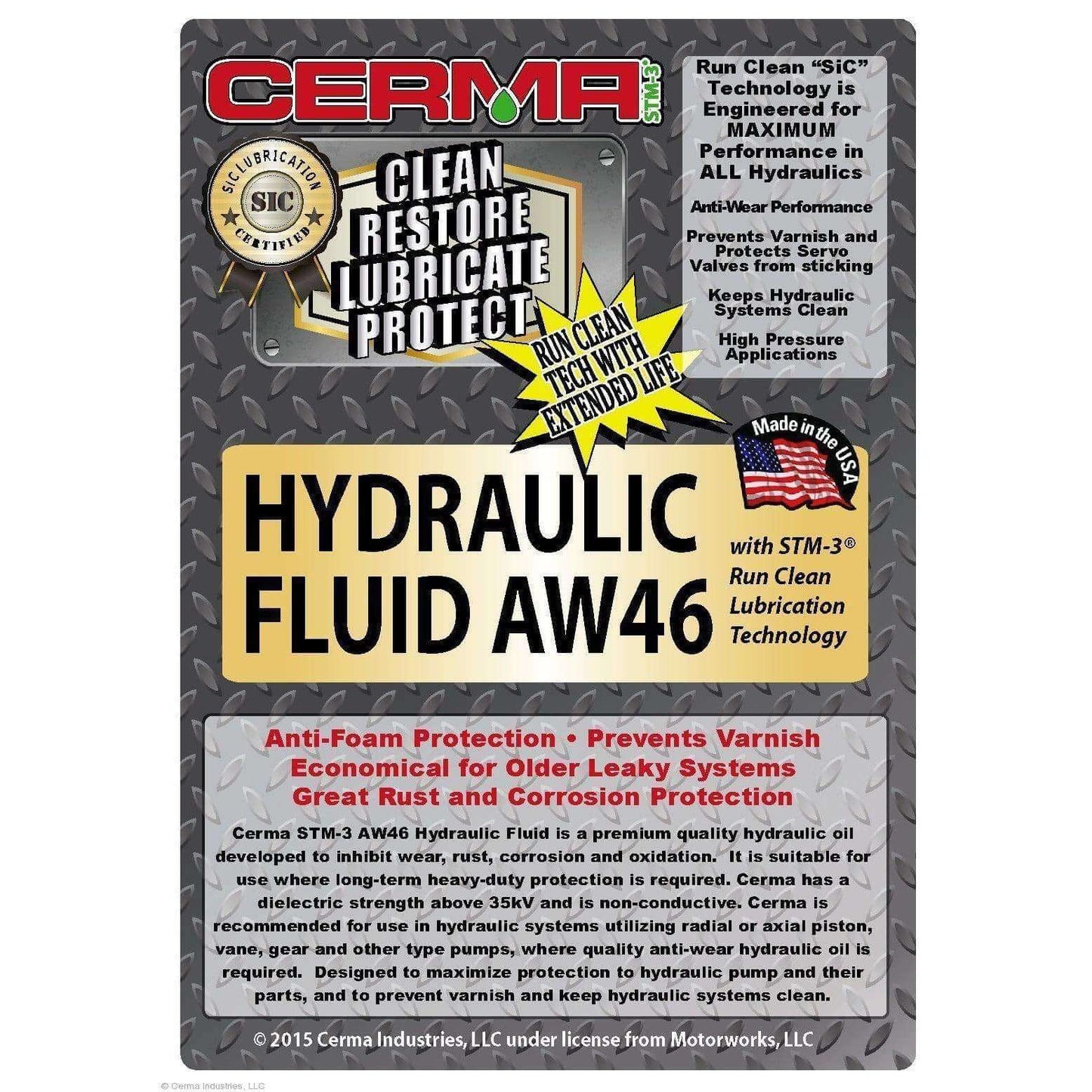
Stop hydraulic system failures before they start. Cermax Ceramic Hydraulic Oil AW46 is an ISO VG 46 anti-wear hydraulic fluid engineered with STM-3 Nano Silicon Carbide (SiC) ceramic technology. Standard AW46 hydraulic oils rely entirely on zinc-based (ZnDTP) anti-wear chemistry that depletes over time. Cermax adds a permanent SiC ceramic layer (Mohs 9.5) that bonds directly to pump, cylinder, and valve surfaces — delivering triple-shield protection against mechanical wear, pump cavitation damage, and thermal breakdown.
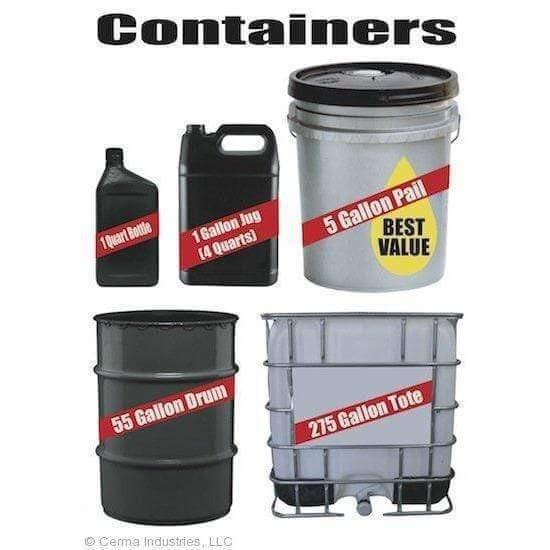
Ready-to-use full-viscosity hydraulic fluid — no blending required. Available in 6 sizes from quart to 55-gallon drum for small hydraulics, fleet service, and industrial plant maintenance.
✅ Triple-Shield Protection Technology
Hydraulic systems have three distinct failure modes. Cermax defends against each with a dedicated protection mechanism:
| Shield | What It Defends Against |
|---|---|
| Shield 1: Anti-Wear SiC Ceramic | Mechanical wear on pump vanes, gears, pistons, valve lands, and cylinder surfaces — SiC bonds permanently to metal for ongoing protection beyond what depleting additives provide |
| Shield 2: Anti-Cavitation Air Release | Pump cavitation damage caused by trapped air bubbles collapsing against metal surfaces — advanced air-release chemistry helps prevent cavitation erosion and air-lock conditions |
| Shield 3: Thermal-Stability Base | Oxidation, thermal breakdown, and viscosity loss under sustained heat — premium base oil with oxidation inhibitor package extends fluid service life |
🔬 Advanced Features
- STM-3 Nano Silicon Carbide ceramic technology — Mohs 9.5 hardness, 2,730°C melting point, permanent bond to pump, cylinder, and valve surfaces
- ISO VG 46 viscosity grade — the most common industrial and mobile hydraulic specification (kinematic viscosity ~46 cSt at 40°C)
- Zinc-free / ashless AW chemistry + SiC — SiC provides the anti-wear protection traditionally delivered by ZnDTP, without relying on depleting zinc additives
- Superior air release & anti-foam — reduces entrained air that causes cavitation damage and spongy cylinder response
- High oxidation stability — resists the thermal breakdown that creates varnish, sludge, and premature fluid failure
- Moisture demulsibility — separates rapidly from water contamination so water can be drained from reservoir sumps
- Improved cold flow — maintains flow characteristics at low temperatures for reliable cold-start operation
- Meets or exceeds DIN 51524 Part 2 (HLP) performance targets — the German industrial hydraulic oil standard used as a global benchmark*
- Compatible with all standard hydraulic seal materials — Buna-N (NBR), Viton (FKM), polyurethane, hydrogenated nitrile (HNBR)
- PTFE-Free, Solvent-Free, Environmentally Safe formulation — made in the USA
🧪 Why SiC Technology Matters for Hydraulic Oil: Most premium AW hydraulic oils rely on Zinc Dialkyl Dithiophosphate (ZnDTP) as the anti-wear additive — an excellent, proven chemistry that reacts with metal surfaces under pressure and heat to form a sacrificial protective film. The limitation: ZnDTP is consumed as it protects, and concentration drops with use. Once depleted, the fluid can no longer protect pump and valve components. Cermax's STM-3 SiC technology works differently: nano-scale Silicon Carbide particles physically bond to metal surfaces under friction and temperature, forming a non-depleting ceramic layer that becomes part of the wear surface itself. Combined with standard anti-wear chemistry, this creates dual-layer protection: active chemistry while the oil is fresh, plus permanent ceramic once bonding is complete.
⚙️ How STM-3 Technology Solves Common Hydraulic Problems
| Hydraulic Problem | How Cermax AW46 Addresses It |
|---|---|
| Oil overheating & thermal breakdown | SiC reduces friction at metal contact points → lower heat generation → premium oxidation-inhibited base stock resists degradation |
| Pump cavitation & erosion damage | Anti-cavitation air release reduces trapped air content that causes erosion pitting on pump internal surfaces |
| Seal leaks & premature seal failure | Compatible with all standard seal materials; lower operating temperatures reduce thermal seal degradation |
| Unstable ram & cylinder operation | Reduced entrained air and consistent viscosity improve hydraulic stiffness and ram control precision |
| Water contamination & corrosion | Rapid demulsibility separates water from oil in the reservoir; rust/corrosion inhibitors protect ferrous components |
| Sluggish cold-weather startup | Improved cold-flow viscosity maintains pump priming and fluid movement at low ambient temperatures |
| Frequent oil changes & high maintenance cost | Extended fluid life from lower operating temperatures + oxidation-stable base stock reduces change intervals and downtime |
📦 Choose Your Size — 6 Variants Available
| Size | Best For |
|---|---|
| Quart (32 fl oz) | Top-offs, small hydraulic systems, log splitters, portable equipment |
| 12 Quart Case | Multiple system fills, mid-size shop inventory, field service trucks |
| 1 Gallon (128 fl oz) | Small-to-medium hydraulic systems, individual machine service |
| 4 Gallon Case | Equipment fleets, construction yards, farm shops, multi-machine service |
| 5 Gallon Pail | Heavy equipment, commercial operations, industrial hydraulic systems |
| 55 Gallon Drum | Large fleets, dealerships, industrial plants, manufacturing operations |
See variant dropdown above for current pricing. Bundle & Save discounts apply on multi-unit orders. For industrial bulk pricing (totes, tank-truck delivery) beyond listed sizes, call 239-344-9861.
📋 How to Use Cermax AW46 Hydraulic Oil
- Verify system specification — confirm your equipment calls for ISO VG 46 (also labeled AW46, HLP 46, HM 46, HF-46, or simply "46 hydraulic oil"). Never substitute AW46 for brake fluid, hydrostatic transmission fluid, fire-resistant fluid, or food-grade hydraulic oil — see warning below.
- Prepare the system — allow the equipment to reach a normal operating state, then shut down and let pressure bleed off. Never open a pressurized hydraulic system.
- Drain existing fluid — drain the reservoir through the drain port. For thorough service, also drain residual fluid from cylinders by actuating them to their fully retracted/extended positions before removing hoses.
- Replace filter(s) — install new return-line and/or suction-strainer filters at the same time as the fluid change. Old filters hold contaminated fluid that will mix back into the new oil on startup.
- Fill reservoir — pour Cermax AW46 through the fill port to the proper level indicator (sight glass, dipstick, or fill line). Avoid overfilling — hydraulic oil expands when warmed.
- Cycle & bleed — start the system at low speed/pressure and cycle all hydraulic circuits slowly through their full range of motion to purge trapped air. On larger systems, some cylinders have bleed screws; consult equipment manual.
- Recheck level & inspect — after initial cycling, shut down, let settle for 5–10 minutes, and recheck reservoir level. Top off as needed. Inspect for leaks at all fittings, hose connections, and the filter housing.
- Ongoing protection — the SiC ceramic bond builds over the first hours of operation. Continue using Cermax for all subsequent top-offs and fluid changes to maintain ceramic concentration.
⚠️ Critical — NOT Suitable For: Cermax AW46 is a standard anti-wear hydraulic oil and must not be substituted for specialty hydraulic fluids. Do NOT use in: (1) Automotive brake systems — requires DOT 3/4/5.1 brake fluid; (2) Hydrostatic transmissions — typically requires J20C-spec tractor hydraulic fluid (HyTran, 303, UTTO, THF); (3) Fire-resistant hydraulic systems — requires HFA, HFB, HFC, or HFD-type fluids for mining, steel mills, molten-metal environments; (4) Food-grade / incidental-contact machinery — requires NSF H-1 registered hydraulic oil; (5) Aerospace / military hydraulics — requires MIL-PRF-5606, MIL-PRF-83282, or equivalent specs; (6) Refrigeration systems — requires refrigeration compressor oil. When in doubt, consult your equipment service manual or call 239-344-9861.
📊 Technical Specifications
| Specification | Details |
|---|---|
| Type | Anti-wear hydraulic oil with STM-3 Nano SiC ceramic technology |
| ISO Viscosity Grade | ISO VG 46 (AW46 / HLP 46 / HM 46) |
| Kinematic Viscosity @ 40°C | Approximately 46 cSt (per ISO VG 46 standard) |
| Industry Standards | Formulated to meet DIN 51524 Part 2 (HLP), ISO 11158 HM, and ASTM D6158 HM performance targets* |
| Pump Test Compatibility | Formulated to meet anti-wear requirements of major pump manufacturer specifications including Denison HF-0/HF-1/HF-2 and Vickers 35VQ25 performance targets* |
| Ceramic Technology | STM-3 Nano Silicon Carbide (SiC) — Mohs 9.5 hardness, 2,730°C melting point |
| Seal Compatibility | All standard hydraulic elastomers — Buna-N (NBR), Viton (FKM), polyurethane, hydrogenated nitrile (HNBR), EPDM |
| Durability Features | Moisture demulsibility, heat resistant, cold resistant, rust/oxidation inhibited, anti-wear, anti-foam |
| Suitable For | Hydraulic pumps (gear, vane, piston), cylinders, valves, rams — all standard industrial and mobile hydraulics |
| Additive Properties | PTFE-Free, Solvent-Free, Environmentally Safe |
| Made In | USA — Fort Myers, FL (Bijou Inc.) |
⚙️ Ideal Applications
- Hydraulic pumps — gear, vane, and piston designs (fixed and variable displacement)
- Hydraulic cylinders and rams in mobile and industrial applications
- Construction equipment — excavators, loaders, backhoes, skid steers, dozers
- Agricultural equipment — tractor implements, sprayers, hay equipment (non-hydrostatic hydraulic circuits only)
- Industrial hydraulics — presses, injection molding machines, stamping, CNC machine tools
- Forestry & logging equipment — skidders, forwarders, log loaders
- Material handling — forklifts, scissor lifts, boom lifts, dock equipment
- Marine hydraulic systems — steering, winches, hatches (closed-loop marine hydraulics)
- Hydraulic log splitters and wood processing equipment
- Snow plows, salt spreaders, cold-climate municipal equipment
- Machine tool hydraulics — lathes, milling machines, grinders
- Stationary industrial hydraulic power units (HPUs)
🛡️ Cermax AW46 vs Standard AW46 Hydraulic Oil
| Feature | Cermax AW46 | Standard AW46 |
|---|---|---|
| Ceramic SiC Technology | ✅ Permanent ceramic bond | ❌ None |
| Anti-Wear Chemistry | ✅ AW additive + SiC ceramic layer | ZnDTP zinc additive (depletes) |
| Operating Temperature | ✅ Reduced under load | Standard |
| Cavitation Resistance | ✅ Enhanced air release | Standard |
| Seal Life | ✅ Extended (lower temps) | Standard thermal degradation |
| Moisture Handling | ✅ Superior demulsibility | Basic |
| Cold Flow | ✅ Improved | Standard |
| Fluid Life | Extended — lower temps + SiC protection* | Standard intervals |
| Total Cost of Ownership | Lower — fewer changes, less downtime | Higher |
🔗 Complete Your Cerma Equipment Protection
Pair Cermax AW46 Hydraulic Oil with other Cerma ceramic products for total equipment coverage:
- Cerma Ceramic Hydraulic Treatment — one-time concentrated ceramic additive for deeper initial SiC bond in hydraulic systems
- Cerma STM-3 Engine Treatments — ceramic protection for gas and diesel equipment engines
- Cermax Motor Oils — ceramic synthetic oils for equipment engines (up to 30,000-mile intervals)
- Cerma 75W-90 Gear Oil — GL-5 ceramic gear oil for equipment differentials and final drives
- Cerma Gear Box & Axle Treatment — one-time ceramic treatment for gear sets
- Cerma Transmission Treatments — ceramic protection for equipment transmissions
- Cerma Gas Fuel Treatment — clean injectors, stabilize ethanol fuel
- Cerma Diesel Fuel Treatment — for diesel equipment fuel systems
🔬 Technical & Application FAQs
Cermax AW46 can stop cavitation from getting worse and in early cases help restore normal operation, but it cannot reverse physical damage that has already occurred. Cavitation damage shows up as pitting erosion on pump vanes, gear faces, valve lands, and cylinder surfaces — actual metal has been removed by collapsing vapor bubbles. No fluid can replace metal that's gone. What Cermax can do: (1) reduce entrained air that causes cavitation in the first place, addressing the root cause; (2) lay a SiC ceramic layer on damaged surfaces that partially compensates for the wear; and (3) lower operating temperatures that accelerate cavitation progression. If cavitation is caught early (noise, pressure drop, reduced performance) and Cermax is installed before serious erosion, many pumps continue serving years of useful life. If cavitation has progressed to the point of pressure loss, overheating, or visible metal debris in the filter, plan for pump rebuild or replacement regardless of fluid choice. Also check: suction-line restrictions, clogged strainer, low reservoir level, or worn pump-shaft seals — these are the mechanical causes of cavitation that Cermax cannot fix.
These are two different products that work together. Cermax AW46 Hydraulic Oil (this product) is the hydraulic fluid itself — a full-viscosity ISO VG 46 anti-wear hydraulic oil with SiC ceramic technology built into the base formulation. It replaces your existing hydraulic fluid. Cerma Ceramic Hydraulic Treatment is a one-time concentrated ceramic additive that's added to your existing hydraulic oil to deliver a high-dose SiC bond to system components. The treatment is added once; its ceramic benefit survives subsequent fluid changes. Which should you use? For maximum initial SiC protection on established systems, many customers use both: add the Treatment first to create a deeper ceramic foundation, then use Cermax AW46 for all subsequent fluid service. The Treatment is typically the higher protection-per-dollar option for an existing system; Cermax AW46 is the right choice when you need a full fluid change regardless. For new hydraulic systems or critical high-value equipment, using both delivers the deepest protection.
Yes, for emergency top-offs. Cermax AW46 is fully compatible with standard AW46 / ISO VG 46 hydraulic oils from major brands (Mobil DTE 25, Shell Tellus S2, Chevron Rando HD, Valvoline AW46, Amsoil AW, Lucas, Pennzoil AW, etc.). Mixing won't damage anything. However, for full SiC ceramic benefit, a complete drain-and-fill is strongly recommended — not mixed top-off. Three reasons: (1) the SiC technology works best at full concentration; (2) ceramic bonding builds faster when the fluid is entirely Cermax; and (3) old hydraulic oil often carries accumulated contamination (water, particulates, oxidized compounds, varnish precursors) that dilutes the protective chemistry. Best practice: drain the reservoir during a scheduled maintenance window, replace the hydraulic filter, refill entirely with Cermax AW46, and cycle the system to purge air. Exception — don't mix with non-standard fluids: if your current system runs fire-resistant fluid (HFA/HFB/HFC/HFD), food-grade NSF H-1 oil, biodegradable ester-based hydraulic oil, or phosphate ester fluid, do NOT mix with Cermax — these chemistries are incompatible and can cause serious system problems.
Follow your equipment manufacturer's recommended hydraulic fluid change interval as the baseline. Typical intervals: mobile hydraulics (construction, agricultural) — 1,000–2,000 hours; industrial stationary hydraulics — 2,000–4,000 hours; severe-duty applications (high-temp, dusty environment, heavy contamination) — shorter intervals. Because Cermax AW46 typically runs at lower operating temperatures and resists oxidation better than conventional fluids, many operations find they can extend intervals. However, fluid condition is the correct trigger, not hours alone. The professional approach is periodic oil analysis (ISO 4406 particle count, water content via Karl Fischer, TAN/TBN acidity, elemental wear metal analysis) sent to a lab like Polaris or Blackstone every 250–500 hours of service. The analysis tells you when the fluid is actually degrading — not an arbitrary calendar date. For critical or high-value systems (industrial presses, hydraulic power units running 24/7), oil analysis pays for itself in extended change intervals and early failure detection. For simple mobile equipment, following manufacturer intervals with Cermax typically yields good service life and equipment protection.
ISO VG 46 is the ISO Viscosity Grade system — the number (46) represents the oil's kinematic viscosity in centistokes (cSt) at 40°C (104°F). Lower number = thinner; higher number = thicker. The most common hydraulic viscosity grades are ISO VG 32, 46, and 68. AW stands for Anti-Wear — the additive package (traditionally ZnDTP) that protects pump components under load. "AW46" = anti-wear hydraulic oil with ISO VG 46 viscosity. Which viscosity should you use? Always match your equipment manufacturer's specification — this is non-negotiable. As a general guide: ISO VG 32 is typically used in colder-climate mobile hydraulics, some aviation ground support, and systems that run cool; ISO VG 46 is the most common general-purpose grade for industrial and most mobile hydraulics in moderate climates (the global default); ISO VG 68 is for warmer-climate or higher-temperature applications, heavy industrial hydraulics, and systems with higher loads or pressures. Substituting a different viscosity than what's specified can cause pump cavitation (too thick = insufficient pump intake flow) or excessive internal leakage and reduced pressure (too thin = fluid bypasses pump clearances). Don't substitute AW46 for a system that calls for AW32 or AW68 without confirming with the equipment manufacturer.
Yes — Cermax AW46 is formulated to be compatible with all standard hydraulic elastomer materials: Buna-N / nitrile (NBR) — the most common hydraulic seal material; Viton / FKM — used in high-temperature applications; polyurethane (PU) — common in cylinder rod seals; hydrogenated nitrile (HNBR) — heavy-duty applications; and EPDM — some specialty applications. Cermax is also compatible with standard hydraulic hose liners (nitrile, synthetic rubber compounds used in SAE 100R1/R2/R17 and similar hoses). Hydraulic filters: Cermax works with all standard return-line, pressure, and suction filters. There is no special filtration concern — the SiC particles are nano-scale (far below the 10–25 micron filtration threshold of typical hydraulic filters) and remain suspended or bonded rather than clogging filter media. In fact, because Cermax runs cleaner with reduced oxidation byproducts, filters typically last as long as or longer than with conventional hydraulic oil. Exception: a small number of specialty systems use non-standard seal compounds (phosphate-ester-resistant EPDM, specific silicone formulations, or legacy leather/cork seals in very old equipment). If your system has unusual seal materials, verify compatibility with your equipment manufacturer before switching.
Standard AW hydraulic oils rely on Zinc Dialkyl Dithiophosphate (ZnDTP or ZDDP) — a proven chemistry that's been the industry workhorse for decades. Under pressure and heat, ZnDTP molecules react with metal surfaces to form a sacrificial phosphate/sulfide film that absorbs wear energy instead of the base metal. It works well — but the chemistry is consumed as it protects. Over time, the ZnDTP concentration drops, and once depleted, protection fails. This is why hydraulic oil change intervals exist: the fluid may still look fine visually, but the additive package is exhausted. Cermax's STM-3 SiC technology works through a different mechanism. Nano-Silicon Carbide particles physically bond to metal surfaces under the same friction/heat conditions that drive ZnDTP chemistry — but SiC becomes a permanent ceramic layer rather than a consumable film. Key advantages: (1) Mohs 9.5 hardness vs ZnDTP's soft chemical film; (2) does not deplete with use; (3) survives subsequent fluid changes; (4) works alongside traditional AW chemistry rather than replacing it, giving dual-layer protection. Practical result: Cermax combines the active chemistry of traditional ZnDTP-style AW protection with the permanence of ceramic surface bonding. Many industrial users describe Cermax as "the next evolution of AW hydraulic oil" rather than a replacement for ZnDTP chemistry.
No — Cermax AW46 is a standard industrial anti-wear hydraulic oil and is not suitable for any of these specialty categories. Each has specific regulatory requirements that Cermax does not meet: Food-grade (incidental contact) — requires NSF H-1 registration, which mandates specific base stocks and additive restrictions to be safe for incidental food contact (food processing plants, bottling lines, packaging equipment). Use a purpose-made NSF H-1 hydraulic oil instead. Biodegradable — environmentally-sensitive applications (marine near-shore, forestry in watersheds, agricultural spray operations) may require hydraulic fluid certified to ISO 15380 HEES (synthetic ester), HETG (vegetable oil), or similar biodegradability standards. Cermax is environmentally safe in the broad sense (PTFE-free, solvent-free) but is not certified biodegradable — it's a petroleum-based industrial hydraulic oil. Fire-resistant — applications near open flame, molten metal, or high-ignition environments (steel mills, mining, foundries, die-casting) require HFA, HFB, HFC, or HFD-type fire-resistant fluids that won't ignite when sprayed on hot surfaces. Cermax is a standard petroleum oil and will burn — do not use in fire-hazard applications. If your operation has any of these regulatory requirements, purchase a purpose-certified product from a supplier specializing in that category. For standard industrial and mobile hydraulics (construction, agriculture, machine tools, presses, log splitters, lifts, general equipment), Cermax AW46 is the appropriate choice.
Made in the USA by Cerma Treatment (Bijou Inc.), Fort Myers, FL. 30-day return policy. Free shipping on orders over $150. Ships to US & Canada. Fleet and industrial bulk pricing available beyond listed sizes. Questions? Call 239-344-9861 or email info@cermatreatment.com.
*Performance claims including extended fluid life, temperature reduction, cavitation reduction, and industry specification compliance (DIN 51524 HLP, ISO 11158 HM, ASTM D6158, Denison HF-0/HF-1/HF-2, Vickers 35VQ25) represent formulation targets and typical results under normal service conditions. Individual hydraulic system performance varies based on pump type and condition, system design, filtration, operating environment, contamination levels, and maintenance practices. Pump manufacturer specification references (Denison, Vickers, and others) are used here for performance identification only and are property of their respective owners (Parker Hannifin, Eaton, etc.). Cermax AW46 is NOT suitable for automotive brake fluid, hydrostatic transmission fluid (J20C/HyTran), fire-resistant hydraulic fluid (HFA/HFB/HFC/HFD), food-grade / NSF H-1 applications, aerospace/military hydraulics (MIL-PRF-5606/83282), refrigeration compressor oil, or biodegradable-certified (ISO 15380) applications — use purpose-made fluid for these specialty requirements. Always verify your equipment manufacturer's hydraulic fluid specification and change interval before installation.
Share