
Cerma
Ceramic-Enhanced Power Steering Fluid with STM-3® SiC Protection
Ceramic-Enhanced Power Steering Fluid with STM-3® SiC Protection
Couldn't load pickup availability
Ceramic-Enhanced Power Steering Fluid with STM-3® SiC Protection
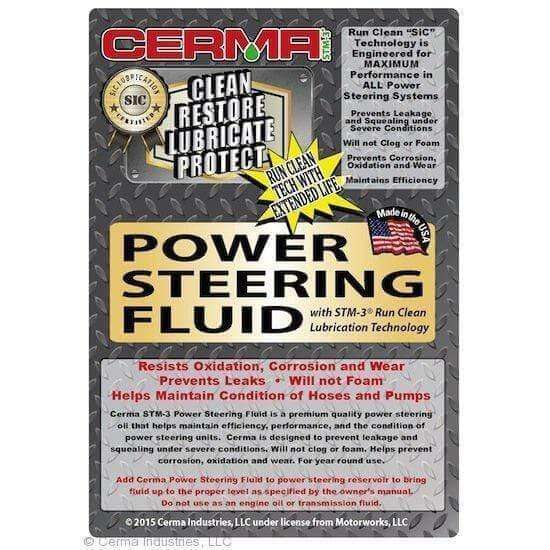
Cerma Ceramic Power Steering Fluid is a premium hydraulic power steering fluid enhanced with STM-3® Nano Silicon Carbide (SiC) ceramic technology. Delivers triple protection — anti-wear, anti-deposit, anti-corrosion — inside the power steering pump, rack, and lines of vehicles that use hydraulic power assist. The SiC ceramic particles help build a protective ceramic layer on internal metal surfaces of the pump and rack, reducing wear progression, supporting seal integrity, and helping extend service life of the entire power steering system.
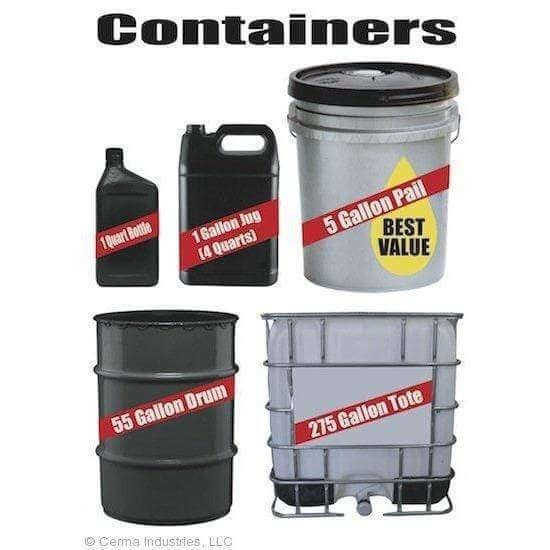
Six sizes from Quart to 55-Gallon Drum — covering everything from single-vehicle DIY service to dealership, fleet, and marine-service volumes. Made in the USA by Bijou Inc. in Fort Myers, FL. PTFE-free, solvent-free.
What Cerma Ceramic Power Steering Fluid Does
- STM-3® SiC ceramic wear protection — Nano Silicon Carbide particles help build a permanent ceramic layer on the metal surfaces inside your power steering pump and rack. Reduces wear progression at the vane-to-cam-ring contact points (in vane-type pumps) and the rotor-to-housing contacts (in rotary pumps) that drive pump wear over time.
- Helps reduce fluid-related pump noise — power steering moan, whine, and squeal can come from several causes (we'll explain which ones Cerma addresses in detail below). For noise caused by fluid aeration, fluid breakdown, or internal friction from accumulated wear, Cerma's anti-foam chemistry and ceramic wear layer help address the underlying cause rather than masking it.
- Anti-foam chemistry — formulated to resist air entrainment under the high-pressure, high-shear conditions inside a power steering pump. Air in the fluid causes the "whoosh" or "moaning" sounds, erratic steering feel, and accelerated fluid breakdown. Quality anti-foam additive chemistry is essential for all hydraulic fluids and Cerma includes a current-generation package.
- Seal conditioner package — includes seal-conditioning additives that help maintain elastomer seal integrity. Important note: seal conditioners help preserve existing functional seals; they do not rebuild failed or hardened seals. If your PS system is already leaking at a damaged seal, the seal needs mechanical replacement.
- Anti-corrosion protection — inhibits rust and corrosion on pump, rack, and line internals. Especially valuable for marine hydraulic steering where moisture and salt exposure shorten hydraulic component life.
- Thermal stability — resists viscosity breakdown across operating temperature range. Power steering pumps generate significant heat during sustained steering loads (towing, off-road, parallel parking); thermal stability helps maintain consistent fluid pressure and response.
- Cold-flow properties — maintains reasonable viscosity and flow at cold-weather startup temperatures, helping prevent the pump strain and squeal common on cold mornings with aged fluid.
- Extended fluid service life compared to basic universal PS fluid — the synthetic base and STM-3 technology support longer service intervals before fluid breakdown becomes a concern.
- PTFE-free, solvent-free — no Teflon particles, no petroleum solvents that could affect elastomer seals.
Power Steering Problems Cerma Addresses
| Symptom | Likely Cause | How Cerma Helps |
|---|---|---|
| Whine or moan during turns | Air entrainment, fluid breakdown | Anti-foam chemistry + fresh fluid clears air from the system |
| High-pressure squeal at full lock | Pump internal wear, fluid thermal breakdown | SiC ceramic layer helps reduce wear; thermal-stable base oil resists breakdown |
| Stiff or jerky steering feel | Fluid contamination, deposit buildup in rack valving | Detergent chemistry helps clear deposits; fresh fluid restores normal viscosity |
| Foaming / bubbles in reservoir | Anti-foam additive depletion, low fluid level, air leak on suction side | Current anti-foam package; note: check for suction-side air leaks mechanically |
| Cold-morning steering squeal | Fluid thickened from age and oxidation; cold-flow viscosity loss | Synthetic base maintains better cold-flow; fresh fluid restores viscosity spec |
| Progressive pump failure over time | Accumulated wear at vane-to-ring and rotor contact points | SiC ceramic layer helps reduce wear progression; supports extended pump life |
| Belt squeal (mistaken for PS squeal) | Glazed serpentine belt, failing tensioner, pulley misalignment | Cerma cannot fix belt/tensioner issues — inspect belt and tensioner mechanically |
Available Sizes & Bulk Pricing Ladder
| Size | Price | Per Quart | Best For |
|---|---|---|---|
| Quart (32 oz) | $14.09 | $14.09 | Single-vehicle flush and fill; top-offs; first-time users |
| 12-Quart Case | $143.78 | $11.98 | Multi-vehicle households, small shops, case-buy inventory |
| 1 Gallon (128 oz / 4 quarts) | $52.91 | $13.23 | Larger vehicles with higher PS capacity; multiple service events |
| 4-Gallon Case (16 quarts) | $178.28 | $11.14 | Service shops and repair facilities — best mid-tier per-unit value |
| 5-Gallon Pail (20 quarts) | $180.58 | $9.03 | Fleet maintenance operations, high-volume service shops |
| 55-Gallon Drum (220 quarts) | $1,404.40 | $6.38 | Dealerships, large fleet operations, marine service, drum-and-pump dispensing |
Per-quart cost drops progressively at larger sizes — the 55-gallon drum is 55% less per quart than single-quart pricing. For distributor or multi-drum volume, call 239-344-9861 for pallet pricing quotes.
Compatibility — Universal Hydraulic Power Steering
| Application | Notes |
|---|---|
| Cars with generic-PS-fluid spec | Domestic (older GM/Ford vehicles specifying generic PS fluid), many import vehicles specifying non-proprietary fluid. Verify owner's manual. |
| Light-duty trucks & pickups | Most full-size pickups with hydraulic PS (F-150, Silverado, Ram, Sierra, Tundra, Titan) — check specific year/model spec. Many allow universal PS fluid; some specify proprietary fluid. |
| Heavy-duty trucks & commercial | Class 3–8 trucks with hydraulic PS typically allow universal or Dexron-III; verify spec per manufacturer. |
| SUVs & crossovers | Same as car section — verify whether your OEM specifies universal or proprietary. |
| Vans (passenger & commercial) | Ford Transit, Chevrolet Express/Savana, Mercedes Sprinter, Ram ProMaster — verify spec; Sprinter typically Pentosin-spec. |
| RVs & motorhomes | Class A/B/C motorhomes on Ford/Chevy/Workhorse/Freightliner chassis — follow chassis manufacturer's PS fluid spec. |
| Marine hydraulic steering | ✓ Compatible. Most marine hydraulic steering systems (SeaStar, Teleflex, Capilano, Uflex) use universal hydraulic PS fluid or ATF. SiC ceramic and corrosion inhibitors especially valuable in marine/saltwater environments. |
| Golf carts, UTVs (with hydraulic PS) | Gas-powered golf carts and UTVs with hydraulic PS typically use universal PS fluid. |
| Hydraulic power assist (trailer brake, steering booster) | Compatible with generic hydraulic fluid applications; verify spec. |
| Electric Power Steering (EPS) vehicles | ❌ Not applicable. EPS systems use no fluid. Most vehicles 2015+ and many earlier have EPS — no power steering fluid cap under the hood = likely EPS. Do not attempt to add fluid to EPS vehicles. |
📋 How to Use — Full Flush vs. Top-Off
Full Flush (recommended — maximum benefit):
- Locate the power steering reservoir — usually near the engine labeled with a steering wheel icon.
- Siphon or extract old fluid from the reservoir using a turkey baster, fluid extractor, or service-shop evac pump. For the most thorough flush, shops use a machine-flush procedure that cycles through the entire system.
- Refill with Cerma Ceramic Power Steering Fluid to the "Full Cold" level.
- Start the engine and turn the steering wheel lock-to-lock slowly 10–15 times with the engine at idle. This circulates new fluid through pump, rack, and return lines.
- Check level and top up to the "Full" mark. Repeat the evac/refill cycle if the reservoir still looks contaminated after first fill — multiple partial flushes gradually replace nearly all old fluid in the system.
- Road-test. The SiC ceramic layer begins developing immediately and strengthens with continued use.
Top-Off (maintenance top-ups on correct-spec systems):
- If your vehicle specifies universal PS fluid and the current fluid is Cerma or a compatible universal fluid, add Cerma Ceramic Power Steering Fluid to bring level to the "Full" mark.
- If uncertain of the existing fluid type or if your system specifies proprietary OEM fluid, do a full flush rather than mixing — some OEM-proprietary fluids are not fully compatible with universal hydraulic PS fluid.
Cerma Ceramic vs. Standard Power Steering Fluid
| Feature | Cerma Ceramic PS Fluid | Standard Universal PS Fluid |
|---|---|---|
| SiC ceramic wear layer | ✓ Yes | ✗ No |
| Anti-foam chemistry | Current-generation | Basic to current, varies by brand |
| Seal conditioner package | ✓ Yes | Varies |
| Anti-corrosion inhibitors | Strong — marine-capable | Varies by brand |
| Synthetic base oil | ✓ Yes | Varies (mineral, semi-synth, or synth) |
| Thermal stability | Strong | Varies |
| PTFE-free / solvent-free | ✓ Yes | Varies — some contain PTFE |
| Bulk sizes for shops/fleets | ✓ Up to 55-gallon drum | Brand-dependent |
Related Cerma Products
- Cerma Ceramic Power Steering Treatment — one-time concentrated SiC ceramic additive for deeper initial bonding
- Cerma STM-3 Engine Treatment — one-time ceramic protection for engine internals
- Cermax Ceramic Synthetic Motor Oils — SiC-enhanced extended-interval engine oils
- Cerma Transmission Treatment — ceramic protection for automatic and manual transmissions
- Cerma Ceramic Hydraulic Treatment — for construction, agricultural, and industrial hydraulic systems
- Cerma Blue Ice A/C Treatment — A/C compressor ceramic protection
Frequently Asked Questions
Check your owner's manual for the power steering fluid specification. Cerma Ceramic Power Steering Fluid is a universal hydraulic PS fluid — it works for vehicles that specify generic "power steering fluid" or equivalent. It is not a direct substitute for these OEM-proprietary fluids: Honda/Acura (Honda PSF-II or PSF-S), BMW / Mercedes-Benz / VW / Audi / Volvo / Porsche (Pentosin CHF 11S or CHF 202), Toyota/Lexus (Toyota PSF), Chrysler/Dodge/Ram/Jeep (Mopar MS-5931, MS-11655, or specified ATF+4), some older GM (Dexron-III/VI where PS system shares ATF spec), some older Ford (Mercon or Type F where PS system shares ATF spec). Using Cerma in vehicles requiring proprietary fluid can damage seals and may void warranty coverage — use only the OEM-specified fluid in those vehicles. When in doubt: call us at 239-344-9861 with your year/make/model/engine and we'll verify whether Cerma is appropriate for your specific vehicle. Newer vehicles (2015+) typically use electric power steering (EPS) and require no fluid at all — check for a PS reservoir cap under the hood to confirm.
Depends on what's causing the squeal. Cerma can help with these causes: fluid breakdown or contamination (old dark/burnt fluid causing internal friction), fluid aeration/foaming (bubbles in the fluid producing moaning or whine), high-pressure squeal at full lock from accumulated pump internal wear, and cold-startup squeal from thickened aged fluid. After a full flush with Cerma, many customers experience noticeable noise reduction — sometimes within minutes, sometimes over the first few drives as the SiC ceramic layer develops and old fluid is fully purged. Cerma cannot fix these causes: glazed or worn serpentine/drive belt (replace the belt — common and often mistaken for pump squeal); failed belt tensioner (replace the tensioner); severely mechanically damaged pump internals (bearing failure, broken vanes, scored cam ring); failed pulley or misalignment. Diagnostic test: spray a little water on the serpentine belt while the engine is running — if the noise changes, the squeal is belt-related and no fluid change will fix it. If the noise stays the same and a full Cerma flush doesn't help, the pump likely needs rebuild or replacement.
Mixing is possible for small top-offs on vehicles that already use universal hydraulic PS fluid, but a full flush is strongly preferred for several reasons. (1) Full flush unlocks the full SiC ceramic benefit — diluting Cerma with old degraded fluid reduces the ceramic concentration reaching your pump's metal surfaces. (2) Full flush removes contamination — old PS fluid accumulates moisture, acid, micro-wear particles, and oxidation byproducts that keep damaging components even after new fluid is added. (3) Avoid proprietary-fluid mixing. Never mix Cerma with proprietary OEM fluids (Honda PSF, Pentosin, Toyota PSF, Mopar ATF+4) — different chemistries may not be fully compatible and mixed systems can cause seal swelling, foaming, or performance issues. If your system currently has proprietary fluid, either stay with the OEM fluid or perform a complete flush (with full system drainage and refill) before switching to Cerma.
Yes — and marine is actually one of the strongest use cases. Marine hydraulic steering systems (SeaStar/Teleflex, Capilano, Uflex, and similar) typically use universal hydraulic PS fluid or ATF-equivalent fluid. Boat hydraulic steering components live in an environment with constant moisture exposure, periodic salt-water contact, and long off-season storage periods where water and corrosion can work on internal metals. Cerma's anti-corrosion chemistry and SiC ceramic wear layer provide meaningful protection in this application. Compatibility note: verify your specific marine steering system's fluid specification — most use universal or ATF, but some require proprietary fluids (SeaStar Touch specifies their proprietary fluid). Larger boats often consume gallons of hydraulic fluid per steering service; the 4-gallon case, 5-gallon pail, or 55-gallon drum sizing is efficient for marinas and boat-service operations.
Not strictly required — Cerma Ceramic Power Steering Fluid contains SiC ceramic technology on its own and provides meaningful protection as a standalone product. The Cerma Power Steering Treatment is a concentrated one-time additive that provides a higher-concentration ceramic dose to establish a deeper initial SiC bond on pump and rack metal surfaces. Recommended when: (1) your PS system has pre-existing mild symptoms (cold-start squeal, fluid breakdown, mild whine); (2) your pump is older and you want maximum extension of remaining service life; (3) you're doing a full system flush and want the strongest initial ceramic layer. Protocol: flush the system with Cerma fluid first, then add the Cerma Power Steering Treatment additive. Subsequent fluid changes use Cerma fluid alone. For a newer vehicle with no symptoms, Cerma fluid alone is typically sufficient.
Follow your vehicle manufacturer's recommended power steering fluid service interval as a baseline — typical intervals range from 30,000 to 100,000 miles depending on the vehicle. Many OEMs list PS fluid as "lifetime" or "severe service only," which in practice often means it never gets changed until a problem appears. Realistic practice: inspect the fluid every 30,000 miles — if the fluid is clean and light-colored, leave it; if it's dark, cloudy, smells burnt, or has visible contamination, do a flush. Cerma's synthetic base and SiC technology support longer service intervals than basic conventional PS fluid, but the SiC ceramic layer persists across fluid changes regardless (bonded to metal, not to the oil itself) — so changing the fluid doesn't reset ceramic protection. Signs it's time to change: dark brown or black fluid (normal is clear or light amber), burnt smell, foam or bubbles in the reservoir, loss of power assist in cold weather, or new pump noise.
Yes — fleet and shop volume is a primary use case. The 4-gallon case, 5-gallon pail, and 55-gallon drum sizes are priced for service operations: the 55-gallon drum lands at $6.38 per quart compared to $14.09 per quart for the single-quart consumer size — a 55% per-unit reduction at the bulk tier. Shops and fleet operators doing regular PS service (especially for marine, truck-fleet, commercial van, RV, or municipal/government fleet operations) can realize significant annual savings at bulk pricing. Drum-and-pump dispensing systems work well with the 55-gallon drum. For distributor-level pricing, pallet orders, or multi-drum quotes, call 239-344-9861. Cerma supports shop accounts with appropriate documentation and payment terms for qualifying service businesses and fleet operations.
Probably not — and this is important to confirm before ordering. Most vehicles from 2015+ use Electric Power Steering (EPS), which has no fluid reservoir and uses no fluid at all. EPS replaces the hydraulic pump with an electric motor driven by the car's electrical system. Quick test: open the hood and look for a small reservoir labeled with a steering wheel icon (sometimes just near the engine or on the firewall). If there's no such reservoir, your vehicle has EPS and Cerma Ceramic Power Steering Fluid does not apply. If you still see power steering-related symptoms on an EPS-equipped vehicle (heavy steering, unusual noise, intermittent loss of assist), the issue is electrical/electronic — the EPS motor, torque sensor, steering column module, or related electronics — and requires diagnostic/repair rather than fluid service. Typical EPS-equipped vehicles: most 2015+ cars and small SUVs, many 2010+ imports (Honda, Toyota, Nissan adopted EPS early), Ford's EcoBoost-equipped vehicles 2011+, GM's full lineup transitioning from 2010s onward. If you're unsure whether your vehicle has hydraulic or electric PS, call 239-344-9861 with your year/make/model.
Made in the USA by Cerma Treatment (Bijou Inc.), 15880 Summerlin Road #300 Box #301, Fort Myers, FL 33908. 30-day return policy. Free shipping on orders over $150. Ships to US & Canada. Shop, fleet, marine service, dealership, and distributor volume pricing available. Questions? Call 239-344-9861 or email info@cermatreatment.com. Use discount code C10 for 10% off.
Cerma STM-3® is a trademark of Bijou Inc. Cerma Ceramic Power Steering Fluid is a universal hydraulic power steering fluid suitable for vehicles specifying generic power steering fluid. Important fluid compatibility notice: many OEM vehicles specify proprietary power steering fluids that must be used to preserve seal compatibility and warranty coverage. Before use, verify your vehicle owner's manual power steering fluid specification. Cerma Ceramic Power Steering Fluid is not a direct substitute for OEM-proprietary fluids including Honda PSF-II/PSF-S (Honda/Acura); Pentosin CHF 11S/CHF 202 (BMW, Mercedes-Benz, Volkswagen, Audi, Volvo, Porsche, some other European); Toyota PSF (Toyota/Lexus/Scion); Mopar MS-5931/MS-11655 or ATF+4 for combined systems (Chrysler/Dodge/Ram/Jeep); Dexron-III/VI ATF (some older GM vehicles where PS system shares ATF specification); Mercon or Type F ATF (some older Ford vehicles where PS system shares ATF specification); or other OEM-proprietary fluids. For vehicles with electric power steering (EPS), no power steering fluid is used — do not attempt to add fluid to EPS systems. Performance claims represent formulation targets and typical results; individual outcomes vary based on vehicle condition, existing PS system wear, fluid history, driving conditions, and OEM compatibility. Cerma Ceramic Power Steering Fluid is a wear-protection and friction-reduction fluid; it is not a mechanical repair product and will not rebuild damaged seals, failed pump bearings, broken pump vanes, worn belt tensioners, glazed serpentine belts, or other mechanically failed components. Third-party brand references (Honda, Acura, BMW, Mercedes-Benz, Volkswagen, Audi, Volvo, Porsche, Toyota, Lexus, Scion, Chrysler, Dodge, Ram, Jeep, Mopar, General Motors, Chevrolet, GMC, Ford, Pentosin, Dexron, Mercon, SeaStar, Teleflex, Capilano, Uflex) are trademarks of their respective owners and are used for compatibility identification only — Cerma is not affiliated with or endorsed by any of these manufacturers.
Frequently Asked Questions
Cerma Ceramic Power Steering Fluid is a universal hydraulic power steering fluid enhanced with STM-3® Nano Silicon Carbide (SiC) ceramic technology. It provides triple protection — anti-wear, anti-deposit, anti-corrosion — for the internal metal surfaces of power steering pumps, racks, and lines. The SiC ceramic particles help build a permanent ceramic layer on pump and rack internals, reducing wear progression at the friction points that cause pump noise and eventual pump failure. Additional functions: anti-foam chemistry prevents air entrainment and bubbling in the fluid; seal conditioner package helps maintain elastomer seal integrity; corrosion inhibitors protect against rust and oxidation (especially valuable in marine applications); thermal stability resists viscosity breakdown at elevated operating temperatures; synthetic base oil supports cold-flow performance for reliable cold-weather starts. The fluid is PTFE-free, solvent-free, and environmentally safe. Made in the USA by Bijou Inc. in Fort Myers, FL. Positioned as a universal hydraulic PS fluid — for vehicles requiring OEM-proprietary fluids (Honda PSF-II, Pentosin CHF 11S/202, Toyota PSF, Mopar MS-5931/11655/ATF+4), use only the OEM-specified product.
It depends on what's causing the squeal. Power steering squeal has multiple possible root causes, and Cerma can help with some but not all. Cerma can help with: fluid breakdown squeal (old dark contaminated fluid causing internal friction) — replaced by fresh fluid with SiC ceramic protection; fluid aeration moaning or whine (bubbles in the fluid) — addressed by Cerma's anti-foam chemistry; cold-startup squeal from aged thickened fluid — resolved by fresh synthetic-based fluid; high-pressure squeal at full lock from accumulated pump internal wear — the SiC ceramic layer helps reduce further wear progression. Cerma cannot fix: glazed or worn serpentine/drive belt (mechanical replacement required — and this is the most common non-fluid cause of "power steering" noise); failed belt tensioner (replace mechanically); severely damaged pump internals requiring rebuild or replacement (bearing failure, broken vanes, scored cam ring); misaligned or failed pulleys. Diagnostic trick: if the noise changes when you spray a little water on the serpentine belt while the engine is running, the squeal is belt-related and no fluid change will resolve it. Many customers find Cerma stops the squeal completely; others find the squeal persists after a full flush and ends up needing mechanical repairs. Before purchase, call 239-344-9861 to discuss your specific symptoms and help determine whether fluid service is likely to resolve them.
Cerma Ceramic Power Steering Fluid is a universal hydraulic PS fluid suitable for vehicles whose owner's manual specifies generic "power steering fluid" or equivalent. Broadly compatible with: domestic cars and trucks specifying universal PS fluid; older GM vehicles specifying universal PS fluid (not those specifying Dexron-III for the PS system); older Ford vehicles specifying universal PS fluid (not those specifying Mercon ATF for the PS system); many heavy-duty trucks and commercial vehicles; RVs and motorhomes (follow chassis manufacturer's spec); marine hydraulic steering systems (SeaStar/Teleflex, Capilano, Uflex non-proprietary applications); golf carts and UTVs with hydraulic PS. NOT a direct substitute for these OEM-proprietary fluids — use OEM-specified fluid instead: Honda/Acura (requires Honda PSF-II or PSF-S); BMW / Mercedes-Benz / Volkswagen / Audi / Volvo / Porsche (typically requires Pentosin CHF 11S or CHF 202 green hydraulic fluid); Toyota/Lexus/Scion (requires Toyota PSF specification); Chrysler/Dodge/Ram/Jeep (requires Mopar MS-5931, MS-11655, or ATF+4 for combined systems); some GM vehicles where PS shares ATF spec (requires Dexron-III or VI as specified); some Ford vehicles where PS shares ATF spec (requires Mercon or Type F as specified). Electric Power Steering (EPS) vehicles — not applicable. Most vehicles 2015+ use EPS and have no fluid reservoir at all. Check the owner's manual or look for a PS reservoir cap under the hood — if none exists, your vehicle has EPS and no PS fluid is needed. When uncertain about your specific year/make/model, call 239-344-9861 for compatibility verification before ordering.
Six sizes with progressive per-unit pricing for different user profiles. Quart (32 oz) — $14.09: single-vehicle flush or top-off, first-time users, $14.09 per quart. 12-Quart Case — $143.78: multi-vehicle households, small shop case-buy, $11.98 per quart (15% per-unit discount vs. single quart). 1 Gallon (4 quarts) — $52.91: larger-capacity vehicles, multi-service convenience, $13.23 per quart. 4-Gallon Case (16 quarts) — $178.28: service shops and repair facilities, best mid-tier per-unit value at $11.14 per quart. 5-Gallon Pail (20 quarts) — $180.58: fleet maintenance operations, high-volume service shops, marinas, $9.03 per quart (36% per-unit discount vs. single quart). 55-Gallon Drum (220 quarts) — $1,404.40: dealerships, large fleet operations, marine service centers, distributor accounts, $6.38 per quart (55% per-unit discount vs. single quart). For pallet orders, distributor wholesale, or multi-drum pricing, call 239-344-9861. Free shipping applies to orders over $150 — the 12-Quart Case, 4-Gallon Case, 5-Gallon Pail, and 55-Gallon Drum qualify automatically.
Two installation approaches depending on whether you want maximum benefit or a simple top-off. Full flush (recommended): (1) Locate the PS reservoir — near the engine, marked with a steering wheel icon. (2) Using a fluid extractor pump, turkey baster, or shop evac tool, remove as much old fluid as possible from the reservoir. (3) Refill with Cerma Ceramic Power Steering Fluid to the "Full Cold" line. (4) Start the engine at idle and slowly turn the steering wheel lock-to-lock 10–15 times — this circulates new fluid through the pump, rack, and return lines. (5) Shut off the engine, check the level, top off to the "Full" mark. (6) For maximum effect, repeat the extract/refill cycle 2–3 times — each cycle replaces more of the old fluid remaining in the lines and rack (service shops often use a machine-flush procedure that cycles fluid completely). (7) Road test and verify normal steering feel and no leaks. The SiC ceramic layer begins developing immediately and strengthens over the first several drives. Simple top-off: if your current fluid is universal PS fluid or Cerma and you're just topping up to the full line, add Cerma directly — no flush required. Do not mix Cerma with proprietary OEM fluids (Honda PSF, Pentosin CHF, Toyota PSF, Mopar ATF+4) — if switching from proprietary to universal fluid, do a full flush rather than a mix. Safety: the engine should not be running during extraction or refill, and avoid running the pump dry at any point during service. For detailed step-by-step guidance or if you're uncertain, call 239-344-9861 before starting.
Share
