
Cerma
Cerma EVO Ceramic 0W-0 Synthetic Motor Oil Max MPG | Cerma
Cerma EVO Ceramic 0W-0 Synthetic Motor Oil Max MPG | Cerma
Couldn't load pickup availability
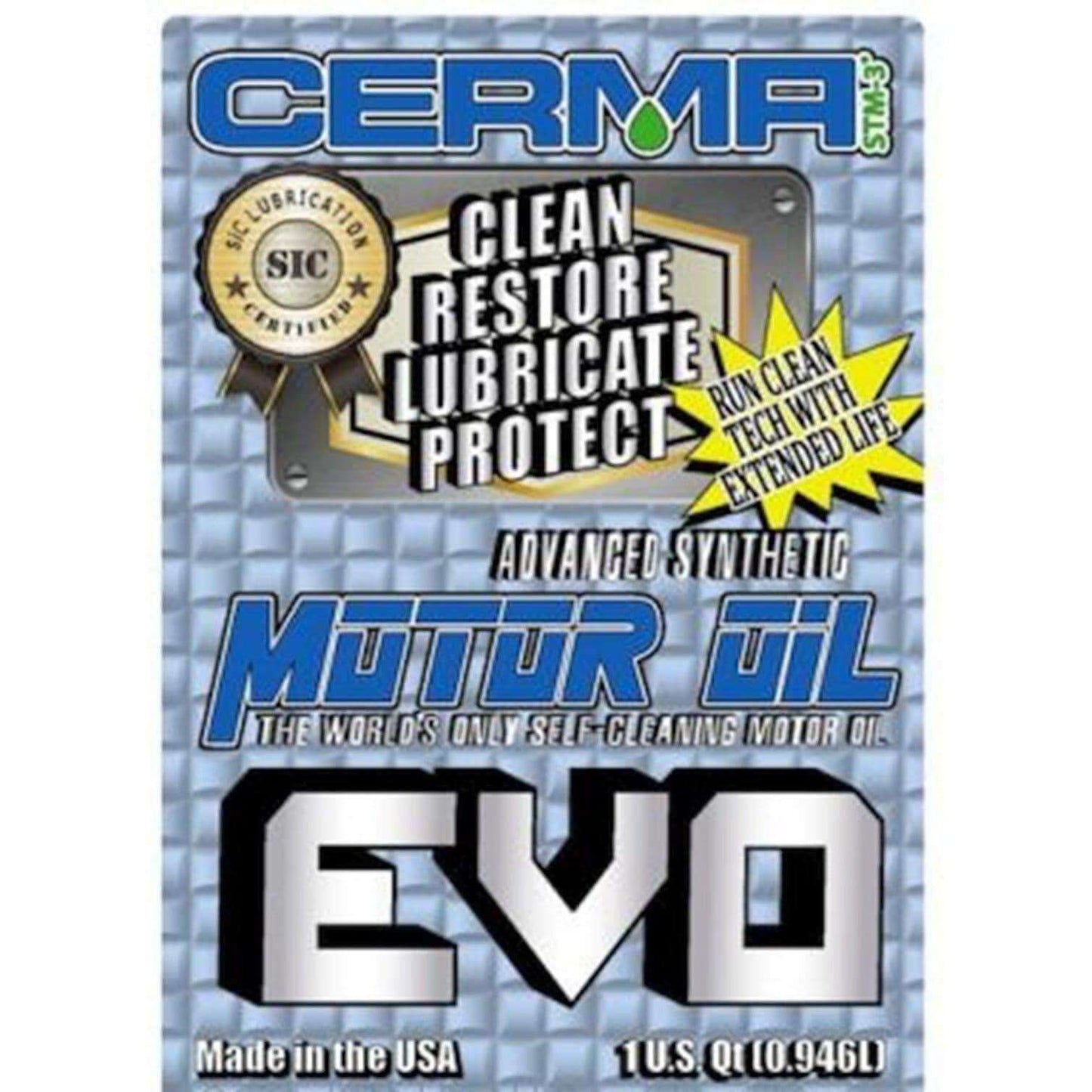
Cerma EVO Ceramic Synthetic 0W-0 Motor Oil — STM-3 Nano Silicon Carbide Technology | Protects Like a 40W, Runs Like a 0W
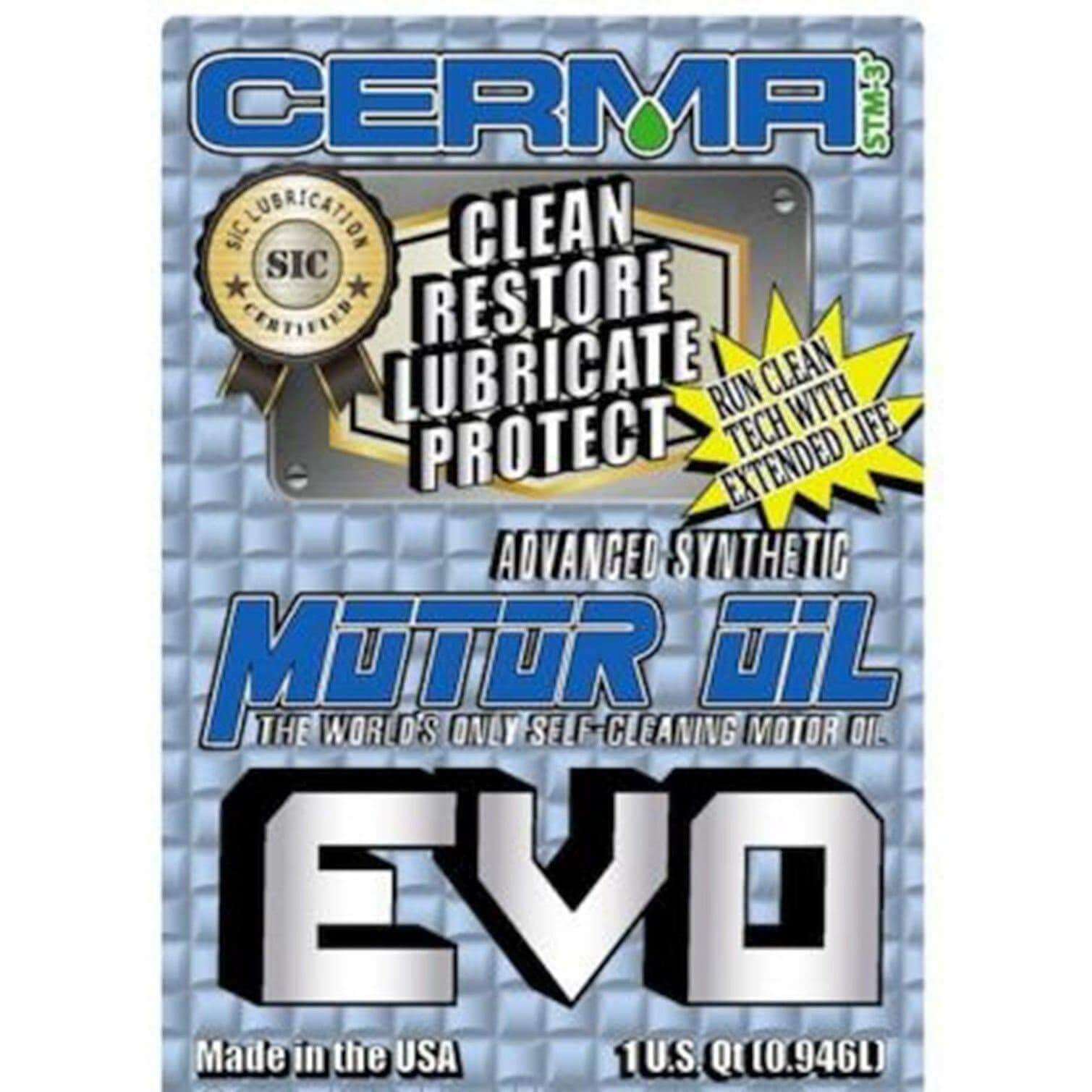
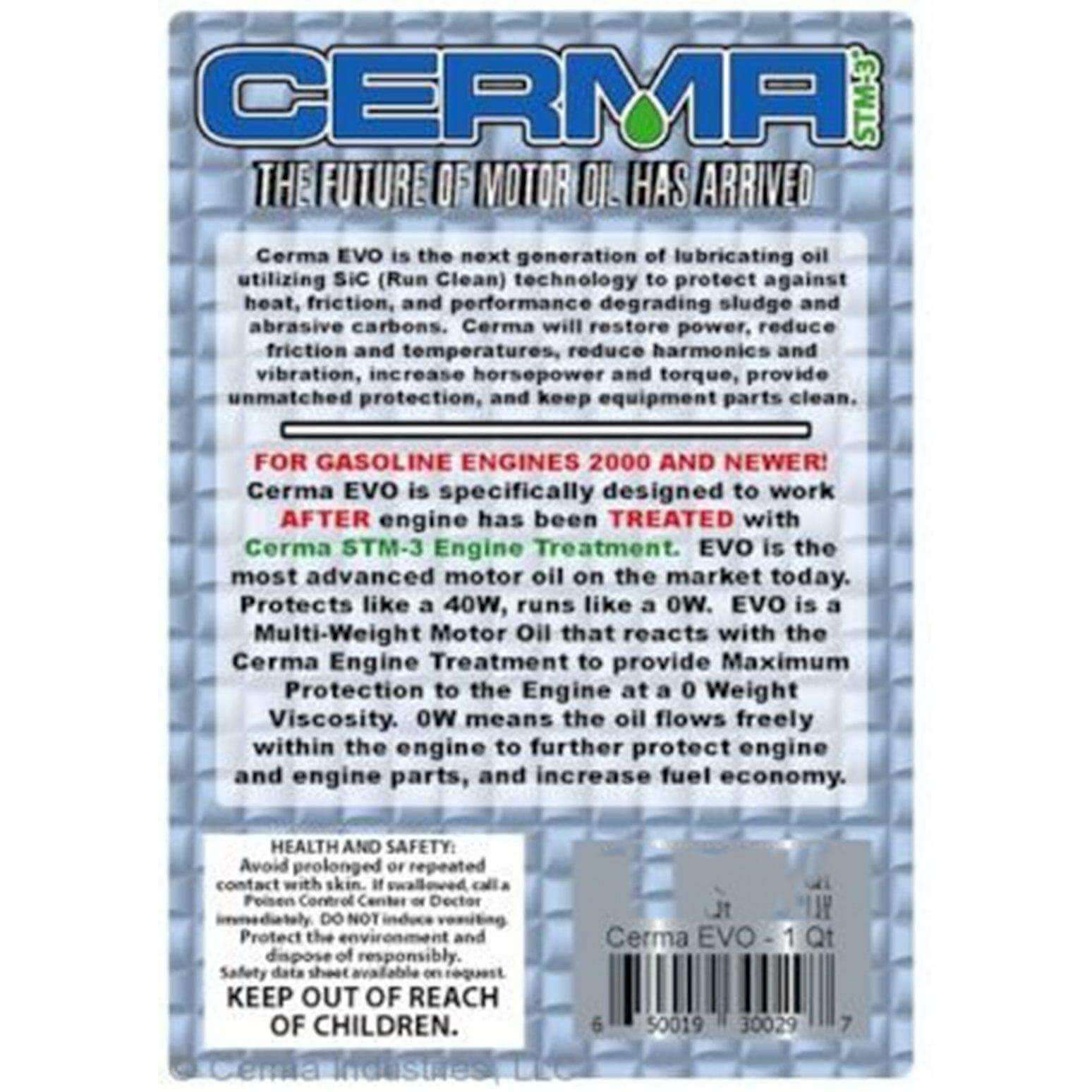
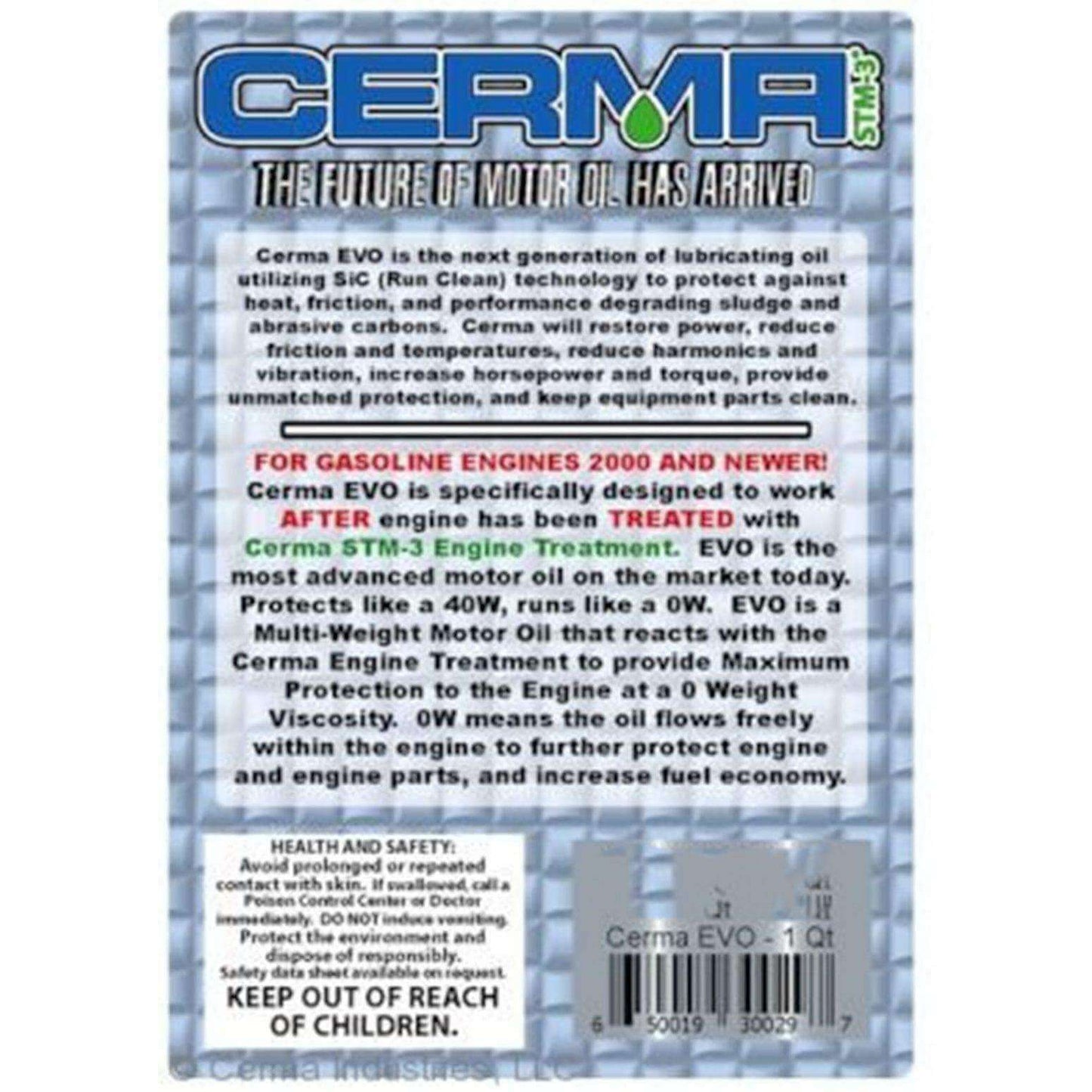
The evolution of motor oil has arrived. Cerma EVO Ceramic Synthetic 0W-0 is an ultra-low-viscosity ceramic oil that delivers maximum fuel economy while providing 40-weight-level engine protection* — a combination previously thought impossible. Designed exclusively for 2008+ gasoline engines that have been pre-treated with Cerma STM-3 Engine Treatment, EVO works in combination with the engine's permanent SiC ceramic matrix to unlock a performance level no single oil can achieve alone.
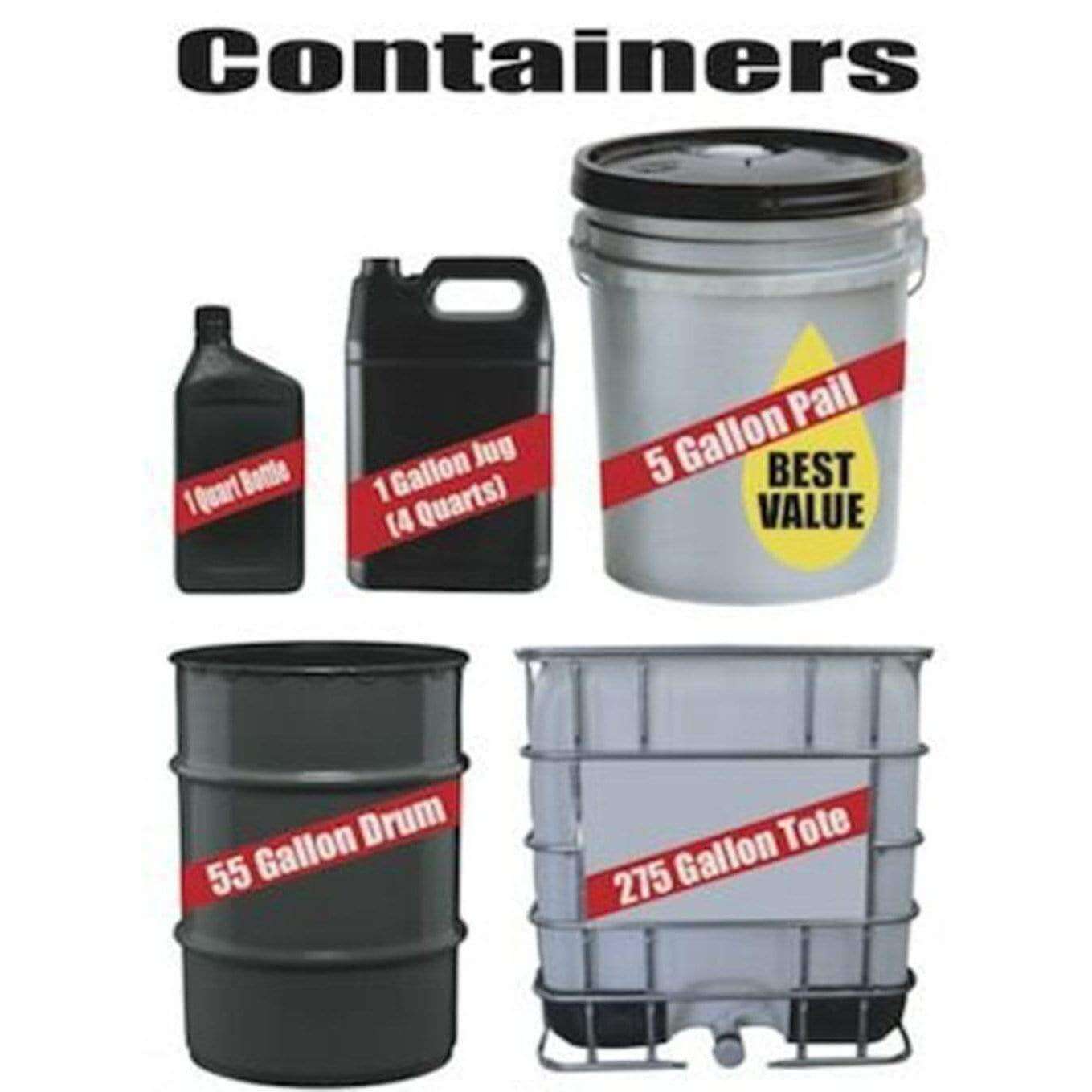
EVO flows like a 0W for instant cold-start protection and maximum MPG, while the pre-bonded SiC ceramic layer inside the engine handles the heavy-duty protection work — protection that no longer depends on oil viscosity. Available in 6 sizes from quart to 55-gallon drum. Volume bundles available: Buy 2 save 1.2%, Buy 5 save 4.1%.
⚠️ REQUIRED: Cerma STM-3 Engine Treatment Must Be Applied First
Cerma EVO 0W-0 is not a standalone oil. It is designed to work only after your engine has been treated with Cerma STM-3 Engine Treatment. The engine treatment creates the permanent SiC ceramic bond that EVO relies on for 40-weight-equivalent protection. Do not use EVO in an untreated engine. If your engine has not yet been treated, start with the Cerma STM-3 Engine Treatment (or a Value Package that includes it), complete the 1,500-mile break-in period (3,000 miles for trucks), then switch to EVO at your next oil change.
✅ Dual-Phase Engine Protection Technology
Conventional motor oil asks one product to do two jobs — lubricate AND protect under pressure. The result is a tradeoff: thicker oil protects better but increases friction and reduces fuel economy. EVO solves this by splitting the work across two cooperating phases:
| Phase | Role |
|---|---|
|
Phase 1: Permanent SiC Ceramic Matrix Applied via Cerma STM-3 Engine Treatment |
Diamond-hard ceramic layer (Mohs 9.5, melting point 2,730°C) bonded permanently to engine metal surfaces — handles the primary wear protection independent of oil viscosity |
|
Phase 2: Ultra-Low-Viscosity Flow Oil EVO 0W-0 Motor Oil |
SAE 0W-0 synthetic flows through the pre-protected engine at minimum internal friction — maximizes fuel economy and reduces operating temperature while maintaining SiC concentration through Run Clean Technology |
Together, these two phases deliver what neither could alone: 40-weight-equivalent engine protection at 0W viscosity*.
🔬 Advanced Features
- Protects Like a 40W, Runs Like a 0W* — 40-weight-equivalent engine protection at ultra-low 0W viscosity (requires Cerma-treated engine)
- Maximum fuel economy — ultra-thin 0W-0 dramatically reduces internal engine friction vs conventional 5W-20 / 5W-30 / 10W-40
- Lowest operating temperatures — reduced friction lowers oil and engine temps, extending component life
- SiC Run Clean Technology — continuously maintains and enhances the ceramic matrix while helping prevent sludge, carbon, and varnish formation
- Smoother, quieter operation — reduced harmonics and vibration from lower internal friction
- Increased horsepower & torque response — less friction means more engine power reaches the wheels
- Instant cold-start protection — 0W-0 flows immediately at start-up, before oil pressure fully builds
- Designed for 2008+ gasoline engines — modern tolerances, precision machining, and materials compatible with ultra-low-viscosity oils
- PTFE-Free, Solvent-Free, Environmentally Safe formulation — made in the USA
🧪 How 40W-Equivalent Protection at 0W Viscosity Works: In a conventional engine, the oil film itself is the only thing between metal surfaces — so thicker oil means more physical separation and better protection. This is why manufacturers historically specified 10W-30, 10W-40, or heavier. In a Cerma-treated engine, the metal surfaces themselves have been permanently modified: nano-scale SiC particles have bonded into the metal sub-surface, creating a ceramic layer harder than steel that doesn't flow, doesn't deplete, and doesn't depend on oil pressure. With that ceramic layer in place, the oil's job shifts from "be the protective barrier" to "circulate, cool, clean, and maintain SiC concentration." EVO can then be formulated at 0W-0 for maximum flow and MPG, because the engine no longer needs the oil to be its primary protection mechanism. This is genuinely a new paradigm in engine lubrication — not a marketing claim about thin oil.
📋 The Cerma EVO Protocol — 3 Steps
Add the correct dose of Cerma STM-3 Engine Treatment to your current engine oil. This is a one-time application — it creates the permanent SiC ceramic matrix on your engine's internal metal surfaces.
Continue normal driving with the treatment in your current oil. During this period, the SiC particles bond to engine metal surfaces under operating conditions. Trucks and heavy-duty applications need the longer 3,000-mile bonding period due to higher typical loads. Then perform a normal oil change.
At your next oil change after the break-in period, drain the old oil and refill with Cerma EVO 0W-0. Change EVO at your manufacturer's recommended interval or 7,500 miles, whichever comes first. Enjoy maximum fuel economy and ceramic-level engine protection. The SiC ceramic matrix from Step 1 remains bonded — you do not need to reapply the engine treatment at each oil change.
📦 Choose Your Size — 6 Variants Available
| Size | Best For |
|---|---|
| Quart (32 fl oz) | Top-offs, single-quart additions, testing before full commitment |
| 12 Quart Case | Multiple oil changes, long-term personal supply, small shop inventory |
| 1 Gallon (128 fl oz) | Most 4-cylinder & V6 oil changes (typical capacity 4.5–6 quarts) |
| 4 Gallon Case | Multi-vehicle households, larger V8 oil changes, shop supply |
| 5 Gallon Pail | Shops and fleet maintenance servicing multiple Cerma-treated vehicles |
| 55 Gallon Drum | High-volume fleets, dealerships, commercial service centers |
See variant dropdown above for current pricing. Bundle & Save: Buy 2 and save 1.2%, Buy 5 and save 4.1% (applied automatically at checkout). For fleet/commercial volume pricing beyond listed sizes, call 239-344-9861.
⚠️ Important Usage Notes
- Engine Treatment Required First — never use EVO without first completing the Cerma STM-3 Engine Treatment protocol with proper break-in mileage
- 2008+ Gasoline Engines Only — modern tolerances required; not for pre-2008 engines or high-mileage engines with significant wear
- Not for Performance / Racing Applications — sustained high-RPM, high-boost, track, and competition use require heavier viscosities; use Cermax Motor Oils (5W-40, 10W-40, 20W-50) instead
- Not for Diesel Engines — use Cermax Diesel Motor Oils in manufacturer-specified viscosities
- 7,500-Mile Maximum Oil Change Interval — or your manufacturer's recommended interval, whichever comes first
- Do Not Add Additional Oil Additives — EVO is a complete protection system. Do not combine with other oil additives or supplements
- Verify OEM Viscosity Spec — engines that specifically require SAE 5W-30 or heavier grades per manufacturer spec may have warranty implications — see warranty FAQ below
📊 Technical Specifications
| Specification | Details |
|---|---|
| Viscosity Grade | SAE 0W-0 (ultra-low viscosity synthetic) |
| Effective Protection Level | Equivalent to 40-weight* — requires Cerma STM-3 pre-treated engine |
| Oil Change Interval | Manufacturer's recommended interval or 7,500 miles, whichever comes first |
| Engine Requirement | 2008+ gasoline engines, pre-treated with Cerma STM-3 Engine Treatment |
| Base Stock | Full synthetic with STM-3 Nano SiC Run Clean Technology |
| Ceramic Technology | STM-3 Nano Silicon Carbide (SiC) — Mohs 9.5 hardness, 2,730°C melting point |
| Application Type | Gasoline passenger cars, SUVs, light trucks (2008+) — daily driving and commuting |
| Not Suitable For | Diesel engines, performance/racing, untreated engines, pre-2008 vehicles |
| Additive Properties | PTFE-Free, Solvent-Free, Environmentally Safe |
| Made In | USA — Fort Myers, FL (Bijou Inc.) |
🚗 Vehicle & Engine Compatibility
| Vehicle / Engine Type | Compatible? |
|---|---|
| 2008+ Gasoline Cars (pre-treated with Cerma STM-3) | ✅ Yes — ideal application |
| 2008+ Gasoline SUVs & Crossovers (pre-treated) | ✅ Yes |
| 2008+ Light Trucks (pre-treated, 3,000-mile break-in) | ✅ Yes — use longer break-in period |
| Turbocharged Gasoline Engines (daily driving, pre-treated) | ✅ Yes — non-performance use |
| Direct-Injection (GDI) Gasoline Engines (pre-treated) | ✅ Yes — non-performance use |
| Pre-2008 Gasoline Engines | ❌ Not recommended — use Cerma or Cermax oils in OEM viscosity instead |
| High-Performance / Racing / Track-Use Vehicles | ❌ Not recommended — use Cermax 5W-40 / 10W-40 / 20W-50 |
| Diesel Engines (all types) | ❌ Not compatible — use Cermax Diesel Motor Oils |
| Engines NOT Treated with Cerma STM-3 | ❌ Do not use — complete engine treatment protocol first |
| Motorcycles / ATVs / 2-Cycle Engines | ❌ Not for motorcycle or small-engine applications |
🛡️ Cerma EVO vs Cerma IX vs Cermax — Which Is Right for You?
| Feature | Cerma EVO 0W-0 | Cerma IX (15K) | Cermax (30K) |
|---|---|---|---|
| Oil Change Interval | Up to 7,500 miles | Up to 15,000 miles | Up to 30,000 miles |
| Viscosity Grades | 0W-0 only | 5W-20, 5W-30 | 0W-20, 5W-20, 5W-30, 5W-40, 10W-30, 10W-40, diesel 10W-30/15W-40 |
| Fuel Economy Priority | Maximum (0W-0) | Good | Good |
| Engine Treatment Required? | Yes — mandatory | Recommended | Recommended |
| SiC Ceramic Technology | ✅ | ✅ | ✅ |
| Performance / Racing Use | ❌ No | Light duty only | ✅ Yes (heavier grades) |
| Diesel Compatibility | ❌ No | ❌ No | ✅ Yes (diesel grades) |
| Best For | Max MPG, 2008+ daily commuters | Value + ceramic protection | Max drain interval, performance, diesel |
🔗 Complete Your Cerma EVO Setup
Everything you need to unlock EVO's full potential:
- Cerma STM-3 Gas Engine Treatment (REQUIRED FIRST) — one-time permanent ceramic treatment that enables EVO to work
- All Cerma & Cermax Motor Oil Options — for vehicles not using EVO, performance applications, or diesel engines
- Cerma Transmission Treatments — automatic and manual transmission ceramic protection
- Cerma Gas Fuel Treatment — clean injectors and stack fuel-economy gains
- Cerma Turbo Nano Treatment — ceramic protection for turbochargers (recommended for turbo EVO users)
- Cerma Power Steering Treatment — ceramic protection for power steering systems
- Cerma Blue Ice A/C Treatment — improve A/C compressor performance
- Cerma Gear Box & Axle Treatment — protect differentials and gear sets
🔬 Technical & Application FAQs
This is the question that makes EVO genuinely different from other motor oils. In conventional engines, the oil film thickness is the protection — thicker oil creates more physical separation between metal surfaces under load. That's why older engines specified 10W-30 or 10W-40: they needed that oil film. In a Cerma-treated engine, the physics change. The Cerma STM-3 Engine Treatment deposits Nano Silicon Carbide (SiC) particles directly into the metal surface through a bonding process driven by engine heat and friction. Once bonded, the SiC layer has a hardness of Mohs 9.5 (just below diamond) and a melting point of 2,730°C — far harder than the engine metal itself, and essentially permanent. With that ceramic layer in place, the metal surfaces are no longer dependent on oil film thickness for primary protection. EVO can then be formulated at 0W-0 viscosity — which minimizes pumping losses, internal friction, and heat generation — because the protection role has been transferred from the oil to the ceramic layer. The "40-weight-equivalent" protection claim refers to the combined effect of the ceramic bond plus EVO's residual film, not EVO's viscosity alone. Without the ceramic bond in place, EVO alone is insufficient for engine protection — which is why the engine treatment is mandatory.
Fuel economy gains vary significantly by vehicle type, driving style, climate, original oil viscosity, and engine condition. As general guidance: (1) drivers switching from conventional 10W-30 or 5W-30 to EVO 0W-0 typically see the largest improvements, because the viscosity drop is significant; (2) drivers switching from 0W-20 or 5W-20 factory fills see smaller but still measurable gains; (3) city and stop-and-go driving typically shows larger gains than highway driving, because cold-start and low-RPM efficiency is where thin oil matters most; (4) shorter trips benefit more than long highway hauls. Real-world reports from Cerma customers generally describe noticeable MPG improvements, though individual results vary. Rather than citing a specific percentage (which would be misleading given the variability), the honest answer is: track your MPG for 3–4 full tanks before installing EVO, then track again for 3–4 tanks after — your actual gain is what matters for your specific vehicle and driving pattern. If you want to maximize the fuel economy stack, combine EVO with Cerma Gas Fuel Treatment and proper tire pressure for additional gains.
Don't do this. EVO's 0W-0 viscosity is far below any OEM-specified motor oil grade — no manufacturer specifies 0W-0 for their engines, because no engine is designed to run safely on a pure 0W-0 oil without the SiC ceramic support layer. Using EVO in an untreated engine means the engine is trying to run on an oil film roughly a third the thickness of a standard 5W-30, with no ceramic layer to compensate. The likely consequences over time: accelerated wear on camshafts, lifters, bearings, and piston rings; elevated oil consumption as EVO burns off more readily than specified-viscosity oils; increased risk of low-oil-pressure warnings and engine damage at high RPM or sustained load; and potentially catastrophic engine failure in severe-duty conditions (heavy towing, track use, extreme heat). If you want to use EVO, the engine treatment and break-in protocol is non-optional. If you're not willing to do the engine treatment first, use a Cerma or Cermax motor oil in your manufacturer's specified viscosity instead — those products deliver SiC ceramic benefits at standard viscosities appropriate for untreated engines.
Yes — for daily driving use in turbocharged and GDI gasoline engines 2008 or newer that have been properly treated with Cerma STM-3, EVO is safe. The SiC ceramic matrix provides the wear protection that turbochargers and high-pressure fuel pumps need, and EVO's ultra-low viscosity reduces the internal pumping losses common in modern turbo-GDI engines. Two additional considerations for turbo/GDI users: (1) Modern turbos spin at 150,000+ RPM and rely on oil for both lubrication AND cooling of the center cartridge bearing. The SiC ceramic bond from Cerma treatment provides excellent wear protection in this environment, but we also recommend Cerma Turbo Nano Treatment for additional turbo-specific ceramic protection. (2) GDI engines are prone to intake valve carbon buildup because fuel doesn't wash the back of the valves like in port-injection engines — this is a fuel-side issue, not an oil-side issue, so pair EVO with Cerma Gas Fuel Treatment for the full solution. Not recommended for: performance turbo applications (aftermarket turbos, boost increases, track/competition) — see performance FAQ.
This is a legitimate concern worth understanding carefully. Under the Magnuson-Moss Warranty Act (US federal law), a manufacturer cannot void your warranty simply because you used an aftermarket fluid — they would have to prove the specific fluid caused a specific failure. That said, EVO at 0W-0 viscosity is significantly lighter than any OEM-specified motor oil grade, which creates a more complicated warranty picture than using, say, Cermax in the specified 5W-30. Practical guidance: (1) If your vehicle is still under factory powertrain warranty, seriously consider sticking with Cermax Motor Oil in your manufacturer's specified viscosity until the warranty expires — Cermax still provides SiC ceramic benefits while meeting OEM spec. (2) If you choose to run EVO under warranty, keep thorough records: Cerma Engine Treatment purchase receipt, break-in mileage documentation, all EVO purchase receipts, and your oil change records. This documentation establishes that you followed the Cerma protocol as designed — important if a warranty dispute ever arises. (3) For vehicles outside the factory warranty period, the warranty concern is a non-issue — you're free to choose any oil that serves your vehicle's needs. (4) Consult your dealer service department before switching on a warranty-covered vehicle — some dealers are familiar with Cerma, others are not. A friendly service advisor may document your use of the Cerma protocol in your service records, which protects you further.
Performance and racing applications generate conditions that exceed what any 0W-0 oil can handle safely — regardless of ceramic matrix support. These conditions include: sustained high RPM (7,000+ RPM in normal track driving, 9,000+ in competition); sustained high boost pressures in turbocharged performance cars; heavy loads under full throttle; sustained oil temperatures of 250°F+; and aggressive shift patterns and G-loading that can starve oil pickup and momentarily reduce film thickness further. Under these conditions, the oil needs to provide a substantially thicker hydrodynamic film than 0W-0 can deliver, even with the ceramic bond in place — because at very high RPMs and loads, the film thickness at bearing surfaces momentarily matters more than the ceramic layer underneath. For performance, track-day, competition, heavy towing, or extreme-duty gasoline applications, use Cermax Motor Oils in 5W-40, 10W-40, or 20W-50 — these provide SiC ceramic benefits with the heavier oil film performance engines require. EVO is optimized for the 90%+ of driving that's daily commuting and highway — save it for that use case and use the right tool for performance applications.
Cold weather: EVO's 0W winter rating means excellent cold-start flow in sub-zero conditions — better than 5W-20, 5W-30, or heavier oils. The 0W side of the viscosity grade indicates EVO will pump and reach upper-end components rapidly on cold start, minimizing dry-start wear during those critical first seconds. For extreme cold (below -20°F / -29°C), always allow normal idle warm-up of 30–60 seconds before driving off — this is true for any oil, not just EVO. Hot weather: This is where EVO's unconventional formulation matters most. In extreme summer heat (ambient 100°F+, engine oil temps 230°F+ sustained), the "0" side of the viscosity grade means the oil becomes even thinner than its already-low baseline — and this is where the ceramic matrix really earns its place. In an untreated engine, 0W-0 in extreme heat would be inadequate. In a Cerma-treated engine, the SiC ceramic layer maintains protection regardless of how thin the oil becomes under temperature. However, for severe-duty hot-weather applications — heavy towing in Arizona summer, extended high-speed highway running in extreme heat, off-roading in the desert — we recommend Cermax in 5W-40 or 10W-40 rather than EVO, for the additional oil film margin under those conditions.
The Cerma STM-3 Engine Treatment is designed as a one-time application. Once the SiC ceramic matrix is bonded to the engine's metal surfaces during the initial break-in period, the bond is permanent — it doesn't wash out with oil changes, it doesn't deplete with mileage, and it remains in place as long as the engine's metal does. You do not need to add the engine treatment at every oil change. What does happen over time: the outer active layer of SiC particles gradually wears as the engine accumulates hundreds of thousands of miles — but because EVO (and other Cerma/Cermax oils) continuously carries fresh SiC particles through the oil system, this outer layer is constantly being replenished from the oil side. So in practice: one treatment application establishes the ceramic foundation; every subsequent oil change with Cerma EVO (or any Cerma/Cermax oil) maintains and reinforces it. Some high-mileage users choose to add a second engine treatment after 150,000–200,000 miles as an extra measure, but this is optional and not required by the protocol. For a newly rebuilt engine, apply the engine treatment during the rebuild break-in — the same one-time process applies.
Made in the USA by Cerma Treatment (Bijou Inc.), Fort Myers, FL. 30-day return policy. Free shipping on orders over $150. Ships to US & Canada. Fleet and commercial volume pricing available beyond listed sizes. Questions? Call 239-344-9861 or email info@cermatreatment.com.
*"Protects Like a 40W, Runs Like a 0W" and "40-weight-equivalent protection" claims describe the combined performance of EVO 0W-0 Motor Oil in combination with a Cerma STM-3 pre-treated engine, after the prescribed break-in period. These claims do NOT apply to EVO used alone in untreated engines. Individual engine protection, fuel economy gains, temperature reduction, and horsepower/torque results vary based on vehicle type, driving conditions, climate, engine condition and age, and adherence to the Cerma EVO Protocol (engine treatment + break-in + 7,500-mile change interval). Manufacturer viscosity specifications (0W-20, 5W-30, etc.) reference the oil specification under which the engine was originally designed and warrantied — EVO at 0W-0 is a significant viscosity deviation, and users should consider warranty implications carefully (see warranty FAQ). Cerma EVO is NOT suitable for: diesel engines, high-performance/racing applications, pre-2008 engines, untreated engines, motorcycles/ATVs/2-cycle engines, or severe-duty/heavy-towing hot-weather conditions. For these applications, use appropriate Cermax Motor Oil grades instead. Always follow the complete Cerma EVO Protocol: (1) apply Cerma STM-3 Engine Treatment; (2) complete 1,500-mile break-in (3,000 for trucks); (3) then switch to EVO. Change EVO at manufacturer's recommended interval or 7,500 miles, whichever comes first.
Share
Frequently Asked Questions
I was a virgin 2.4L owner until i put this in my engine, now its a 6.4L and im an absolute chad with a 8 figure job. Would reccomend for anyone with any car