
Cerma
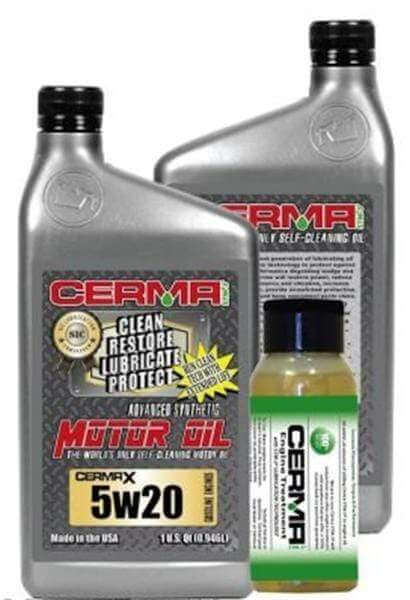
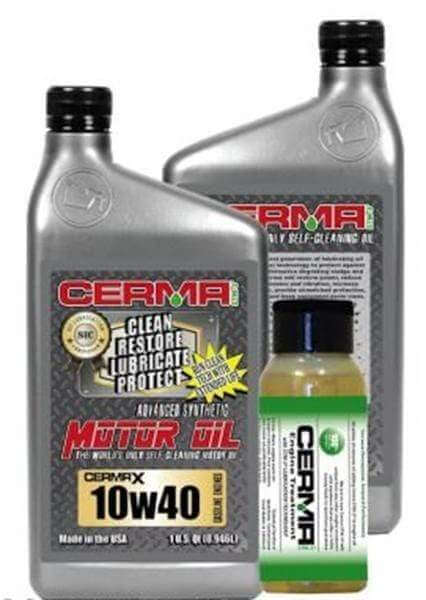
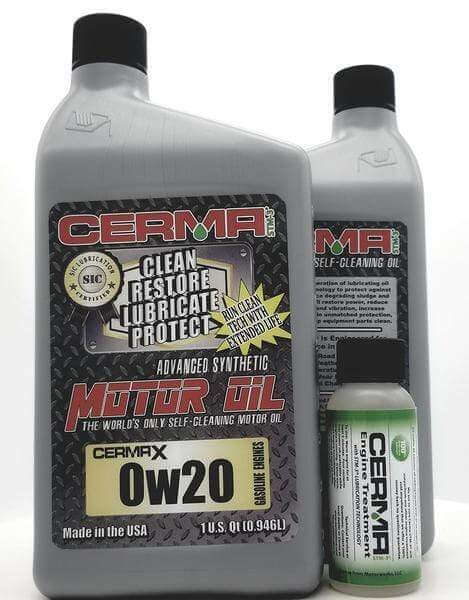
Cermax Performance Ceramic Synthetic 0-20w Oil Value Package for Gas Engines
Cermax Performance Ceramic Synthetic 0-20w Oil Value Package for Gas Engines
Couldn't load pickup availability
Cermax Performance Ceramic Synthetic Oil Value Package for Gas Engines — STM-3 Engine Treatment + Cermax SiC Motor Oil in One Kit | Up to 30,000-Mile Oil Changes
The entry point to complete Cerma ceramic engine protection — everything you need to transform your engine with STM-3 Nano Silicon Carbide (SiC) ceramic technology, delivered in a single discounted kit. Cermax Performance Ceramic Synthetic Oil Value Package bundles Cerma STM-3 Engine Treatment (2oz one-time permanent ceramic bonding) with Cermax Ceramic Synthetic Motor Oil (5–10 quarts in your choice of 6 viscosities) — designed specifically for gas engines seeking the deepest initial ceramic bond followed by 30,000-mile drain intervals with SiC-enhanced protection.
Perfect for any gasoline-engine vehicle you own and plan to keep long-term — daily drivers, commuter cars, family SUVs, work trucks, classic cars, enthusiast vehicles. Save approximately $58 (~24% off) versus buying the components separately, plus single-shipment convenience.
💰 Package Savings
Regular separate-purchase total: $241.50. Package price starts at $183.43 — save approximately $58 (~24% off) plus single-shipment shipping cost. Exact savings vary by viscosity and oil quantity selected.
⬆️ Need Transmission Protection Too?
This package covers engine and oil protection only. If you also want ceramic transmission protection, upgrade to one of the fuller Racing Value Packages:
• Manual transmission vehicle? → Racing Value Package with Manual Transmission (adds 2oz Manual Transmission Treatment)
• Automatic transmission vehicle? → Racing Value Package with Automatic Transmission (adds 2oz Automatic Transmission Treatment)
Both Racing Value Packages include everything in this Value Package PLUS transmission protection, for maximum driveline coverage. Choose this simpler Value Package if you only want engine + oil protection, or if your transmission is already covered by a separate treatment.
📦 What's Included
| Component | Size | Purpose |
|---|---|---|
| Cerma STM-3 Engine Treatment | 2 oz (treats all gas engines 4–8 cylinders) | One-time permanent ceramic bonding — Nano Silicon Carbide (SiC) particles bond to cylinders, pistons, rings, bearings, and cam lobes; Mohs 9.5 hardness, 2,730°C melting point; survives all future oil changes |
| Cermax Ceramic Synthetic Motor Oil | 5–10 quarts (your choice) | SiC-enhanced premium full synthetic motor oil delivering up to 30,000-mile drain intervals; available in 6 viscosities; continuously maintains and reinforces the ceramic protection established by the Engine Treatment |
🔧 Choose Your Viscosity — 6 Options Available
Select the viscosity that matches your vehicle manufacturer's specification. Always verify in your owner's manual before selecting.
| Viscosity | Typical Applications |
|---|---|
| 0W-20 | Most Toyota/Lexus 2011+, Honda/Acura 2016+, Subaru 2014+, Hyundai/Kia newer models, all hybrid vehicles, modern fuel-economy engines |
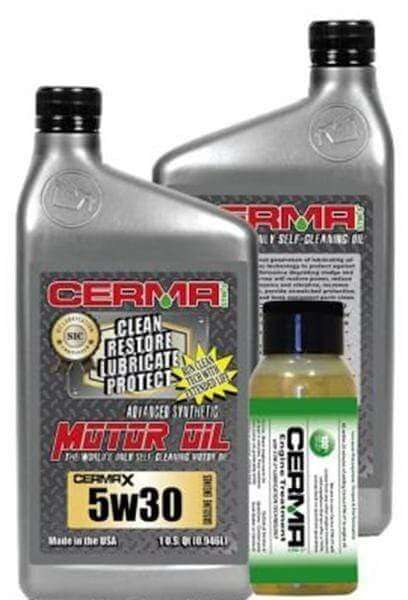
| 5W-20 | Most Ford F-150/Mustang/Escape 2004–2020, Honda/Acura 2001–2015, Chrysler Hemi 5.7L/6.4L V8, Mazda Skyactiv-G, early Ford EcoBoost 2011–2013 |
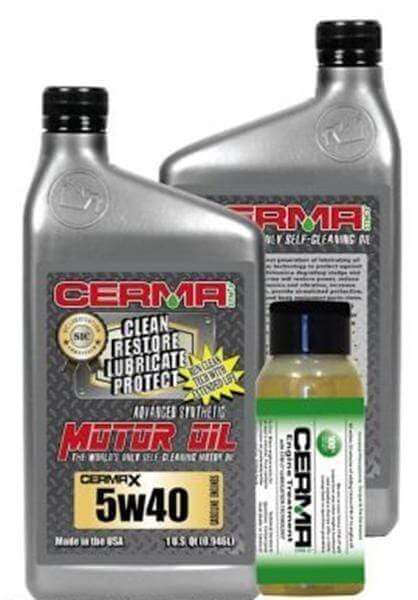
| 5W-30 | Most GM gasoline vehicles (Silverado, Tahoe, Equinox, Corvette, Camaro SS), Ford 2014+ EcoBoost (F-150, Explorer ST, Mustang EcoBoost), Chrysler Pentastar V6, many European applications |
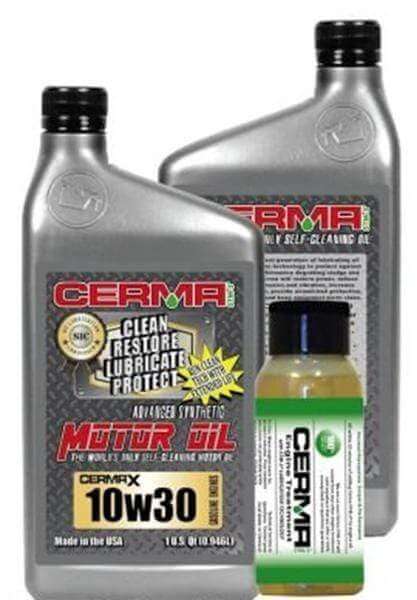
| 5W-40 | European performance — BMW M-series, Porsche 911/Cayman/Boxster, Mercedes AMG, Audi RS/S models, most European turbo performance engines; also recommended for tuned/modified turbo vehicles |
| 10W-30 | Older engines, classic muscle cars (vintage Mustangs, Camaros, Challengers), older Jeep Wrangler 4.0L I6, hot-climate applications, older GM trucks |
| 10W-40 | High-mileage engines (200,000+ miles), classic performance engines, hot-climate heavy-duty applications, older European vehicles with wider viscosity tolerance |
🛢️ Choose Your Oil Quantity — 5 to 10 Quarts
Select the quantity that matches your engine's oil capacity (including filter change):
| Quantity | Typical Applications |
|---|---|
| 5 Quarts | Most 4-cylinder imports: Toyota Camry 2.5L, Honda Accord/Civic, Subaru WRX, Mazda MX-5/CX-5, Hyundai Tucson, Ford Escape 2.0L |
| 6 Quarts | Most V6 cars and compact trucks: Toyota Highlander, Ford F-150 2.7L EcoBoost, Honda Pilot, Chrysler Pentastar V6, BMW M2 (earlier) |
| 7 Quarts | Ford F-150 5.0L Coyote, Mustang GT 5.0L, Chevy Camaro SS 6.2L LT1, Chrysler Hemi 5.7L, BMW M3/M4 (some years) |
| 8 Quarts | Ford F-150 3.5L EcoBoost, Corvette 6.2L LT1/LT2, Dodge Challenger/Charger Hemi, Jeep Wrangler 3.6L, larger V8 trucks |
| 9 Quarts | Porsche 911 (8.5–9.5 qt depending on year), Corvette C8, larger displacement V8 engines, BMW M5, some Mercedes AMG |
| 10 Quarts | Shelby GT350/GT500, Corvette Z06/ZR1, Dodge Hellcat, track-prepared vehicles with dry-sump systems, large displacement engines with extra capacity |
Your owner's manual lists the exact oil capacity with filter change. When in doubt, select one quart more than your capacity requires — extra quarts are useful for top-offs between changes, especially in engines prone to oil consumption (GDI engines, high-mileage vehicles).
🛡️ Dual-Layer Ceramic Protection — How the Package Works
This package delivers two complementary layers of SiC ceramic protection — a permanent foundation laid by the Engine Treatment, continuously maintained and reinforced by Cermax Oil over every oil change thereafter.
Layer 1 — Cerma STM-3 Engine Treatment (One-Time, Permanent)
The 2oz Engine Treatment is a concentrated dose of SiC ceramic particles designed to bond permanently to your engine's internal metal surfaces over a 1,500-mile break-in period. Once bonded, the SiC layer:
- Permanently integrates into cylinder walls, piston skirts, piston rings, bearing surfaces, cam lobes, lifters, and valve train components
- Creates a Mohs 9.5 hardness surface (nearly as hard as diamond, 2,730°C melting point)
- Survives every future oil change — the ceramic bond doesn't wash out with old oil; it's metallurgically integrated
- Fills micro-imperfections in worn surfaces — particularly valuable for higher-mileage engines where compression loss and oil consumption have developed
- Provides a cumulative foundation that continues to benefit your engine indefinitely after that single application
Layer 2 — Cermax Ceramic Synthetic Motor Oil (Ongoing, Every Change)
Cermax Oil continues the ceramic protection after the engine treatment's 1,500-mile bond period. Unlike standard synthetic oils that only lubricate, Cermax delivers fresh SiC particles with every mile — reinforcing the foundation laid by the treatment and protecting components the treatment doesn't reach. Specifically:
- Maintains the ceramic layer — fresh SiC particles reinforce and build upon the initial bond over successive oil changes
- Protects non-ferrous metals — Cermax Oil's formula includes SiC chemistry that bonds to aluminum turbo housings, bronze bushings, and other non-ferrous components the ferrous-metal-focused Engine Treatment doesn't reach. This is why a separate Turbo Nano Treatment is optional with this package — Cermax Oil handles it.
- Up to 30,000-mile drain intervals — premium full synthetic base stocks with extended-performance additive package
- Run Clean self-cleaning action — continues to attract carbon and varnish deposits into filterable masses rather than depositing on metal surfaces
- Restoration action — ongoing SiC delivery continues to fill micro-wear sites gradually, extending benefit over time
💡 Best of Both Worlds: The Engine Treatment creates a permanent ceramic foundation through a concentrated one-time application. Cermax Oil reinforces that foundation AND protects the components (non-ferrous turbo/bushing materials) that the ferrous-metal-focused treatment alone doesn't reach. Together, they provide more complete protection than either product individually — and at a package discount that makes the combination more cost-effective than separate purchases.
🔧 Turbo/Supercharged Engine Note: Because Cermax Ceramic Synthetic Motor Oil already contains SiC protection for non-ferrous components (aluminum turbo housings, bronze thrust bushings), you do NOT need to separately purchase Cerma Turbo Nano Treatment when using this package. The Turbo Nano Treatment is only necessary when using non-Cermax motor oils after the Engine Treatment. If you plan to continue using your existing non-Cermax oil brand after the initial bonding period, add the Turbo Nano Treatment. If you use Cermax Oil (as this package provides), skip it — already covered.
📋 The Cerma Protocol — 3 Simple Steps
Step-by-Step Installation
- Add 2oz Engine Treatment to your EXISTING engine oil (not to the Cermax Oil from this package — keep that sealed for later). Engine should be warm and at idle. Pour slowly through the oil fill cap. Drive 15–20 minutes immediately to distribute.
- Drive normally for at least 1,500 miles. During this break-in period, the SiC ceramic permanently bonds to engine metal surfaces. The full bonding process continues over approximately 90 days of normal driving.
- After 1,500+ miles: Perform a complete oil change — drain old oil, replace oil filter with a premium filter (for extended drain intervals), and refill with the Cermax Ceramic Synthetic Motor Oil included in this package. From this point forward, Cermax maintains and reinforces the ceramic layer, supporting drain intervals up to 30,000 miles.
⚠️ Critical — Follow the Protocol Sequence: Do NOT add Engine Treatment and Cermax Oil at the same time. The SiC ceramic in the treatment must bond during the 1,500-mile break-in period while your engine is still running the old oil. Adding Cermax Oil simultaneously causes the oil's SiC particles to compete with the treatment's SiC particles, dramatically reducing bonding effectiveness. Patience here pays off in permanent ceramic protection.
🚗 Ideal For — Gasoline Vehicle Applications
- Daily drivers — any gasoline-powered car, truck, or SUV you own and plan to keep long-term (5+ years of ownership); the permanent ceramic bond pays off increasingly over time
- High-mileage vehicles (100,000+ miles) — the SiC restoration action fills micro-wear in cylinder walls, helping recover lost compression and reduce oil consumption
- Modern turbo and GDI engines — Ford EcoBoost, GM 2.7L Turbo, Chrysler Pentastar, Honda 1.5T/2.0T, Hyundai Theta T-GDI, most modern turbo-GDI applications (Cermax Oil's built-in non-ferrous protection handles turbo bearings)
- Naturally-aspirated V8 muscle cars — Ford Mustang GT Coyote, Chevy Camaro SS 6.2L, Corvette Stingray, Dodge Challenger/Charger 5.7L Hemi, Chrysler 300
- Classic vehicles — vintage muscle cars (pre-2005 Mustangs, Camaros, Challengers), older Mopar Hemi, classic European sports cars, restored vehicles where engine wear matters
- Sport cars and performance vehicles — Mazda MX-5, Toyota GR86/Supra, Subaru WRX, BMW M-series, Porsche 911, any enthusiast vehicle you drive hard
- Commercial and fleet vehicles — delivery trucks, contractor vehicles, commercial vans; the 30,000-mile Cermax drain intervals cut labor costs significantly over typical 10K-mile schedules
- First-time Cerma users — this package is the recommended starting point to experience Cerma ceramic technology; covers the primary engine protection without the upsell of transmission treatment (which you can add separately later if desired)
🛡️ Package Value vs Buying Components Separately
| Component | If Purchased Separately (Approx) |
|---|---|
| Cerma STM-3 Gas Engine Treatment (2oz) | ~$105.60 |
| Cermax Ceramic Synthetic Motor Oil (5 qt @ $19.50/qt for standard viscosities) | ~$97.50 |
| Typical Separate-Purchase Total (5-qt, standard viscosity) | ~$203.10 |
| List price reference | ~$241.50 |
| Package Price (starting at) | $183.43 |
| Package Savings | Save ~$58 (~24% off list) |
Exact savings vary by viscosity (premium viscosities 0W-20 and 5W-40 cost more per quart) and oil quantity (5–10 quarts). Package buyers also save the shipping cost of multiple separate orders — one shipment vs two.
🔗 Optional Companion Products — Complete Your Protection
- Cerma Ceramic Gas Fuel Treatment — continuous 6-in-1 fuel system protection and injector cleaning (especially critical for GDI/T-GDI engines prone to intake valve carbon)
- Cerma Transmission Treatments — ceramic protection for automatic or manual transmissions (or upgrade to one of the Racing Value Packages above for bundled savings)
- Cerma Gear Box & Axle Treatment — ceramic protection for differentials, transfer cases (AWD/4WD vehicles)
- Cerma Power Steering Treatment — hydraulic power steering system protection (older vehicles with non-electric steering)
- Cerma Blue Ice A/C Treatment — A/C compressor protection and cooling performance improvement
- Cerma Turbo Nano Treatment — only needed if using non-Cermax oil; not required with this package since Cermax Oil includes non-ferrous protection
🔬 Technical & Application FAQs
This Value Package is the simpler, entry-level bundle: it includes only the Engine Treatment and Cermax Oil — the two core components for complete engine protection. The Racing Value Packages are fuller bundles that add a transmission treatment on top of everything in this package. Value Package (this product): Engine Treatment (2oz) + Cermax Oil (5–10 qt). Designed for buyers who only want engine + oil protection, or whose transmission is already covered separately. Racing Value Package with Manual Transmission: Everything in this package PLUS 2oz Manual Transmission Treatment PLUS optional Turbo Nano Treatment add-on. For 3-pedal manual transmission vehicles. Racing Value Package with Automatic Transmission: Everything in this package PLUS 2oz Automatic Transmission Treatment PLUS optional Turbo Nano Treatment add-on. For traditional automatic transmission vehicles. Which should you choose? (1) If you want complete driveline protection (engine + transmission + oil) in a single bundle with the best overall savings → Racing Value Package (Manual or Automatic as appropriate); (2) If you only want engine + oil protection right now and may add transmission treatment later → this Value Package; (3) If your vehicle has a DCT/DSG/PDK dual-clutch transmission or CVT — this Value Package is the correct choice (DCT and CVT require specialized fluids; don't use the manual or automatic transmission treatments in those applications); (4) If you're new to Cerma and want the simplest introduction → this Value Package. Cost difference: the Racing packages cost more than this Value Package but include the added transmission treatment value — typically cheaper than buying this package plus a separate transmission treatment individually.
Adding the Engine Treatment and Cermax Oil simultaneously dramatically reduces the effectiveness of the ceramic bonding process. Here's the physics of why: The Engine Treatment is a concentrated dose of SiC ceramic particles designed to bond permanently to engine metal sub-surfaces. This bonding requires: (1) the SiC particles delivered through existing engine oil that has LOW base SiC concentration; (2) heat and pressure from normal engine operation; (3) time for particles to migrate to metal surfaces and permanently integrate into sub-surface metallurgy; (4) approximately 1,500 miles of normal driving to complete. Cermax Motor Oil also contains SiC particles — at lower concentration than the treatment, formulated for continuous delivery rather than one-time bonding. If you add Cermax Oil simultaneously with the Engine Treatment, you create a much higher total SiC concentration in the oil — and counterintuitively, this REDUCES bonding efficiency because: (1) particles compete for limited metal surface sites; (2) excess SiC stays suspended in oil rather than bonding; (3) the initial concentration gradient that drives effective bonding (high SiC in treatment dose, lower in existing oil) is disrupted. Proper sequence produces strongest results: (1) Engine Treatment creates a high-SiC pulse in existing oil; (2) 1,500 miles of driving allows particles to permanently bond to metal; (3) At your next oil change, old oil plus any unbonded particles drain out; (4) Cermax Oil goes in with its own SiC delivery system that maintains and slightly builds the ceramic layer over each drain interval. Shortcut consequences: if you add everything simultaneously, you'll still get SOME ceramic benefit, but the bond will be weaker and less uniform. For a product that provides permanent engine protection, the 1,500-mile patience is worth it.
If you've previously applied Cerma Engine Treatment to this vehicle, you don't necessarily need another treatment dose — but there are situations where a second dose is beneficial. Cases where you can skip the Engine Treatment and just buy Cermax Oil separately: (1) You applied Cerma Engine Treatment within the last 100,000 miles AND the vehicle hasn't been through a major rebuild/machining/oversized piston upgrade (the ceramic bond is still present on your engine metal); (2) You're continuing routine maintenance on an already-treated engine; (3) The engine runs well, doesn't consume oil, doesn't have performance issues. Cases where a second treatment dose IS beneficial: (1) 100,000+ miles have accumulated since original treatment and the vehicle is entering a new wear cycle — concentrated SiC dose adds to the existing bond; (2) Major engine work has been done — rebuild, oversized pistons, cylinder honing, head work — exposes fresh metal that the original treatment can't cover; (3) Engine has developed new oil consumption or compression loss since original treatment (second dose helps address new wear); (4) Vehicle has been through severe-duty operation since original treatment (extensive towing, track use, commercial delivery service) where accelerated wear may have occurred; (5) You want maximum accumulated protection for a long-term-keeper vehicle (100K-200K+ mile daily drivers, classic cars, collector vehicles). Practical approach: the Value Package is optimally designed for first-time treatment OR for re-treating vehicles 100K+ miles after original treatment. If neither applies and you just need Cermax Oil, buy Cermax Oil separately rather than re-buying the full package. If you're unsure whether your situation warrants re-treatment, call 239-344-9861 with your vehicle's mileage, previous treatment date, and current performance details.
No — this Value Package is formulated for gas engines only. Both components are gasoline-engine-specific: (1) The 2oz Engine Treatment is sized for gas engines (4–8 cylinders). Diesel engines require LARGER treatment doses based on displacement — a 2oz dose is insufficient for a 6.7L diesel (which needs approximately 6oz) or a large-displacement heavy-duty diesel (up to 12oz for semi trucks). Using the gas-engine 2oz dose in a diesel engine won't damage the engine, but it won't provide adequate ceramic coverage and wastes the product investment. (2) The Cermax Ceramic Synthetic Motor Oil in this package is formulated for gasoline engines with API SN/SM and ILSAC GF-5 performance targets. Modern diesel engines require CK-4, CJ-4, or CI-4 certified diesel-specific oil with different additive chemistry — higher TBN (Total Base Number) to handle diesel combustion acidity, different anti-wear chemistry for diesel valvetrain, lower SAPS for DPF-equipped diesels. Using gasoline oil in a diesel engine can cause DPF damage and doesn't provide adequate acid neutralization. For diesel vehicles, use instead: (1) Cerma Diesel Engine Treatment — sized by engine displacement (2oz for 1–2.8L, 4oz for 3–4.8L, 6oz for pickups like Powerstroke/Cummins/Duramax, 12oz for semi trucks); (2) Cermax Diesel 10W-30 or 15W-40 — diesel-specific Cermax motor oils with appropriate diesel certifications. Call 239-344-9861 for diesel-specific package recommendations based on your specific vehicle.
Using Cerma products should not void your warranty as long as you use the correct viscosity grade specified in your owner's manual and meet the performance category your manufacturer requires. Under the US Magnuson-Moss Warranty Act, a manufacturer cannot void your warranty simply because you used an aftermarket oil or treatment — they must prove the specific product caused a specific failure. Dealer strictness varies by brand: (1) Toyota/Lexus dealers are typically strict about oil certifications (prefer Toyota Genuine or current ILSAC GF-6A certified oils); (2) GM dealers are among the strictest — they often require dexos1 Gen 3 certification on current vehicles. Cermax is formulated to meet performance targets of API SN/SM and ILSAC GF-5 but does NOT carry current dexos1 Gen 3 certification; (3) Ford/Honda/Chrysler dealers are generally moderate — most accept quality full synthetic oils in the correct viscosity; (4) European brand dealers (BMW, Mercedes, Audi, Porsche) are typically strictest, often requiring specific OEM approvals (BMW Longlife, MB 229.5, VW 504 00, Porsche A40). Practical guidance for warranty-covered vehicles: (1) Keep all purchase receipts showing this package purchase with dates and odometer readings; (2) Save used oil filters from each oil change (sealed plastic bags); (3) Document every oil change with mileage, date, Cermax product used, and filter brand; (4) For maximum warranty protection during coverage period, some owners prefer using an OEM-certified oil during the factory warranty period and switching to Cermax after warranty expires — when SiC ceramic benefits matter most for long-term ownership; (5) The Engine Treatment is a one-time application — once bonded, it's permanently in your engine; there's no ongoing product-based dependency to worry about for warranty. For out-of-warranty vehicles: no warranty concerns — this is actually the ideal scenario for Cerma, where ceramic benefits provide the most value as vehicles age.
Yes — this Value Package is particularly valuable for high-mileage engines. In fact, older engines often show the most dramatic improvement from Cerma ceramic treatment because the SiC particles fill the accumulated micro-wear sites that develop over time. Common high-mileage issues that ceramic treatment can help address: (1) Oil consumption — SiC particles fill worn cylinder walls and piston ring lands where oil was previously escaping into combustion. Many owners report reduced oil consumption within a few thousand miles of treatment; (2) Compression loss — filling micro-wear restores cylinder sealing, often recovering measurable compression; (3) Power loss and reduced fuel economy — reduced friction and better sealing recover lost performance; (4) Noisy engines — smoother metal-to-metal interfaces reduce valvetrain and bearing noise; (5) Blue smoke on startup (valve stem seal issues) — while the treatment doesn't directly repair valve stem seals, reduced oil consumption overall often reduces start-up smoke. What the treatment CANNOT fix: (1) Mechanical damage — cracked pistons, broken rings, damaged crankshaft, scored cylinder walls beyond micro-wear level; (2) Blown head gaskets — unrelated to ceramic technology; (3) Destroyed bearings — treatment can help slow wear but cannot rebuild destroyed clearances; (4) Catastrophic oil burning from severe engine damage. Best practice for high-mileage engines: (1) Consider using Cermax 10W-30 or 10W-40 instead of thinner viscosities IF your owner's manual permits — thicker oil helps compensate for accumulated wear in some older engines, but NEVER deviate from manufacturer spec for engines with VVT/VCT calibrated for specific viscosity; (2) Allow full 90-day ceramic bonding period before expecting peak results; (3) Consider a second engine treatment dose (beyond this package) after another 100K miles for vehicles you plan to keep very long-term. Realistic expectations: most high-mileage owners report noticeable improvement in 500-2000 miles; dramatic "like new" restoration over 5,000-10,000 miles for engines with primarily wear-based issues (not mechanical damage).
Yes — tuned and track vehicles often benefit MORE from ceramic protection than stock vehicles because they experience higher cylinder pressures, more heat, and more stress cycles than factory-spec use. Ceramic surface protection helps compensate for the increased wear rates associated with modified vehicles. Viscosity considerations for modified vehicles: (1) Tuned Subaru WRX/STI (higher boost, advanced timing) — consider 5W-40 or 5W-30 instead of factory 5W-30 if your tune adds significant boost; (2) Tuned Ford EcoBoost (tuned F-150 EcoBoost, Focus RS, Mustang EcoBoost with aftermarket tune) — most benefit from 5W-30 or 5W-40 even if factory spec is thinner; increased turbo heat demands thicker hot film; (3) Built naturally-aspirated engines — consult engine builder for viscosity recommendation based on clearances; Cermax + ceramic treatment is excellent for built engines where maximum durability is the goal; (4) Supercharger builds (Shelby GT500, Corvette Z06 C7, Hellcat variants, aftermarket supercharger kits) — most benefit from 5W-30 or 5W-40 for the additional heat and pressure loads; (5) Track-prepped vehicles — consider one grade thicker than street spec (5W-30 instead of 5W-20, 5W-40 instead of 5W-30) for sustained high-RPM track conditions. Additional recommendations for modified vehicles: (1) Shorter drain intervals — for track vehicles and heavily-tuned street cars, consider 15,000–20,000 mile drain intervals rather than the full 30,000, particularly if using oil analysis to verify; (2) Fresh engine treatment after major modifications — if you add a supercharger, turbo kit, or do internal engine work post-original-treatment, apply a second engine treatment dose (beyond this package) to cover new wear surfaces; (3) Consider the Cerma Turbo Nano Treatment separately for heavily-tuned turbo vehicles, even though Cermax Oil has built-in non-ferrous protection — the concentrated Turbo Nano dose provides extra margin for extreme heat conditions. Warranty considerations for modified vehicles: tunes, aftermarket modifications, and track use often affect factory warranty regardless of oil choice — not specifically a Cerma issue but worth being aware of.
This package specifically includes Cermax 30,000-mile motor oil — the premium tier. The Cerma 15,000-mile version uses the same STM-3 SiC ceramic technology but at a lower SiC concentration and with standard additive package, priced more affordably per quart. If you prefer the value-tier 15K Cerma Oil, you have two options: (1) Look for a Cerma Performance Value Package (if available) — the equivalent bundle with Cerma 15K oil instead of Cermax 30K oil. Check the Cerma Value Packages section of the website, or call 239-344-9861 to inquire about Cerma-version pricing. (2) Buy components separately — the Engine Treatment is the same regardless of which oil tier you choose afterward. Buy Cerma STM-3 Gas Engine Treatment separately (~$105.60) plus 5–10 quarts of your preferred Cerma 15K viscosity (Cerma 5W-20, Cerma 5W-30, or Cerma 10W-30). Which tier should you choose? (1) Cerma (15K): lowest price per quart; 15,000-mile drain intervals; suitable if you change oil at normal intervals anyway; good fit for secondary/short-term-use vehicles; ideal for multi-vehicle households where you want ceramic protection at value pricing. (2) Cermax (30K — this package): premium per-quart pricing; 30,000-mile drain intervals (dramatic labor savings over time); best for primary vehicles you drive a lot, fleet use, commercial vehicles, long-term-keeper vehicles where cumulative ceramic benefit compounds; lowest total cost per mile despite higher per-quart pricing. Both use the same SiC ceramic technology and deliver the same engine protection benefits — the differences are drain interval capability and per-quart pricing. For first-time Cerma users trying the system, many choose Cermax (this package) for the flagship experience.
Made in the USA by Cerma Treatment (Bijou Inc.), Fort Myers, FL. 30-day return policy. Free shipping on orders over $150 (this package qualifies automatically). Ships to US & Canada. Questions? Call 239-344-9861 or email info@cermatreatment.com.
*Package pricing and savings figures represent approximate values — exact savings vary by viscosity selection (standard viscosities vs premium viscosities like 0W-20 and 5W-40) and oil quantity (5–10 quarts). "Up to 30,000-mile drain interval" for included Cermax Oil represents maximum recommended interval under normal operating conditions — severe-duty operation (track use, sustained high-load driving, heavy towing, taxi/rideshare service, dusty environments) and direct-injection (GDI/T-GDI) engines may benefit from shorter 15,000–20,000 mile intervals. Always follow your vehicle manufacturer's recommended interval when shorter than 30,000 miles, and observe annual time-based oil change regardless of mileage. This Value Package is formulated for gasoline engines specifying SAE viscosities 0W-20, 5W-20, 5W-30, 5W-40, 10W-30, or 10W-40 — not for diesel engines (use Cerma Diesel Engine Treatment and Cermax Diesel oils separately), motorcycles with shared-sump transmissions, or DPF-equipped vehicles requiring low-SAPS oils. The 2oz Engine Treatment dose is sized for gas engines 4–8 cylinders; larger diesel engines require displacement-specific dosing. Performance claims — including restored compression, reduced oil consumption, 30K drain capability, and ceramic bonding benefits — represent formulation targets and typical results; individual vehicle results vary based on engine condition, age, mileage, driving style, climate, and maintenance practices. Cermax Oil is formulated to meet performance targets of API SN/SM and ILSAC GF-5 but does not currently carry specific API SP, ILSAC GF-6A/GF-6B, GM dexos1 Gen 3, Ford WSS-M2C946-A, or European OEM certifications required by some vehicles under factory warranty. Verify your specific vehicle's required oil viscosity and certification in your owner's manual before installation. Third-party brand references (Toyota, Lexus, Honda, Acura, Subaru, Hyundai, Kia, Mazda, Nissan, Ford, F-150, Mustang, EcoBoost, Coyote, Chevrolet, Chevy, Silverado, Tahoe, Equinox, Corvette, Camaro, GMC, Cadillac, Buick, dexos, Chrysler, Dodge, Jeep, Ram, Pentastar, Hemi, BMW, M-series, Mercedes, AMG, Audi, Volkswagen, Porsche, 911, Mobil 1, Pennzoil, Castrol, Valvoline, Amsoil) are property of their respective owners and are used for compatibility identification only — Cerma is not affiliated with or endorsed by any of these brands.
Frequently Asked Questions
The Cermax Performance Ceramic Synthetic Oil Value Package bundles two core STM-3 Nano Silicon Carbide (SiC) ceramic products for complete gas engine protection:
- Cerma STM-3 Gas Engine Treatment (2 oz) — One-time permanent ceramic bonding for your engine's ferrous metal surfaces (cylinders, pistons, rings, bearings, cam lobes, valve train). The 2oz dose treats all gas engines 4–8 cylinders. SiC particles bond permanently with Mohs 9.5 hardness and 2,730°C melting point — the ceramic matrix survives every future oil change and builds cumulatively over time.
- Cermax Ceramic Synthetic Motor Oil (5–10 quarts, your choice) — SiC-enhanced premium full synthetic motor oil supporting drain intervals up to 30,000 miles. Available in six viscosities: 0W-20, 5W-20, 5W-30, 5W-40, 10W-30, 10W-40. Continuously delivers fresh SiC particles to maintain and reinforce the ceramic foundation laid by the Engine Treatment. Also includes built-in non-ferrous metal protection (aluminum turbo housings, bronze bushings) — eliminates the need for a separate Turbo Nano Treatment for most applications.
Two variant choices combine into 36 possible package configurations:
- Package Type dropdown: Select one of 6 viscosities (0W-20, 5W-20, 5W-30, 5W-40, 10W-30, 10W-40)
- Oil Quantity dropdown: Select 5, 6, 7, 8, 9, or 10 quarts of Cermax Oil
All components arrive in a single shipment. Made in the USA by Bijou Inc. in Fort Myers, FL. Package pricing starts at $183.43 — approximately $58 in savings versus buying components separately (~24% off list), plus shipping cost savings.
Note — what's NOT included: this package does not include transmission treatment. For complete driveline protection including your transmission, upgrade to the Racing Value Package with Manual Transmission or Racing Value Package with Automatic Transmission depending on your vehicle.
The Value Package includes Cermax Ceramic Synthetic Motor Oil in six viscosity grades — select the one that matches your vehicle manufacturer's specification:
- 0W-20 — The dominant modern fuel-economy viscosity. Compatible with most Toyota/Lexus 2011+ (Camry, RAV4, Highlander, Corolla, Tacoma, Tundra, Prius), Honda/Acura 2016+ (Civic, Accord, CR-V, Pilot, Odyssey), Subaru 2014+ (Outback, Forester, Impreza, Ascent), Hyundai/Kia newer models, Nissan/Infiniti newer, Mazda newer Skyactiv, all hybrid vehicles, and modern downsized turbo engines specifying 0W-20.
- 5W-20 — Ford's dominant 2004–2020 viscosity. Compatible with most Ford F-150 (2004–2020), Mustang GT 5.0L Coyote, Escape, Explorer (non-EcoBoost), Ranger; Honda/Acura 2001–2015 (Civic, Accord, CR-V, Pilot, Odyssey — pre-0W-20 transition); Chrysler Hemi 5.7L and 6.4L V8s; Mazda Skyactiv-G naturally-aspirated; early Ford EcoBoost (2011–2013).
- 5W-30 — North America's most versatile viscosity. Compatible with most GM gasoline vehicles (Silverado, Tahoe, Equinox, Malibu, Corvette, Camaro), Ford 2014+ EcoBoost (F-150 EcoBoost, Explorer ST, Mustang EcoBoost, Bronco), Chrysler Pentastar 3.6L V6, many European 5W-30 applications, Hemi 6.4L (newer specs).
- 5W-40 — European performance and turbo viscosity. Compatible with BMW M-series (M2/M3/M4, M5, M8 — most performance models), Porsche 911/Cayman/Boxster/Panamera/Cayenne/Macan turbo, Mercedes AMG (C63, E63, S63, G63), Audi S/RS models, VW performance (Golf R, Arteon), most European turbo performance engines; also recommended for tuned/modified turbo vehicles where factory spec is thinner.
- 10W-30 — Older vehicles and hot-climate applications. Compatible with vintage muscle cars (classic Mustangs, Camaros, Challengers pre-2005), older Jeep Wrangler 4.0L I6, older GM trucks, classic European with wider viscosity tolerance, hot-climate high-mileage applications.
- 10W-40 — Very high-mileage and classic performance. Compatible with 200,000+ mile engines with accumulated wear, classic performance engines, older European with wide tolerance, hot-climate heavy-duty applications, some older Japanese performance engines.
CRITICAL: ALWAYS verify your specific vehicle model year's viscosity requirement in your owner's manual before selecting. Common transition points to be aware of:
- Honda/Acura transitioned most models from 5W-20 to 0W-20 around 2016
- Ford EcoBoost transitioned from 5W-20 (2011–2013) to 5W-30 (2014+) in many applications
- Toyota/Lexus moved from 5W-30 → 5W-20 → 0W-20 → 0W-16 in newest models
Using the wrong viscosity can cause VVT/VCT timing system errors, reduced fuel economy, potential warranty issues, and in extreme cases engine damage. If you have a tuned or modified vehicle and aren't sure whether to step up one viscosity grade for added protection, call 239-344-9861 for guidance.
Installation follows the simple three-step Cerma Protocol:
Step 1: Add Engine Treatment to existing oil
- Keep the Cermax Oil from this package sealed — you'll use it later. Do NOT add it yet.
- Make sure your engine is warm (driven 5–10 minutes) and at idle.
- Pour the full 2oz bottle of Cerma STM-3 Engine Treatment into your engine oil fill cap, slowly.
- Drive for 15–20 minutes immediately after adding. This distributes the treatment throughout the engine and begins the ceramic bonding process.
- Return home or continue normal driving.
Step 2: Drive 1,500+ miles for ceramic bonding
- Drive your vehicle normally — daily commuting, weekend trips, routine use — for at least 1,500 miles.
- During this period, the SiC ceramic particles permanently bond to engine metal surfaces (cylinder walls, bearings, cam lobes, piston rings).
- The complete ceramic bonding process takes approximately 90 days of normal driving to fully develop.
- You may notice improvements in engine smoothness, reduced noise, and reduced oil consumption during this period.
- Do NOT perform an oil change during this 1,500-mile period — let the treatment work with your existing oil.
- Do NOT add the Cermax Oil during this period — this reduces bonding effectiveness.
Step 3: Complete oil change with Cermax Oil
- After at least 1,500 miles of driving post-treatment, perform a complete oil change.
- Drain all old oil (drive the car 5–10 minutes first so the oil flows freely).
- Replace the oil filter with a premium filter (use OEM or equivalent high-quality brand like Fram Ultra, Wix XP, K&N, Mobil 1; avoid economy filters at extended drain intervals).
- Reinstall drain plug (use new crush washer if required by your vehicle; torque to manufacturer spec).
- Fill with the correct capacity of Cermax Ceramic Synthetic Motor Oil from this package.
- Start engine, let idle 30 seconds, check level with engine off, top off as needed.
- Reset your vehicle's Oil Life Monitor (procedure varies by make/model).
Going forward: Cermax Oil supports drain intervals up to 30,000 miles under normal operating conditions. Shorter intervals (15K-20K) apply for severe-duty operation (heavy towing, extreme temperatures, extensive short-trip driving, GDI engines with fuel dilution concerns). Always follow your vehicle manufacturer's interval if shorter, and observe annual time-based oil change regardless of mileage.
For detailed vehicle-specific installation guidance, call 239-344-9861 or email info@cermatreatment.com.
No — a separate Turbo Nano Treatment is NOT required when using this Value Package, because Cermax Ceramic Synthetic Motor Oil already includes built-in non-ferrous metal protection.
Here's why:
- The Engine Treatment (Layer 1 of this package) is formulated to bond SiC ceramic primarily to ferrous metal surfaces — cylinder walls, pistons, rings, steel bearings, cam lobes, valve train components. It's most effective on iron-based engine internals.
- Turbochargers contain non-ferrous metals — aluminum compressor housings, bronze thrust bushings, specialized alloys. These materials don't bond with the ferrous-metal-focused Engine Treatment alone.
- Cermax Ceramic Synthetic Motor Oil (Layer 2 of this package) includes SiC chemistry specifically formulated to protect non-ferrous metals — this is a key formulation advantage over standard synthetic oils.
- Result: The Cermax Oil in your package already provides the non-ferrous turbo protection that the Turbo Nano Treatment would otherwise add separately. They're redundant.
When Turbo Nano Treatment IS needed:
- If you plan to stop using Cermax Oil after the Engine Treatment protocol — for example, if you return to Mobil 1, Pennzoil, Castrol, or another brand after the 1,500-mile bonding period. Standard synthetic oils don't have built-in non-ferrous protection, so your turbo would benefit from a separate Turbo Nano Treatment dose.
- For heavily-tuned turbo vehicles (high-boost applications, built engines, track-use turbo cars) — the concentrated Turbo Nano dose provides extra protection margin beyond what the oil formulation provides. Optional but beneficial for aggressive applications.
- For aged turbos (vehicles with 150,000+ miles where turbo bearings have accumulated wear) — the concentrated ceramic dose can help slow further wear progression.
- For vehicles with turbo bearing issues under investigation (e.g., slight shaft play, early shaft wear signs) — the ceramic bond may help extend turbo life while you plan potential replacement.
Supercharged engines: same logic as turbocharged — Cermax Oil includes non-ferrous protection, so the Turbo Nano Treatment is optional, not required. Superchargers have similar aluminum housing and bearing construction.
Naturally-aspirated engines: the Turbo Nano Treatment is unnecessary since there's no turbocharger or supercharger to protect. Skip it entirely.
If you have a specific question about your turbo application, call 239-344-9861 with your vehicle details.
The Value Package offers four practical advantages over buying the Engine Treatment and Cermax Oil separately:
1. Direct Package Discount (~24% off list)
- Separate purchase at list price: approximately $241.50 (Engine Treatment + 5 qt of standard viscosity Cermax)
- Package price: starting at $183.43
- Direct savings: approximately $58 (~24% off)
- Savings scale with oil quantity — buying the package with 10 quarts vs buying separately yields proportionally greater savings
- Savings scale with premium viscosities — 0W-20 and 5W-40 separate purchases cost more than standard viscosities, but package pricing is more consistent
2. Single-Shipment Savings
- Free shipping threshold on individual orders is $150
- Buying Engine Treatment alone ($105.60) doesn't meet the threshold — you'd either pay shipping or need to add items to qualify
- Buying oil alone ($97.50 for 5 qt) also doesn't meet the threshold on its own
- The Value Package at $183.43 automatically qualifies for free shipping — no additional order padding required
- Single shipment means one package arriving together rather than tracking multiple separate orders
3. Matched Components
- The Engine Treatment and Cermax Oil are designed to work together as a system
- Package ensures you receive both components simultaneously and can begin the protocol immediately
- No risk of one component arriving before the other, causing delays in starting treatment
- Matched viscosity — the Cermax Oil viscosity you select aligns with your engine treatment application
4. Simplified Decision-Making
- One product page covers everything you need for complete engine protection
- Clear viscosity and quantity selection via variant dropdowns
- No need to cross-reference multiple product pages, confirm matching compatibility, or worry about pairing
- Particularly valuable for first-time Cerma customers learning the product ecosystem
When buying components separately MAY be better:
- You already have Cerma Engine Treatment from a previous purchase (just buy the oil separately)
- You want to mix-and-match — for example, you want the Engine Treatment but prefer Cerma 15K Oil instead of Cermax 30K (buy Cerma Oil separately)
- You need an oil quantity not offered in the package variants (unlikely, since 5–10 quarts covers almost all engines)
- You're restocking oil for an already-treated vehicle and don't need another treatment dose
For most first-time Cerma users and most retreatment scenarios, the Value Package is the most cost-effective and convenient way to begin complete engine protection. Start here, then add transmission treatment, fuel treatment, or other ceramic products as you expand your Cerma coverage over time.
Share
Frequently Asked Questions
Alright, so I added the small bottle of additive to my engine after a fresh oil change. I performed the addition EXACTLY as prescribed in the instructions. I know that my engine has significant blow-by and it really needs a ring job (or rebuilding) but I was just trying a temporary stopgap measure. I ran and drove the engine and it was very difficult to really get a measure of improvement, but I do know that after about a week, I took my ole'truck on a little road trip. After about 6 hours of driving I needed fuel, so I decided to check the oil level. The dipstick was dry. So, I added a quart of oil. waited a bit. Still dry. So I added another quart. Then waited about 45 minutes. Still dry. Repeated again, but this time the stick read a quart low. So I added the oil and saw it was in the middle/top of the stick and was off on my merry way. Ford inline-6 is so very forgiving.
That being said, the product did not work for me, but it may be because my engine is too far gone for anything less than a complete rebuild.